. 1999 Sep;19(9):6065-75.
doi: 10.1128/MCB.19.9.6065.

Interactions of TLC1 (which encodes the RNA subunit of telomerase), TEL1, and MEC1 in regulating telomere length in the yeast Saccharomyces cerevisiae

Affiliations

Interactions of TLC1 (which encodes the RNA subunit of telomerase), TEL1, and MEC1 in regulating telomere length in the yeast Saccharomyces cerevisiae

K B Ritchie et al. Mol Cell Biol. 1999 Sep.

Abstract

In the yeast Saccharomyces cerevisiae, chromosomes terminate with a repetitive sequence [poly(TG(1-3))] 350 to 500 bp in length. Strains with a mutation of TEL1, a homolog of the human gene (ATM) mutated in patients with ataxia telangiectasia, have short but stable telomeric repeats. Mutations of TLC1 (encoding the RNA subunit of telomerase) result in strains that have continually shortening telomeres and a gradual loss of cell viability; survivors of senescence arise as a consequence of a Rad52p-dependent recombination events that amplify telomeric and subtelomeric repeats. We show that a mutation in MEC1 (a gene related in sequence to TEL1 and ATM) reduces telomere length and that tel1 mec1 double mutant strains have a senescent phenotype similar to that found in tlc1 strains. As observed in tlc1 strains, survivors of senescence in the tel1 mec1 strains occur by a Rad52p-dependent amplification of telomeric and subtelomeric repeats. In addition, we find that strains with both tel1 and tlc1 mutations have a delayed loss of cell viability compared to strains with the single tlc1 mutation. This result argues that the role of Tel1p in telomere maintenance is not solely a direct activation of telomerase.


Figures
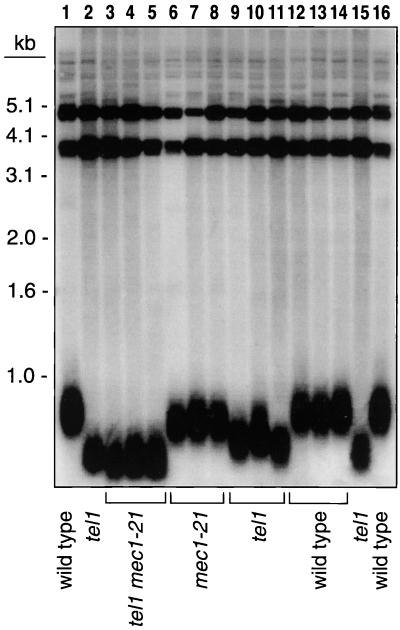
FIG. 1
FIG. 1
Telomere lengths in wild-type, tel1, mec1-21, and tel1 mec1-21 strains. A diploid strain heterozygous for tel1 and mec1-21 mutations was sporulated, and tetrads were dissected. In three tetrads in which all four genotypes were represented, DNA was isolated from spore cultures without subculturing; the strains had undergone about 35 cell divisions at the time of DNA extraction. The DNA was treated with PstI, and Southern analysis was performed. Strains analyzed: W303a (lanes 1 and 16); KRY20a (lanes 2 and 15); JMY300-1a, -2a, -3a (lanes 3 to 5, respectively); JMY300-1c, -2d, and -3d (lanes 6 to 8, respectively); JMY300-1d, -2b, and -3b (lanes 9 to 11, respectively); JMY300-1b, -2c, and -3c (lanes 12 to 14, respectively). Since the tel1 mutation exhibits a long phenotypic lag (20), the telomeres in the tel1 control strain KRY20a (lane 2), which had been subcultured for more than 100 doublings, were slightly shorter than those in the tel1 strains derived from the spores, which had not been subcultured.
FIG. 2
FIG. 2
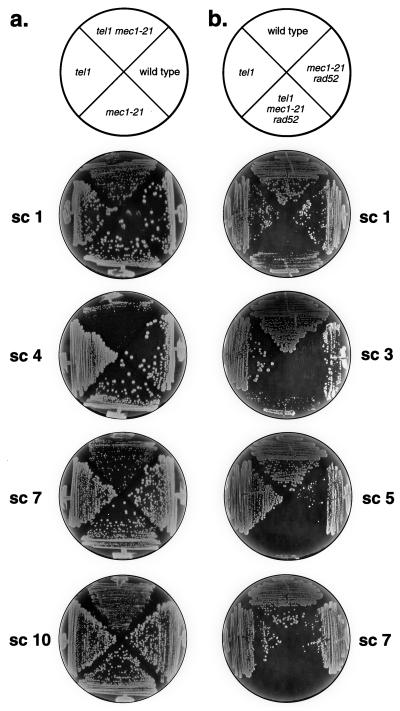
Senescent phenotypes of tel1 mec1-21 and tel1 mec1-21 rad52 strains. Spores derived from JMY300 (JMY300-2a [tel1 mec1-21], JMY300-2b [tel1], JMY300-2c [wild type], and JMY300-2d [mec1-21]) or KRY242 (KRY242-8a [wild type], KRY242-8b [mec1-21 rad52], KRY242-8c [tel1 mec1-21 rad52], and KRY242-8d [tel1]) were vegetatively subcultured by streaking on plates containing rich growth medium (subcloning 1 [sc 1]). After 2 days at 30°C, each strain was restreaked onto a new plate (sc 2), and this protocol was continued for 10 subclonings; we calculate that there are about 20 cell divisions per subcloning.
FIG. 3
FIG. 3
Amplification of Y′ elements associated with survivors in the tel1 mec1-21 genotype. Southern analysis was done on PstI-treated DNA derived from the tel1 mec1-21 strain JMY300-3a after 1, 4, 7, and 10 subclonings (sc1, sc4, sc7, and sc10). Following hybridization to a Y′-specific probe, the blot was boiled to remove the probe and rehybridized to a single-copy probe (as described in Materials and Methods). By quantitating the hybridization to these two probes, we concluded that one class of tandem Y′ elements was amplified more than 10-fold in the 10th subcloning relative to the wild-type strain. By the 10th subcloning, most of the JMY300-3a cells were fast-growing survivors.
FIG. 4
FIG. 4
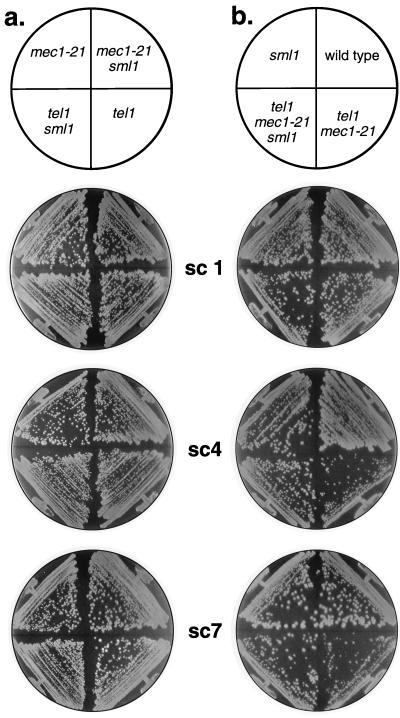
Effect of the sml1 mutation on cellular senescence. The diploid strains JMY302 and JMY303 (heterozygous for tel1, mec1-21, and sml1) were sporulated, and tetrads were dissected. Spore cultures of the eight expected genotypes were vegetatively subcultured as described in Materials and Methods. In most tetrads, the rate of senescence in sml1 tel1 mec1-21 strains was delayed relative to the rate in tel1 mec1-21 strains. Strains analyzed: JMY302-11a (mec1 sml1), -11b (mec1), -11c (tel1), and -11d (tel1 sml1); JMY303-6a (wild-type), -6b (sml1), -6c (tel1 mec1), and -6d (tel1 mec1 sml1).
FIG. 5
FIG. 5
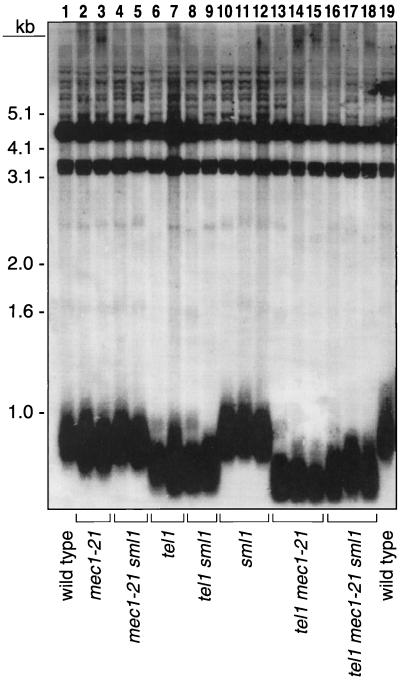
Effect of the sml1 mutation on telomere length. DNA was isolated from cultures of spores derived from the diploid JMY302 (heterozygous for tel1, mec1-21, and sml1). These samples were treated with PstI and examined by Southern analysis as described previously. Strains analyzed (from left to right): JMY302-6d, -11b, -25c, -11a, -22a, -11c, -22b, -11d, -25b, -6c, -9d, -12d, -6a, -9c, -12b, -6b, -9b, -12c, and -9a.
FIG. 6
FIG. 6
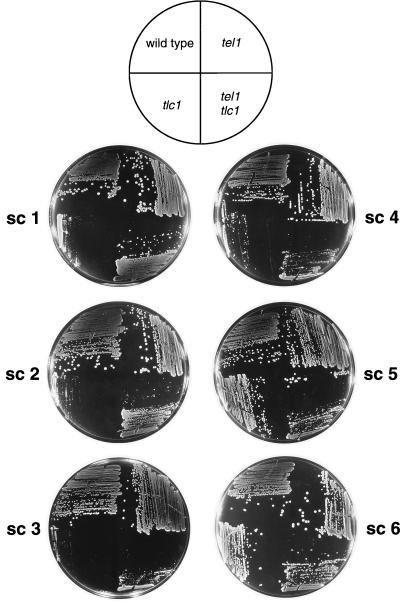
Comparison of senescence phenotypes of tlc1 and tel1 tlc1 strains. A diploid heterozygous for tlc1 and tel1 mutations was sporulated, and tetrads were dissected. Spore colonies (KRY229-6a [wild-type], KRY229-6b [tel1], KRY229-6c [tlc1], and KRY229-6d [tel1 tlc1]) were subcloned as described in the legend to Fig. 2 except that each subcloning was done at 24-h intervals. In general, strains with the tel1 tlc1 genotype had a delay in senescence compared to those of the tlc1 genotype. In addition, the fast-growing survivor strains appeared more quickly in the tlc1 strains than in the tel1 tlc1 strains.
FIG. 7
FIG. 7
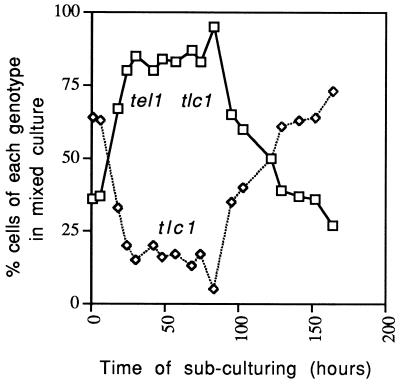
Comparative growth rates of tlc1 and tel1 tlc1 strains in mixed cultures. The diploia KRY229 was sporulated, and spores of the same mating type with the genotypes tlc1::LEU2 and tel1::URA3 tlc1::LEU2 were identified. Equal number of cells of pairs of such strains were mixed and inoculated into rich growth medium. The cultures were grown at 30°C. Exponential growth was maintained by dilution of the culture 1:100 into fresh medium every 24 h. Samples were taken every 6 to 12 h, and the ratio of the two strains was determined as described in Materials and Methods. Dotted lines and solid lines represent the data for the tlc1 (KRY229-13c) and tel1 tlc1 (KRY229-13d) strains, respectively.
FIG. 8
FIG. 8
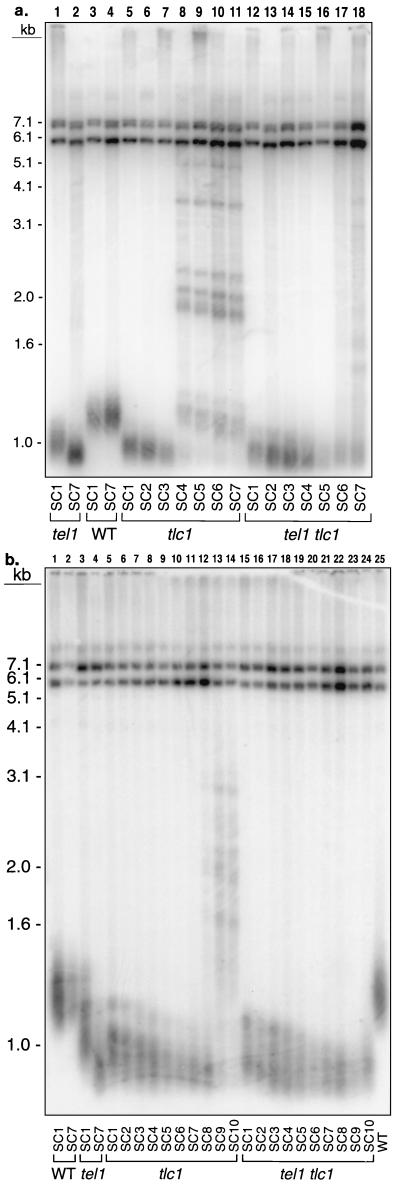
Effect of subculturing tlc1 and tel1 tlc1 strains on telomere length phenotypes. Strains of the tel1, tlc1, tel1 tlc1, and wild-type genotypes derived from the diploids KRY229 (W303a background) (a) and KRY232 (AMY125 background) (b) were inoculated into rich growth medium and grown at 30°C. Cultures were diluted 1:100 into fresh medium every 24 h, and samples for DNA isolation were harvested every 24 h. Each subculturing (SC) represents about 10 cell divisions. Southern analysis was performed on XhoI-treated DNA samples. In such samples, the terminal fragments from Y′-bearing telomeres are about 1.2 kb in size and the tandemly arranged Y′ elements yield DNA fragments of about 5.4 and 6.7 kb. Strains analyzed: (a) KRY229-6b (lanes 1 and 2), KRY229-6a (lanes 3 and 4), KRY229-6c (lanes 5 to 11), and KRY229-6d (lanes 12 to 18); (b) KRY232-7d (lanes 1, 2, and 25), KRY232-7b (lanes 3 and 4), KRY232-7c (lanes 5 to 14), and KRY232-7a (lanes 15 to 24).
FIG. 9
FIG. 9
Telomere accessibility model for the functions of Tel1p and Mec1p. In this model, Tel1p and Mec1p affect the accessibility of the telomeres to telomerase and exonucleases by phosphorylation of target proteins (TelXp for Tel1p and TelYp for Mec1p) located at the telomeres. Phosphorylated forms of TelXp and TelYp are indicated by encircled “P’s.”

References

    1. Alani E, Cao L, Kleckner N. A method for gene disruption that allows repeated use of URA3 selection in the construction of multiply disrupted yeast strains. Genetics. 1987;116:541–545. - PMC - PubMed
    1. Brush G S, Morrow D M, Heiter P, Kelly T J. The ATM homologue MEC1 is required for phosphorylation of replication protein A in yeast. Proc Natl Acad Sci USA. 1996;93:15075–15080. - PMC - PubMed
    1. Dahlen M, Olsson T, Kanter-Smoler G, Ramne A, Sunnerhagen P. Regulation of telomere length by checkpoint genes in Schizosaccharomyces pombe. Mol Biol Cell. 1998;9:611–621. - PMC - PubMed
    1. De Lange T. Telomeres and senescence: ending the debate. Science. 1998;279:334–335. - PubMed
    1. Emili A. MEC1-dependent phosphorylation of Rad9p in response to DNA damage. Mol Cell. 1998;2:183–189. - PubMed

Publication types

MeSH terms