


GABA(B), opioid and alpha2 receptor inhibition of calcium channels in acutely-dissociated locus coeruleus neurones
- PMID: 10455306
- PMCID: PMC1566140
- DOI: 10.1038/sj.bjp.0702693
GABA(B), opioid and alpha2 receptor inhibition of calcium channels in acutely-dissociated locus coeruleus neurones
Abstract
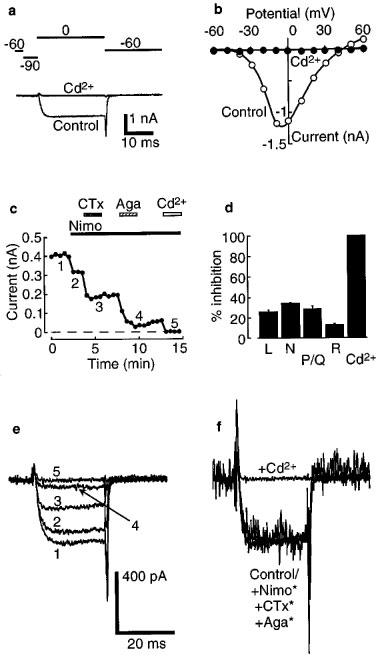
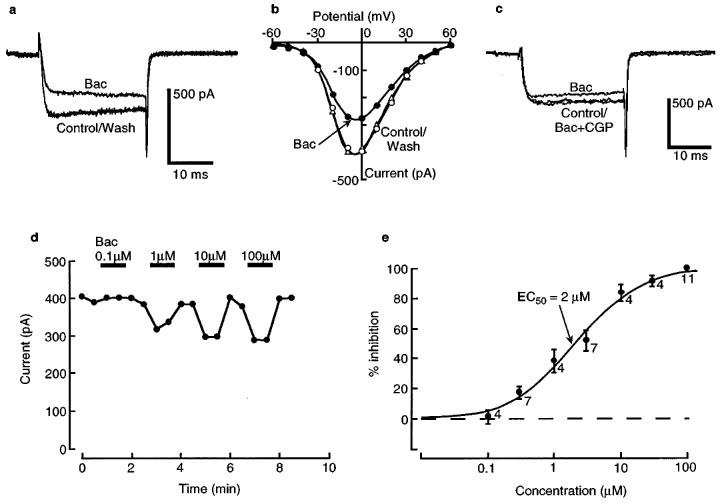
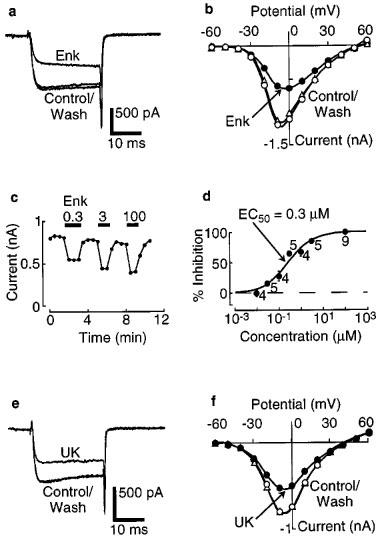
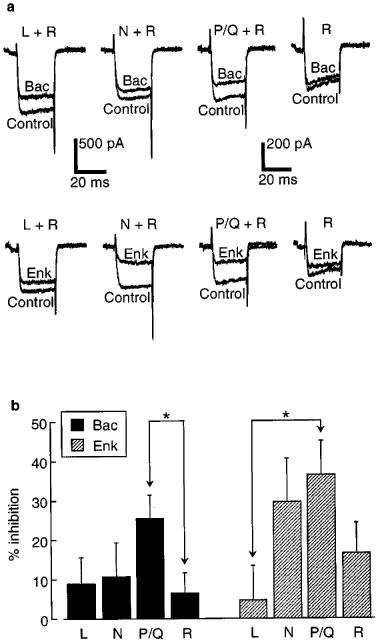
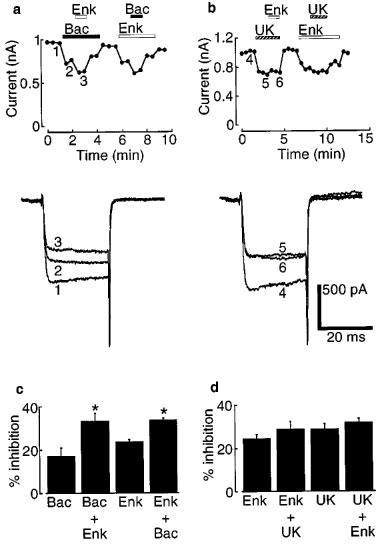
1. The effects of GABA(B), opioid and alpha2 receptor activation on different subtypes of calcium channels in acutely-dissociated rat locus coeruleus (LC) neurones were investigated using whole-cell patch clamping. 2. Barium currents through calcium channels could be fractionated into four classes: L-type (nimodipine-sensitive), N-type (omega-conotoxin GVIA-sensitive), P/Q-type (omega-agatoxin IVA-sensitive) and R-type (remaining in the presence of all three blockers). The percentage of each was, respectively, 25+/-2, 34+/-1, 28+/-3 and 12+/-1% (mean+/-s.e.mean, n=4). 3. The GABA(B) receptor agonist, baclofen, and the opioid receptor agonist, enkephalin, partially inhibited the total barium current in a concentration-dependent manner with EC50 values of 2 and 0.3 microm , respectively. Maximal inhibition was 17+/-1% (n=38) for baclofen and 30+/-2% (n=20) for enkephalin. The alpha2-adrenoceptor agonist, UK14304 (10 microM), also inhibited barium current in these neurones (28+/-2%, n=11). The agonists did not shift the current-voltage relationship along the voltage axis. 4. Maximal baclofen inhibition of different calcium channel subtypes was 9+/-7% (L-type, n=4), 11+/-8% (N-type, n=4), 26+/-6% (P/Q-type, n=4), and 6+/-5% (R-type, n=5). The corresponding values for enkephalin inhibition were 5+/-9% (L-type), 30+/-11% (N-type), 37+/-9% (P/Q-type), and 17+/-8% (R-type). 5. In the presence of a saturating concentration of enkephalin, baclofen produced additional inhibition of the barium current. In contrast, in the presence of a saturating concentration of enkephalin, UK14304 produced no further inhibition of the barium current. 6. These results indicate that neuromodulation of calcium channels in LC neurones involves a complex pattern of overlapping and distinct second messenger pathways. Regulation of LC neuronal firing activity by the modulation of calcium channels may be important for LC-mediated behaviour such as alertness and vigilance.
Figures
References
-
- AGHAJANIAN G.K. Tolerance of locus coeruleus neurones to morphine and suppression of withdrawal response by clonidine. Nature. 1978;276:186–188. - PubMed
-
- AGHAJANIAN G.K., WANG Y.Y. Common alpha 2- and opiate effector mechanisms in the locus coeruleus: intracellular studies in brain slices. Neuropharmacology. 1987;26:793–799. - PubMed
-
- ASTON-JONES G., CHIANG C., ALEXINSKY T. Discharge of noradrenergic locus coeruleus neurons in behaving rats and monkeys suggests a role in vigilance. Prog. Brain Res. 1991a;88:501–520. - PubMed
-
- ASTON-JONES G., SHIPLEY M.T., CHOUVET G., ENNIS M., VAN BOCKSTAELE E., PIERIBONE V., SHIEKHATTAR R., AKAOKA H., DROLET G., ASTIER B., CHARLÉTY P., VALENTINO R.J., WILLIAMS J.T. Afferent regulation of locus coeruleus neurons: anatomy, physiology and pharmacology. Prog. Brain Res. 1991b;88:47–75. - PubMed
-
- CATTERALL W.A. Structure and function of voltage-gated ion channels. Annu. Rev. Biochem. 1995;64:493–531. - PubMed
Publication types
MeSH terms
Substances
LinkOut - more resources
Full Text Sources
