. 1999 Sep;67(9):4819-26.
doi: 10.1128/IAI.67.9.4819-4826.1999.

beta-Chemokines enhance parasite uptake and promote nitric oxide-dependent microbiostatic activity in murine inflammatory macrophages infected with Trypanosoma cruzi

Affiliations

beta-Chemokines enhance parasite uptake and promote nitric oxide-dependent microbiostatic activity in murine inflammatory macrophages infected with Trypanosoma cruzi

J C Aliberti et al. Infect Immun. 1999 Sep.

Abstract

In the present study, we describe the ability of Trypanosoma cruzi trypomastigotes to stimulate the synthesis of beta-chemokines by macrophages. In vivo infection with T. cruzi led to MIP-1alpha, RANTES, and JE/MCP1 mRNA expression by cells from peritoneal inflammatory exudate. In addition, in vitro infection with T. cruzi resulted in expression of beta-chemokine MIP-1alpha, MIP-1beta, RANTES, and JE mRNA by macrophages. The expression of the beta-chemokine MIP-1alpha, MIP-1beta, RANTES, and JE proteins by murine macrophages cultured with trypomastigote forms of T. cruzi was confirmed by immunocytochemistry. Interestingly, macrophage infection with T. cruzi also resulted in NO production, which we found to be mediated mainly by beta-chemokines. Hence, treatment with anti-beta-chemokine-specific neutralizing antibodies partially inhibited NO release by macrophages incubated with T. cruzi parasites. Further, the addition of the exogenous beta-chemokines MIP-1alpha, MIP-1beta, RANTES, and JE/MCP-1 induced an increased T. cruzi uptake, leading to enhanced NO production and control of parasite replication in a dose-dependent manner. L-NMMA, a specific inhibitor of the L-arginine-NO pathway, caused a decrease in NO production and parasite killing when added to cultures of macrophages stimulated with beta-chemokines. Among the beta-chemokines tested, JE was more potent in inhibiting parasite growth, although it was much less efficient than gamma interferon (IFN-gamma). Nevertheless, JE potentiates parasite killing by macrophages incubated with low doses of IFN-gamma. Together, these results suggest that in addition to their chemotactic activity, murine beta-chemokines may also contribute to enhancing parasite uptake and promoting control of parasite replication in macrophages and may play a role in resistance to T. cruzi infection.


Figures
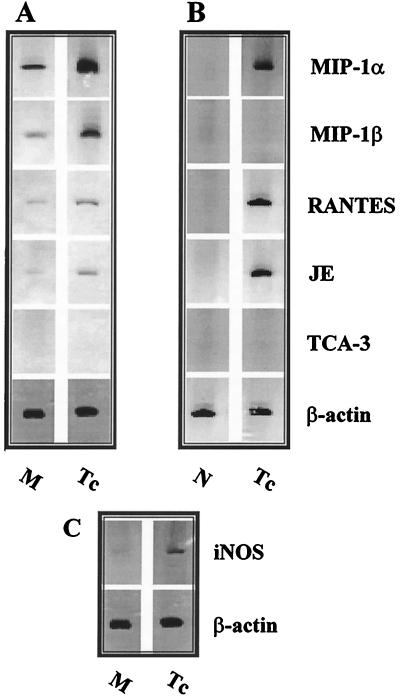
FIG. 1
FIG. 1
T. cruzi trypomastigotes induce β-chemokine expression in murine macrophages. Total RNA was extracted from thioglycolate-elicited peritoneal macrophages (A and C) cultured in the presence of medium (M) alone or with T. cruzi trypomastigotes (Tc) in a parasite/cell ratio of 1:1 for 6 h at 37°C in a humidified chamber containing air plus 5% CO2. Total RNA was extracted from C3H/HeJ peritoneal cells (B) harvested from normal (N) mice and from mice injected 6 h before with 105 T. cruzi trypomastigote forms. cDNA was synthesized, and PCR was performed with primers for the β-chemokines and for β-actin. Equal amounts of DNA were loaded into each well. The results shown are representative of five different experiments.
FIG. 2
FIG. 2
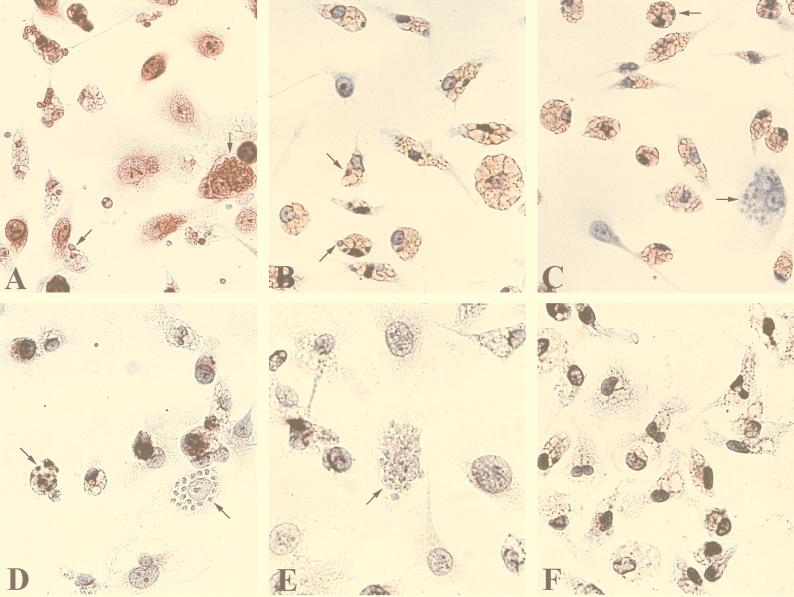
T. cruzi induces β-chemokine production by mouse peritoneal macrophages. Immunoperoxidase staining for β-chemokines of thioglycolate-elicited murine macrophages exposed (A to E) or not (F) to culture-derived T. cruzi trypomastigotes. The cells were incubated with anti-JE/MCP-1 (A and F), anti-MIP-1α (B), anti-MIP-1β (C), and anti-RANTES (D), or normal goat serum (E). 9-Amino-3-ethyl carbazole was used as the peroxidase substrate to generate a brown-staining signal. The arrows indicate intracellular amastigote forms. Magnification, ×364.
FIG. 3
FIG. 3
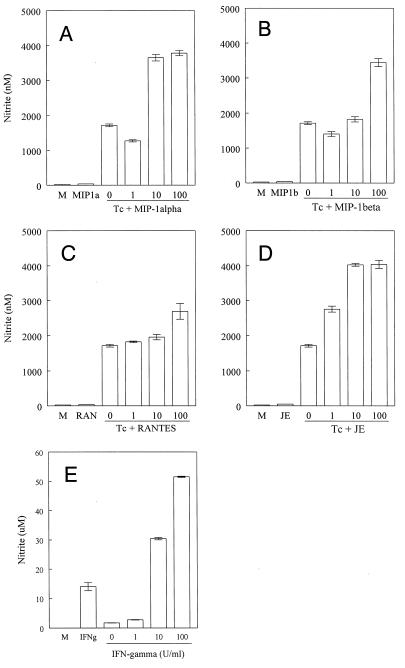
β-Chemokines induce NO production in T. cruzi-infected macrophages. Thioglycolate-elicited murine macrophages were incubated with culture-derived T. cruzi trypomastigotes (Tc) in a parasite/cell ratio of 1:1 for 2 h, and the extracellular parasites were removed. This was followed by 48 h of incubation, with or without the indicated concentrations (in nanograms per milliliter) of recombinant murine MIP-1α (A), MIP-1β (B), RANTES (C), JE/MCP-1 (D), and IFN-γ (E), at 37°C in a humidified chamber containing 5% CO2. The supernatants were harvested, and the nitrite concentration was assayed by the Griess method. The bars represent the means ± standard deviations of triplicate samples. The results shown are representative of three independent experiments.
FIG. 4
FIG. 4
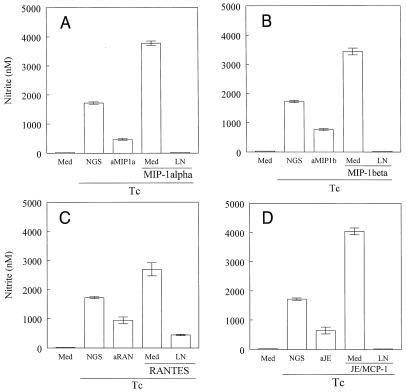
l-NMMA inhibits β-chemokine-induced NO production by infected macrophages. Thioglycolate-elicited C3H/HeJ macrophages were incubated with culture-derived T. cruzi trypomastigotes (Tc) in a parasite/cell ratio of 1:1 for 2 h, and the extracellular parasites were removed. This was followed by 48 h of incubation with or without MIP-1α (A), MIP-1β (B), RANTES (C), or JE/MCP-1 (D) (all at 100 ng/ml). Specific antibodies against the chemokines (aMIP1a [A], aMIP1b [B], aRAN [C], and aJE [D]) (100 μg/ml) were added. l-NMMA (LN) (200 μM) was added simultaneously with the recombinant chemokines. The bars represent means ± standard deviations of triplicate samples from one of three independent experiments.
FIG. 5
FIG. 5
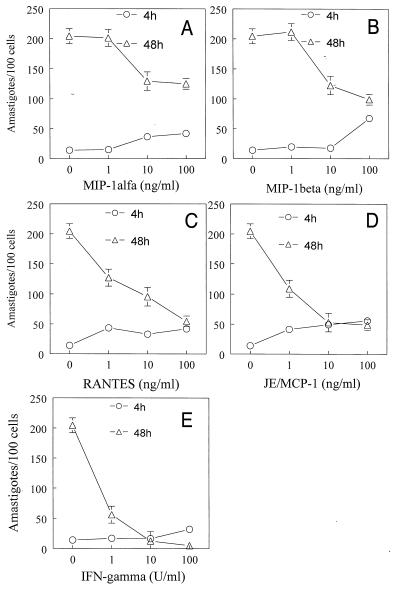
Cytostatic effects of β-chemokines upon intracellular T. cruzi amastigote growth in murine macrophages. C3H/HeJ-derived thioglycolate-elicited peritoneal macrophages were infected with culture-derived T. cruzi trypomastigotes in a parasite/host cell ratio of 1:1, with or without different concentrations of recombinant murine MIP-1α (A), MIP-1β (B), RANTES (C), JE/MCP-1 (D), and IFN-γ (E), at 37°C in a humidified chamber containing 5% CO2. After 2 h, the cells were washed to remove the extracellular parasites, and the chemokines and IFN-γ were again added to the cultures. Two (○) or 48 (▵) h later, the cells were washed, fixed with cold methanol, and stained with Giemsa stain. The intracellular parasites were counted (at ×400 magnification under a light microscope) in 500 cells. Each point represents the mean ± standard deviation of triplicate samples. The results shown are representative of three independent experiments.
FIG. 6
FIG. 6
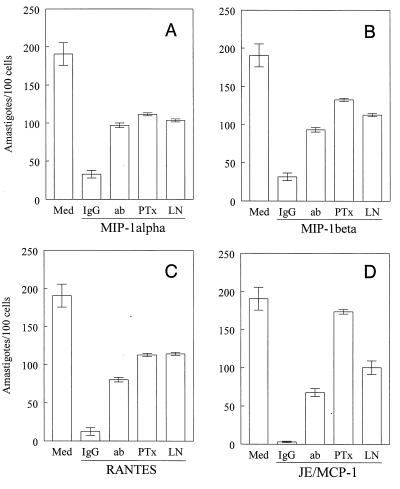
β-Chemokine-mediated cytostatic effects are reverted with l-NMMA. Thioglycolate-elicited murine macrophages were incubated with culture-derived T. cruzi trypomastigotes in a parasite/cell ratio of 1:1 for 2 h, and the extracellular parasites were removed. This was followed by 48 h of incubation, with or without recombinant murine MIP-1α (A), MIP-1β (B), RANTES (C), or JE/MCP-1 (D) (all at 100 ng/ml) and with or without l-NMMA (LN; 200 μM), PT (30 ng/ml), antibodies (ab) against MIP-1α (A), MIP-1β (B), RANTES (C), JE/MCP-1 (D) (all at 100 μg/ml), or irrelevant antibody (immunoglobulin G). After 48 h, the cultures were washed, fixed, and stained with Giemsa stain. Intracellular amastigotes were counted in 500 cells (at ×400 magnification under a light microscope). The data (means ± standard deviations) are representative of two independent experiments.
FIG. 7
FIG. 7
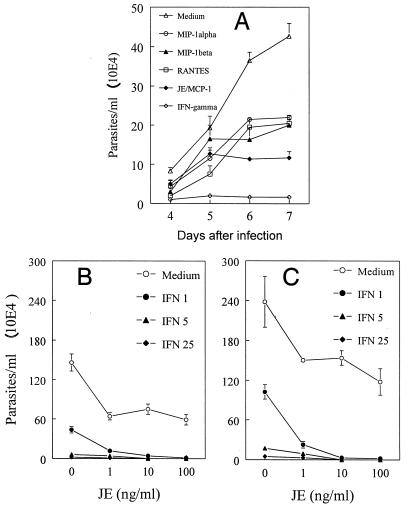
Effects of β-chemokines on control of T. cruzi replication in macrophages. Thioglycolate-elicited C3H/HeJ macrophages were infected with culture-derived trypomastigotes in a parasite/host cell ratio of 1:1 (A) or 5:1 (B and C) for 2 h, and the extracellular parasites were removed. MIP-1α, MIP-1β, RANTES, JE/MCP-1 (all at 100 ng/ml) or IFN-γ (100 U/ml) (A) or JE/MCP-1 (0, 1, 10, and 100 ng/ml) and/or IFN-γ (0, 1, 5, and 25 U/ml) (B and C) were then added to the cultures. The cells were incubated at 37°C in a humidified chamber containing 5% CO2. The released parasites were counted daily (A) or on days 4 (B) and 6 (C) in a Newbauer chamber. The bars represent means ± standard deviations of triplicate counts. The data are representative of two independent experiments.

References

    1. Aliberti J C S, Cardoso M A, Martins G A, Gazzinelli R T, Vieira L Q, Silva J S. Interleukin-12 mediates resistance to Trypanosoma cruzi in mice and is produced by murine macrophages in response to live trypomastigotes. Infect Immun. 1996;64:1961–1967. - PMC - PubMed
    1. Alspaugh J A, Granger D L. Inhibition of Cryptococcus neoformans replication by nitrogen oxides supports the role of these molecules as effectors of macrophage-mediated cytostasis. Infect Immun. 1991;59:2291–2296. - PMC - PubMed
    1. Andrade Z A. Mechanisms of myocardial damage in Trypanosoma cruzi infection. Ciba Found Symp. 1983;99:214–233. - PubMed
    1. Baggiolini M, Dewald B, Moser B. Interleukin-8 and related chemotactic cytokines—CXC and CC chemokines. Adv Immunol. 1994;55:97–179. - PubMed
    1. Brener Z, Gazzinelli R T. Immunological control of Trypanosoma cruzi infection and pathogenesis of Chagas’ disease. Int Arch Allergy Immunol. 1997;114:103–110. - PubMed

Publication types

MeSH terms

LinkOut - more resources