Review
. 1999 Sep;45 Suppl 2(Suppl 2):II6-II16.
doi: 10.1136/gut.45.2008.ii6.

Fundamentals of neurogastroenterology

Affiliations
Review

Fundamentals of neurogastroenterology

J D Wood et al. Gut. 1999 Sep.

Abstract

Current concepts and basic principles of neurogastroenterology in relation to functional gastrointestinal disorders are reviewed. Neurogastroenterology is emphasized as a new and advancing subspecialty of clinical gastroenterology and digestive science. As such, it embraces the investigative sciences dealing with functions, malfunctions, and malformations in the brain and spinal cord, and the sympathetic, parasympathetic and enteric divisions of the autonomic innervation of the digestive tract. Somatomotor systems are included insofar as pharyngeal phases of swallowing and pelvic floor involvement in defecation, continence, and pelvic pain are concerned. Inclusion of basic physiology of smooth muscle, mucosal epithelium, and the enteric immune system in the neurogastroenterologic domain relates to requirements for compatibility with neural control mechanisms. Psychologic and psychiatric relations to functional gastrointestinal disorders are included because they are significant components of neurogastroenterology, especially in relation to projections of discomfort and pain to the digestive tract.


Figures
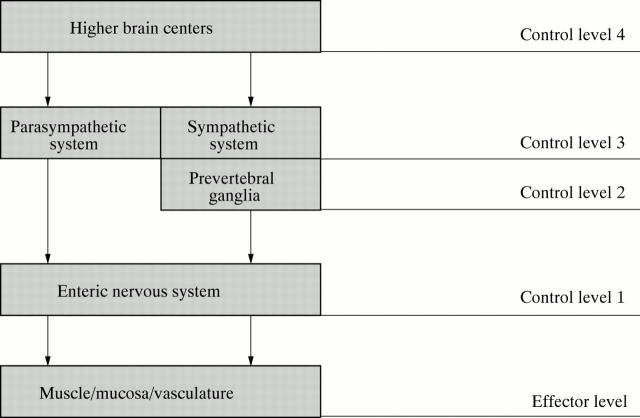
Figure 1
Figure 1
Neural control of the gut is hierarchic with four basic levels of integrative organization. Level 1 is the enteric nervous system (ENS) which behaves like a local minibrain. The second level of integrative organization is in the prevertebral sympathetic ganglia. The third and fourth levels are within the central nervous system (CNS). Sympathetic and parasympathetic signals to the digestive tract originate at level 3 and represent the final common pathways for outflow of information from the CNS to the gut. The fourth level includes higher brain centers that provide input for integrative functions at level 3.
Figure 2
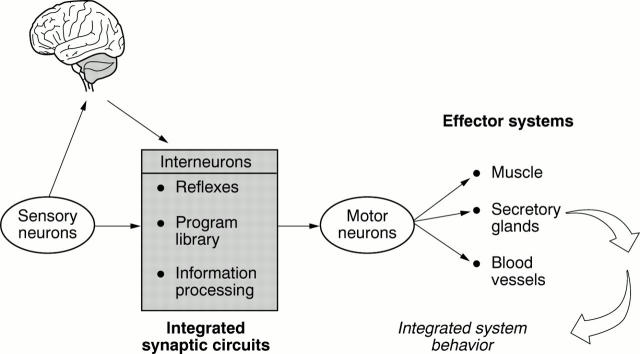
Figure 2
The conceptual model for the enteric nervous system (ENS) is the same as for the central nervous system (CNS). Sensory neurons, interneurons, and motor neurons are connected synaptically for flow of information from sensory neurons to interneuronal integrative networks to motor neurons to effector systems. The ENS organizes and coordinates the activity of each effector system into meaningful behavior of the integrated organ. Bi-directional communication occurs between the CNS and ENS.
Figure 3
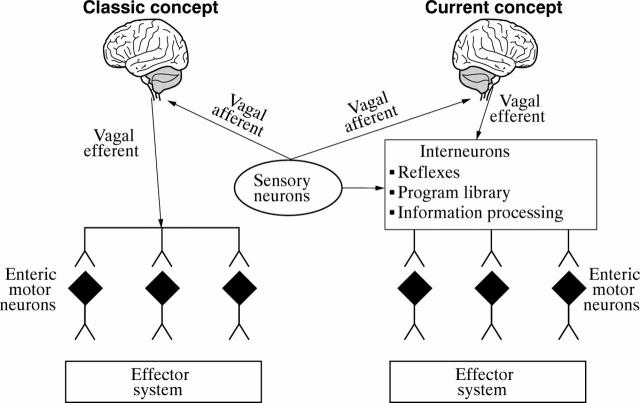
Figure 3
Classic outmoded and current concepts of relations between the brain and the digestive tract. The classic concept viewed parasympathetic efferents (e.g., vagal efferents) as synapsing directly with enteric motor neurons, as illustrated on the left side of the diagram. In the current concept, parasympathetic efferent fibers transmit command signals from the brain to the integrative and motor program circuitry of the enteric nervous system minibrain as shown on the right side of the diagram.
Figure 4
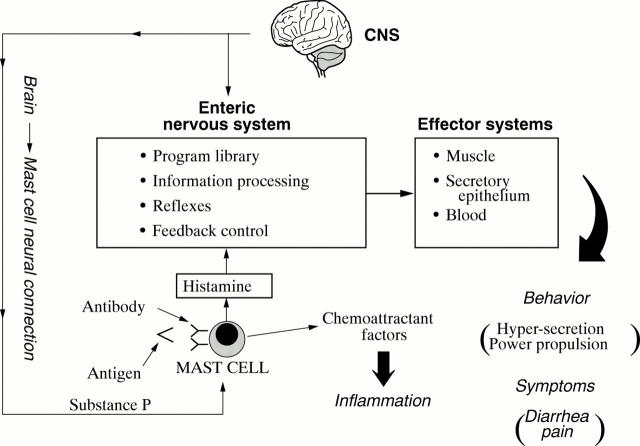
Figure 4
Conceptual model for enteric neuro-immunophysiology. The enteric nervous system (ENS) is a minibrain located in close apposition to the gastrointestinal effectors it controls. Enteric mast cells are in position to detect foreign antigens and signal their presence to the ENS. Stimulated mast cells release several paracrine mediators simultaneously. Some of the mediators signal the ENS whereas others act as attractant factors for polymorphonuclear leucocytes responsible for acute inflammatory responses. The ENS responds to the mast cell signal by initiating a program of coordinated secretion and propulsive motility that expels the source of antigenic stimulation from the bowel. Symptoms of abdominal pain and diarrhea result from operation of the neural program. Neural inputs to mast cells from the brain stimulate simultaneous release of chemoattractant factors for inflammatory cells and chemical signals to the ENS with symptomatic consequences that mimic antigenic stimulation. CNS, central nervous system.

References

    1. Gastroenterology. 1998 Mar;114(3):559-78 - PubMed
    1. Prog Neurobiol. 1998 Jan;54(1):1-18 - PubMed
    1. Dig Dis Sci. 1998 Apr;43(4):727-37 - PubMed
    1. Dig Dis Sci. 1996 Apr;41(4):633-40 - PubMed
    1. Am J Physiol. 1996 Aug;271(2 Pt 1):G357-69 - PubMed

MeSH terms