Review
. 1999 Sep;45 Suppl 2(Suppl 2):II17-24.
doi: 10.1136/gut.45.2008.ii17.

Principles of applied neurogastroenterology: physiology/motility-sensation

Affiliations
Review

Principles of applied neurogastroenterology: physiology/motility-sensation

J E Kellow et al. Gut. 1999 Sep.

Abstract

Many of the symptoms characteristic of the functional gastrointestinal disorders (FGID) are consistent with dysfunction of the motor and/or sensory apparatus of the digestive tract. Those aspects of sensorimotor dysfunction most relevant to the FGID include alterations in: gut contractile activity; myoelectrical activity; tone and compliance; and transit, as well as an enhanced sensitivity to distension, in each region of the gastrointestinal tract. Assessment of these phenomena involves a number of techniques, some well established and others requiring further validation. Using such techniques, researchers have reported a wide range of alterations in sensory and in motor function in the FGID. Importantly, however, relationships between such dysfunction and symptoms have been relatively weak, and so the clinical relevance of the former remains unclear. Moreover, the proportions of patients in the various symptom subgroups who display dysfunction, and the extent and severity of their symptoms, require better characterization. On a positive note, progress is occurring on several fronts, especially in relation to functional dyspepsia and irritable bowel syndrome, and based on the data gathered to date, a number of areas where further advances are required can be highlighted.


Figures
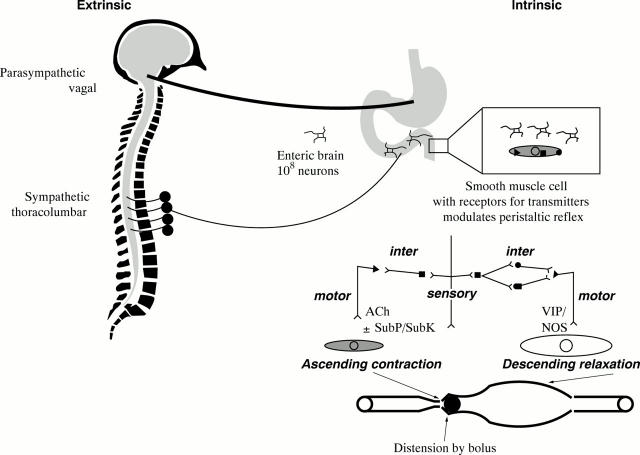
Figure 1
Figure 1
Extrinsic and intrinsic control of gastrointestinal motility. The extrinsic sympathetic and parasympathetic supply to the gut modulates the function of the enteric brain located in ganglionated plexi along the gastrointestinal tract. Transmitters released from the enteric neurons, which are the intrinsic neural control of the gut, modulate the peristaltic reflex. The major transmitters in the peristaltic reflex are shown on the right, acetylcholine (ACh) and substance P (SubP) are the predominant excitatory neurotransmitters, and vasoactive intestinal polypeptide (VIP) and nitric oxide are the predominant inhibitory neurotransmitters. SubK, substance K; NOS, nitric oxide synthase. (Reproduced with permission, Ann Rev Med 1999 (in press).)
Figure 2
Figure 2
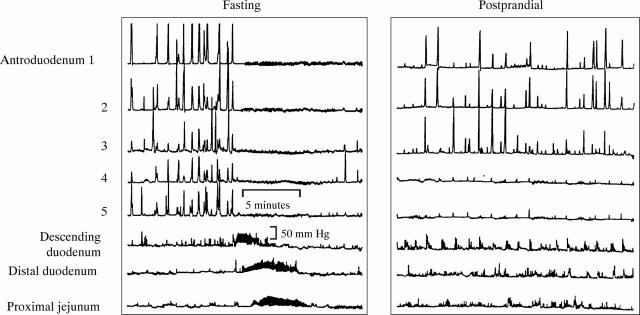
Example of fasting and postprandial motility in a healthy subject. Note the activity front (phase 3 of the migrating motor complex) during fasting (left panel) and the sustained but irregular contractile phasic pressure activity postprandially. (Reproduced with permission, Ann Rev Med 1999 (in press).)
Figure 3
Figure 3
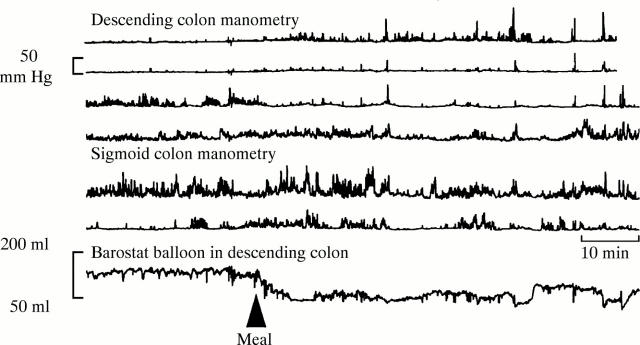
Colonic motility measured by means of manometry and barostatically controlled balloon in a healthy subject. Note the postprandial increase in phasic pressure activity in the descending colon, and the reduction in balloon volume, signifying an increase in colonic tone.
Figure 4
Figure 4
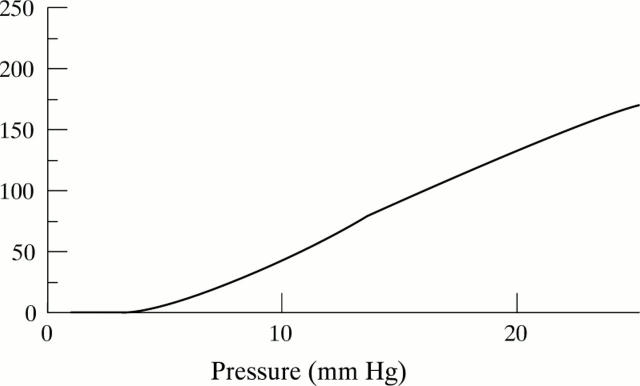
Compliance curve (dV:dP) drawn for human colon in a healthy subject.
Figure 5
Figure 5
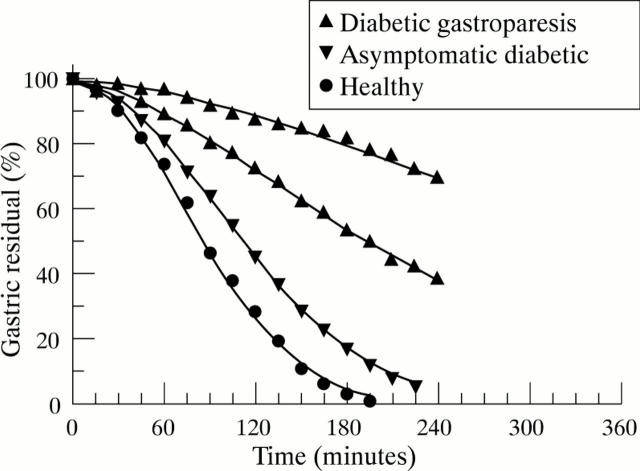
Gastric emptying of solids measured using scintigraphy: note the delay in gastric emptying t1/2 in a symptomatic diabetic patient compared with an asymptomatic patient and a healthy subject.

References

    1. Am J Gastroenterol. 1998 Feb;93(2):160-5 - PubMed
    1. Scand J Gastroenterol. 1997 Jul;32(7):676-80 - PubMed
    1. Gut. 1998 Feb;42(2):235-42 - PubMed
    1. Gastroenterology. 1998 Sep;115(3):542-50 - PubMed
    1. Gastroenterology. 1998 Sep;115(3):747-62 - PubMed