


No effect of bipolar interferential electrotherapy and pulsed ultrasound for soft tissue shoulder disorders: a randomised controlled trial
- PMID: 10460185
- PMCID: PMC1752938
- DOI: 10.1136/ard.58.9.530
No effect of bipolar interferential electrotherapy and pulsed ultrasound for soft tissue shoulder disorders: a randomised controlled trial
Abstract
Objective: To assess the efficacy of bipolar interferential electrotherapy (ET) and pulsed ultrasound (US) as adjuvants to exercise therapy for soft tissue shoulder disorders (SD).
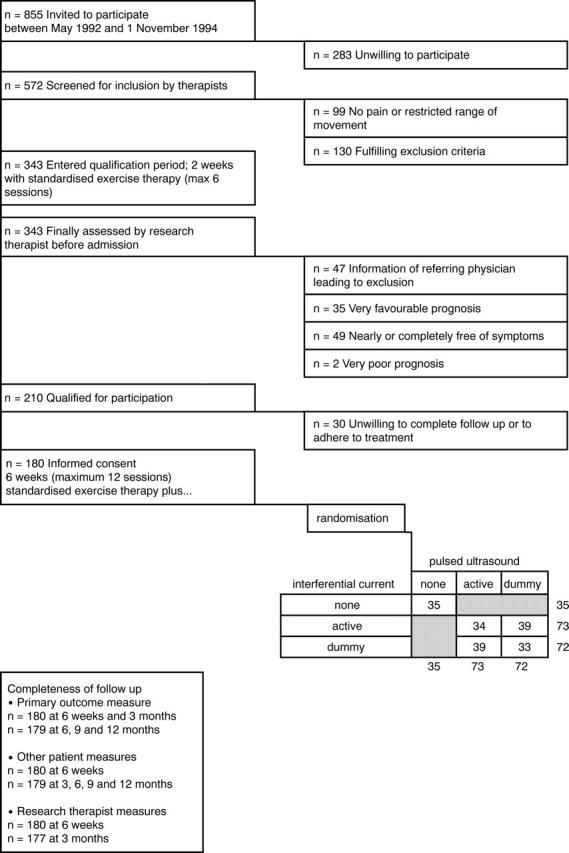
Methods: Randomised placebo controlled trial with a two by two factorial design plus an additional control group in 17 primary care physiotherapy practices in the south of the Netherlands. Patients with shoulder pain and/or restricted shoulder mobility, because of a soft tissue impairment without underlying specific or generalised condition, were enrolled if they had not recovered after six sessions of exercise therapy in two weeks. They were randomised to receive (1) active ET plus active US; (2) active ET plus dummy US; (3) dummy ET plus active US; (4) dummy ET plus dummy US; or (5) no adjuvants. Additionally, they received a maximum of 12 sessions of exercise therapy in six weeks. Measurements at baseline, 6 weeks and 3, 6, 9, and 12 months later were blinded for treatment.
Outcome measures: recovery, functional status, chief complaint, pain, clinical status, and range of motion.
Results: After written informed consent 180 patients were randomised: both the active treatments were given to 73 patients, both the dummy treatments to 72 patients, and 35 patients received no adjuvants. Prognosis of groups appeared similar at baseline. Blinding was successfully maintained. At six weeks seven patients (20%) without adjuvants reported very large improvement (including complete recovery), 17 (23%) and 16 (22%) with active and dummy ET, and 19 (26%) and 14 (19%) with active and dummy US. These proportions increased to about 40% at three months, but remained virtually stable thereafter. Up to 12 months follow up the 95% CI for differences between groups for all outcomes include zero.
Conclusion: Neither ET nor US prove to be effective as adjuvants to exercise therapy for soft tissue SD.
References
Publication types
MeSH terms
LinkOut - more resources
Full Text Sources
Medical
