


Rasch analysis of the Western Ontario MacMaster questionnaire (WOMAC) in 2205 patients with osteoarthritis, rheumatoid arthritis, and fibromyalgia
- PMID: 10460190
- PMCID: PMC1752940
- DOI: 10.1136/ard.58.9.563
Rasch analysis of the Western Ontario MacMaster questionnaire (WOMAC) in 2205 patients with osteoarthritis, rheumatoid arthritis, and fibromyalgia
Abstract
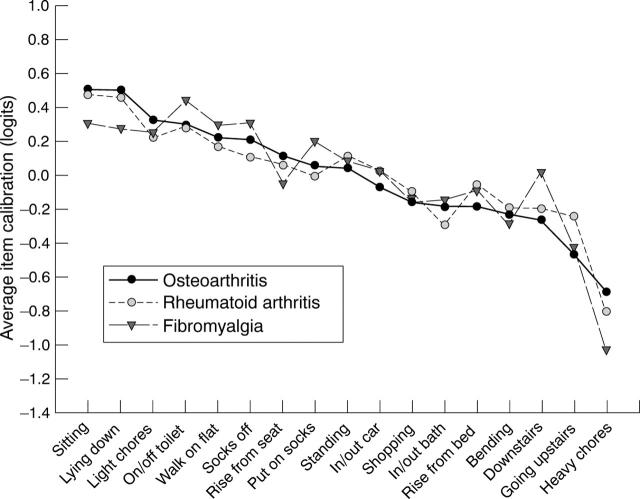
Objective: Advances in health measurement have led to the application of Rasch Item Response Theory (IRT) analysis (Rasch analysis) to evaluate instruments measuring health status and quality of life of patients, including the Health Assessment Questionnaire and SF-36. This study investigated the extent to which the Western Ontario MacMaster osteoarthritis questionnaire (WOMAC) satisfies the Rasch model, particularly in respect to unidimensionality, item separation, and linearity.
Methods: The study included a total of 2205 patients, 1013 with rheumatoid arthritis (RA), 655 with osteoarthritis of the knee or hip (OA), and 537 with fibromyalgia. All patients completed the WOMAC as part of a longitudinal study of rheumatic disease outcomes. To examine whether the WOMAC pain and function scales each fits the Rasch model, the Winsteps program was used to assess item difficulty, scale unidimensionality, item separation, and linearity.
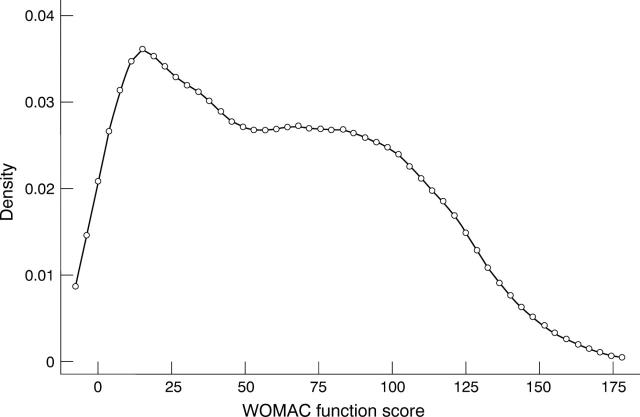
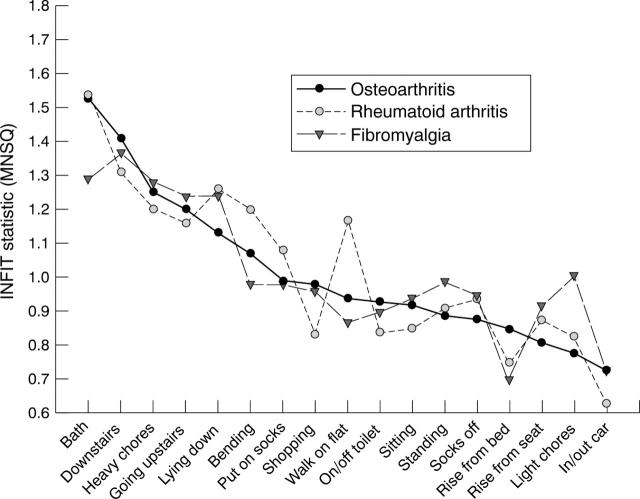
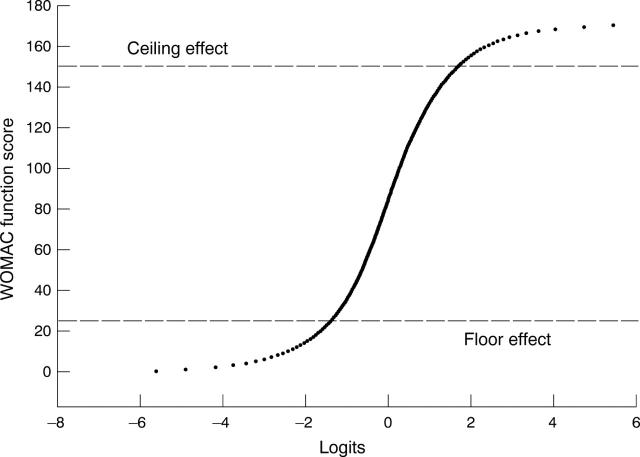
Results: Although the WOMAC worked best in OA, regardless of disorder, both the pain and function scales were unidimensional, had adequate item separation, and had a long range (25-150) of linearity in the function scale. Several functional items, however, had a high information weight fit (INFIT) statistic, indicating poor fit to the model. These items included "getting in and out of the bath" and "going down stairs."
Conclusion: The WOMAC generally satisfies the requirements of Rasch item response theory across all disorders studied, and is an appropriate measure of lower body function in OA, RA and fibromyalgia. Although some individual items do not fit well, it is not likely that removing such items would result in more than overall minimal differences, and it will be difficult to remove traces of multidimensionality while keeping the central constructs of progressive lower body musculoskeletal abnormality intact. In addition, it is possible that a "purer", still more unidimensional instrument would be less useful in clinical trials and epidemiological studies by restricting the range of the scale.
Figures
References
Publication types
MeSH terms
Grants and funding
LinkOut - more resources
Full Text Sources
