. 1999 Sep 1;19(17):7426-33.
doi: 10.1523/JNEUROSCI.19-17-07426.1999.

Specificity and sensitivity of a human olfactory receptor functionally expressed in human embryonic kidney 293 cells and Xenopus Laevis oocytes

Affiliations

Specificity and sensitivity of a human olfactory receptor functionally expressed in human embryonic kidney 293 cells and Xenopus Laevis oocytes

C H Wetzel et al. J Neurosci. .

Abstract

Here, we provide the first evidence for functional expression of a human olfactory receptor protein (OR17-40) and show that recombinant olfactory receptors can be functionally expressed in heterologous systems. A mixture of 100 different odorants (Henkel 100) elicited a transient increase in intracellular [Ca(2+)] in human embryonic kidney 293 (HEK293) cells stably or transiently transfected with the plasmid pOR17-40. By subdividing the odorant mixture into progressively smaller groups, we identified a single component that represented the only effective substance: helional. Only the structurally closely related molecule heliotroplyacetone also activated the receptor. Other compounds, including piperonal, safrole, and vanillin, were completely ineffective. Mock-transfected cells and cells transfected with other receptors showed no change in intracellular [Ca(2+)] in response to odor stimulation. We were also able to functionally express OR17-40 in Xenopus laevis oocytes. Coexpression of a "reporter" channel allowed measurement of the response of oocytes injected with the cRNA of the human receptor to the odor mixture Henkel 100. The effective substances were the same (helional, heliotropylacetone) as those identified by functionally expressing the receptor in HEK293 cells and were active at the same, lower micromolar concentration. These findings open the possibility of now characterizing the sensitivity and specificity of many, if not all, of the hundreds of different human olfactory receptors.


Figures
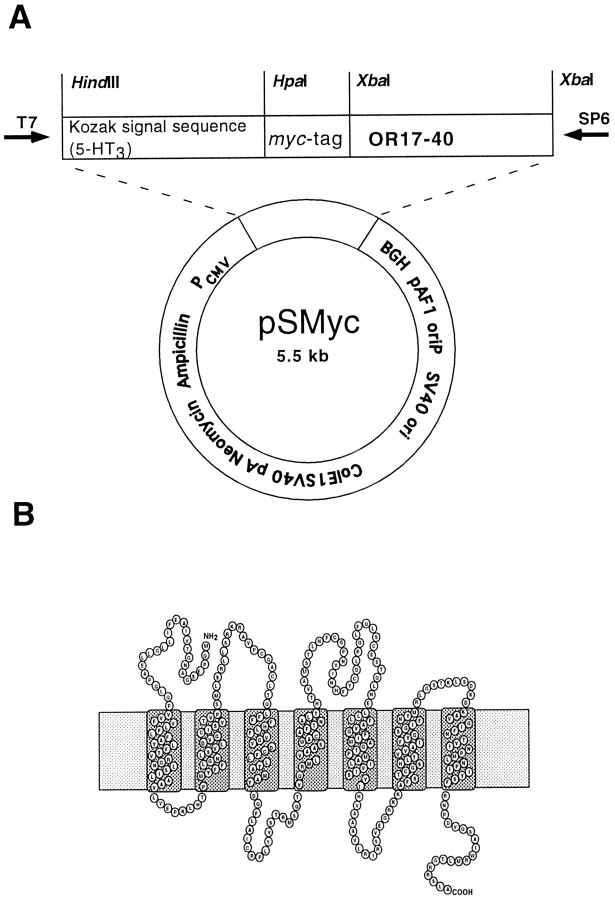
Fig. 1.
Fig. 1.
A, Construct of the eucaryotic expression vector pSMyc, which contains a cytomegalovirus promotor and the membrane import sequence of the guinea pig 5-HT3 receptor, followed by a human myc epitope. The receptor-encoding DNA has been cloned into the XbaI restriction site of this vector to reveal a fusion protein tagged at the extracellular N-terminal site. B, In the diagram, the protein encoded by the human OR17–40 gene is presented transversing the plasma membrane seven times, with the N terminal located extracellularly and the C terminal intracellularly.
Fig. 2.
Fig. 2.
Calcium changes induced by Henkel 100 mixture in various transfected cells; basal Ca2+ distribution in nonstimulated cells (left) is compared with a Henkel 100-stimulated state in which the Ca2+ response is maximal (right). Calcium changes are indicated in pseudocolors. The integrated fluorescence ratio (f340/f380) for different cells measured over time is shown in the two right columns, for Henkel 100 and, as a control, for ATP, which induced Ca2+ signals in all cells tested. Thebars indicate the duration of the stimulus application.A, Transiently transfected HEK293 cells; thetraces show that only one of the four cells responds to the application of Henkel 100 (1:10,000). B, Stably transfected HEK293 cells; all four cells respond to the odorant stimulus. C, Mock-transfected cells failed to elicit a Ca2+ response.
Fig. 3.
Fig. 3.
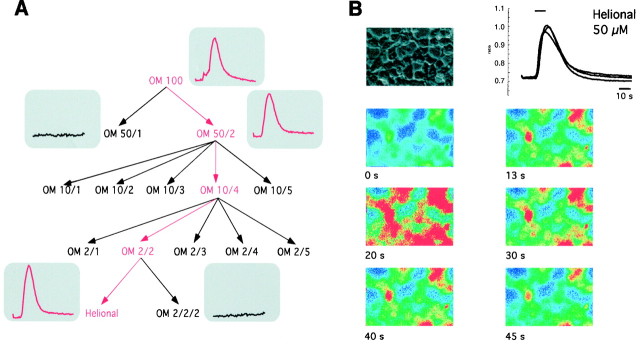
A, To identify the effective component(s) in the Henkel 100 solution, the odorant mixture was subdivided into smaller fractions and then tested for activity. The only effective substance was helional; 99 substances were ineffective.B, Application of helional (50 μm) induced a transient increase in intracellular [Ca2+] in a HEK293 cell line, stably transfected with the human OR17–40 odorant receptor. The integrated fluorescence ratio for three different cells measured over time (40 sec) is shown. Changes in intracellular [Ca2+] are indicated as changes in color (blue, low [Ca2+];red, high [Ca2+]).
Fig. 4.
Fig. 4.
U73122, a specific inhibitor of PLC, reduced the Ca2+ signals induced by helional (10 μm). After a control measurement with helional (10 μm), the cultures were incubated for 10 min with U73122 (10 μm); the resulting significant reduction of the Ca2+ response was reversible after 15 min washout. The application (2 sec) of helional is indicated by thearrowheads.
Fig. 5.
Fig. 5.
Presumed signal transduction pathway in injectedXenopus laevis oocytes heterologously expressing the odorant receptor OR17–40 and the CFTR. Binding of the agonistic odor to the OR17–40 leads to activation of an endogenous G-protein and stimulation of adenylate cyclase. The resulting increase in intracellular cAMP activates cAMP-dependent PKA, which phosphorylates the CFTR protein. The PKA-mediated phosphorylation of the CFTR protein in the presence of intracellular ATP leads to opening of the innate Cl channel and a corresponding increase in membrane conductance. To amplify the signal further, we blocked the enzymatic breakdown of cAMP by application of the membrane-permeable phosphodiesterase inhibitor IBMX (1 mm).
Fig. 6.
Fig. 6.
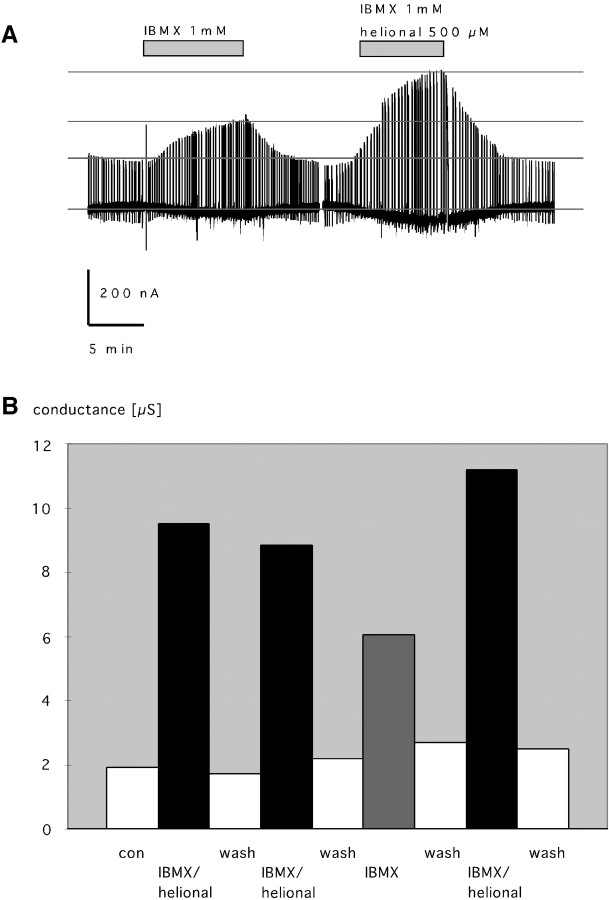
A, Chart recording of a two-electrode voltage-clamp experiment with injected Xenopus laevis oocytes heterologously expressing the odorant receptor OR17–40. The membrane conductance is monitored as the current response to a command voltage step from −50 (holding) to +50 (duration, 2 sec) mV. Superfusion of the oocyte with IBMX (1 mm) and the presumptive ligand helional (500 μm) (indicated by thebar) produced a 4.5-fold increase in membrane conductance (from 1.65 to 8.85 μS) and an inward current of −800 pA. After washout, the membrane conductance decreased to the basal level, the same as it was before the coapplication of IBMX and helional (right). Superfusion of the oocyte with IBMX (1 mm) alone produced a 1.8-fold increase in membrane conductance (left). B, Analysis of a representative two-electrode voltage-clamp experiment showing the reproducibility of the response of injected oocytes expressing the OR17–40 to helional. Repeated application of helional (500 μm) and IBMX (1 mm) produced corresponding increases in membrane conductance to an average of five times the resting conductance (from 2.1 to 9.9 μS). IBMX alone produced a 2.8-fold increase in membrane conductance.
Fig. 7.
Fig. 7.
Chart recording of a two-electrode voltage-clamp experiment with injected Xenopus laevis oocytes heterologously expressing the rat odorant receptor I7. The membrane conductance is monitored as the current response to a command voltage step from −50 (holding) to +50 (duration, 2 sec) mV. Superfusion of the oocyte with IBMX (1 mm) and the ligandn-octanal (500 μm) (indicated by thebar) produced a 2.8-fold increase in membrane conductance (from 20 to 55 μS) and an inward current of −800 nA. After washout, the membrane conductance decreased to the basal level, the same as it was before the coapplication of IBMX and octanal. Application of IBMX (1 mm), alone or together with helional or diacetyl (500 μm each), produced a 2.1-fold increase in membrane conductance.
Fig. 8.
Fig. 8.
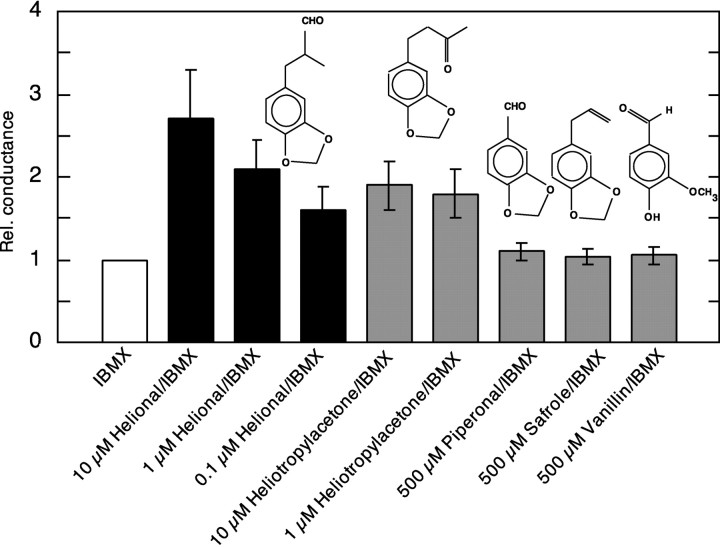
Structure–activity relationship and dose-dependence of various ligands at the OR17–40. The diagram shows the chemical structure of helional and the effect of its action on OR17–40 at three concentrations (100 nm, 1 μm, and 10 μm), as well as those of heliotropyl acetone (1 and 10 μm) and of piperonal, safrole, and vanillin (500 μm each). The activity of the tested ligands is shown as relative conductance (mean ± SE), which means that the increase of membrane conductance produced by 1 mm IBMX is set to 1. Helional and heliotropyl acetone (at the indicated concentrations) activate the OR17–40, whereas piperonal, safrole and, vanillin do not.

References

    1. Afshar M, Hubbard RE, Demaille J. Towards structural models of molecular recognition in olfactory receptors. Biochimie. 1998;80:129–135. - PubMed
    1. Axel R. The molecular logic of smell. Sci Am. 1995;273:154–159. - PubMed
    1. Beets J. Olfactory response and molecular structure. Handbook of sensory physiology 1971. 4:257–321.
    1. Ben-Arie N, Lancet D, Taylor C, Khen M, Walker N, Carrozzo R, Patel K, Sheer D, Lehrach H, North MA. Olfactory receptor gene cluster on human chromosome 17: possible duplication of an ancestral receptor repertoire. Hum Mol Genet. 1994;3:229–235. - PubMed
    1. Buck L, Axel R. A novel multigene family may encode odorant receptors: a molecular basis for odor recognition. Cell. 1991;65:175–187. - PubMed

Publication types

MeSH terms

LinkOut - more resources