. 1999 Sep;181(17):5193-200.
doi: 10.1128/JB.181.17.5193-5200.1999.

An autoregulatory circuit affecting peptide signaling in Bacillus subtilis

Affiliations

An autoregulatory circuit affecting peptide signaling in Bacillus subtilis

B A Lazazzera et al. J Bacteriol. 1999 Sep.

Abstract

The competence and sporulation factor (CSF) of Bacillus subtilis is an extracellular pentapeptide produced from the product of phrC. CSF has at least three activities: (i) at low concentrations, it stimulates expression of genes activated by the transcription factor ComA; at higher concentrations, it (ii) inhibits expression of those same genes and (iii) stimulates sporulation. Because the activities of CSF are concentration dependent, we measured the amount of extracellular CSF produced by cells. We found that by mid-exponential phase, CSF accumulated to concentrations (1 to 5 nM) that stimulate ComA-dependent gene expression. Upon entry into stationary phase, CSF reached 50 to 100 nM, concentrations that stimulate sporulation and inhibit ComA-dependent gene expression. Transcription of phrC was found to be controlled by two promoters: P1, which precedes rapC, the gene upstream of phrC; and P2, which directs transcription of phrC only. Both RapC and CSF were found to be part of autoregulatory loops that affect transcription from P1, which we show is activated by ComA approximately P. RapC negatively regulates its own expression, presumably due to its ability to inhibit accumulation of ComA approximately P. CSF positively regulates its own expression, presumably due to its ability to inhibit RapC activity. Transcription from P2, which is controlled by the alternate sigma factor sigma(H), increased as cells entered stationary phase, contributing to the increase in extracellular CSF at this time. In addition to controlling transcription of phrC, sigmaH appears to control expression of at least one other gene required for production of CSF.


Figures
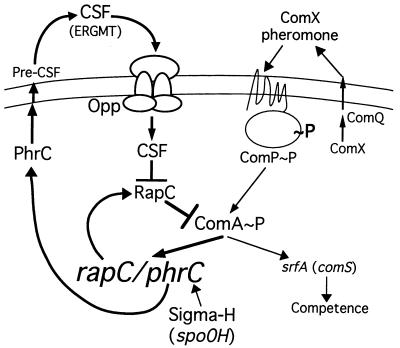
FIG. 1
FIG. 1
Model of the regulation of synthesis of and response to RapC and CSF. CSF is synthesized as a precursor protein PhrC with a signal sequence and putative peptidase cleavage sites. Pre-CSF is cleaved to produce the active CSF pentapeptide (ERGMT). The transcription factor ComA is activated (phosphorylated) by the membrane-bound histidine protein kinase ComP and by ComX pheromone, which probably activates ComP. ComQ is needed for production of the active ComX pheromone. CSF is transported into the cell by the oligopeptide permease (also known as Spo0K), where it stimulates expression of genes activated by ComA∼P, probably by inhibiting activity of the phosphatase RapC, which is a negative regulator of ComA∼P. Results presented in this report indicate that ComA∼P activates transcription of both rapC and phrC. Furthermore, we show that RapC negatively regulates it own synthesis, presumably by dephosphorylating ComA∼P. CSF, in contrast, was shown to positively regulate transcription of itself and rapC, presumably by inhibiting the phosphatase activity of RapC. ςH, the spo0H gene product, activates transcription of phrC.
FIG. 2
FIG. 2
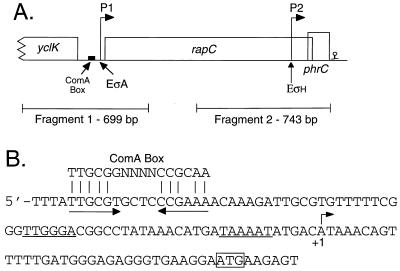
(A) The rapC phrC operon. The location of each of the two promoters is indicated by the arrows. The location of P1 was determined by primer extension analysis and is inferred, based on sequence, to depend on the major sigma factor ςA (see panel B). The ςH-dependent promoter P2 was mapped previously (2). A putative Rho-independent terminator is located downstream of phrC, and a putative ComA-binding site (ComA Box) is upstream of rapC. Fragment 1 and 2 indicate the regions used for making promoter fusions to lacZ. Fragment 2 includes the entire phrC gene. (B) Sequence of the P1 promoter region. Primer extension analysis was used to map the 5′ end of the rapC mRNA (see Materials and Methods). The 5′ end is indicated by the arrow and +1. The putative −10 and −35 regions are underlined, and the ATG start codon for rapC is boxed. The consensus ComA box (17) is aligned with the putative ComA box in the rapC promoter region.
FIG. 3
FIG. 3
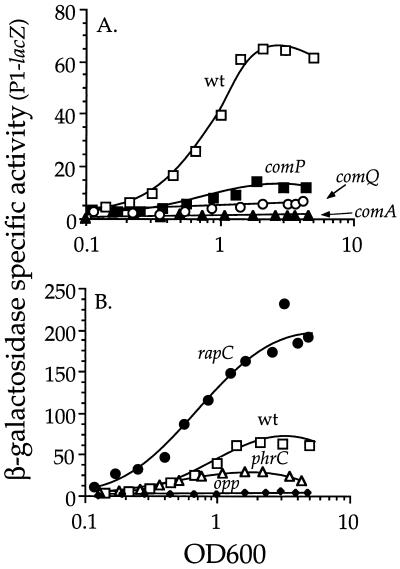
Regulation of rapC P1 by ComA∼P. Strains containing a P1-lacZ fusion were grown in defined minimal medium, and β-galactosidase specific activity is plotted as a function of OD600. Shown are data only from the exponential phase of growth. The data are from one of at least three independent experiments. (A) wt, wild type (IRN216); comP, IRN220; comQ, IRN222; comA, IRN219. (B) rapC, IRN217; phrC, IRN218; opp, IRN224; wt, wild type (IRN216) (same data as in panel A).
FIG. 4
FIG. 4
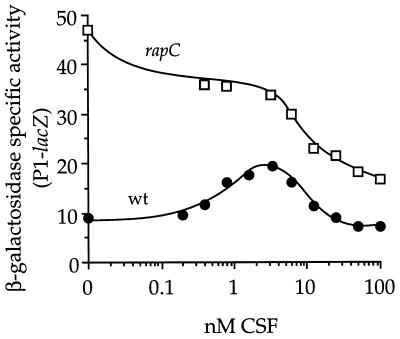
Regulation of rapC P1 by CSF. The β-galactosidase specific activity from P1-lacZ in cells at low density was measured 70 min after the addition of synthetic CSF (see Materials and Methods). Shown are data from one of at least three independent experiments. wt, wild type (IRN216); rapC, IRN217.
FIG. 5
FIG. 5
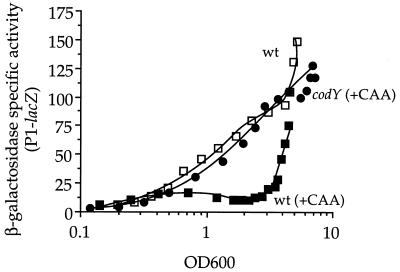
Control of rapC P1 by CodY. Strains containing a P1-lacZ fusion were grown in minimal medium with the indicated additions, and β-galactosidase specific activity is plotted as a function of OD600. Shown are data from one of at least three independent experiments. wt, wild type (IRN289) grown without and with Casamino Acids (+CAA); ΔcodY (+CAA), IRN299 grown with Casamino Acids. unkU::spc, which was used as a selectable maker in the transformation of the ΔcodY marker, had no effect on expression of P1-lacZ (data not shown). codY had no effect in the absence of Casamino Acids (data not shown). Apparent differences in P1-lacZ expression between Fig. 3 and 5 at high ODs are due to extra data points after the end of cell growth in Fig. 5 and daily variation.
FIG. 6
FIG. 6
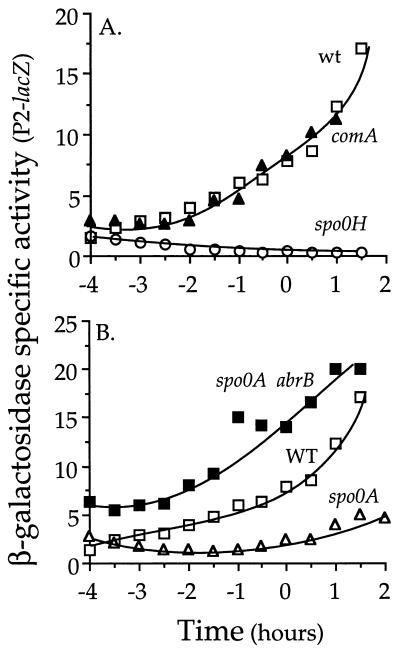
Expression of phrC P2. Strains containing a P2-lacZ fusion were grown in defined minimal medium, and β-galactosidase specific activity is plotted as a function of time relative to entry into stationary phase. The data are not plotted as a function of cell density because upon entry into stationary phase there is little increase in culture density but a significant increase in specific activity. Shown are data from one of at least three independent experiments. Time zero is defined as the end of exponential growth. (A) wt, wild type (IRN238); comA, IRN250; spo0H, IRN243. (B) WT, wild type (IRN238); spo0A, IRN249; spo0A abrB, IRN252.
FIG. 7
FIG. 7
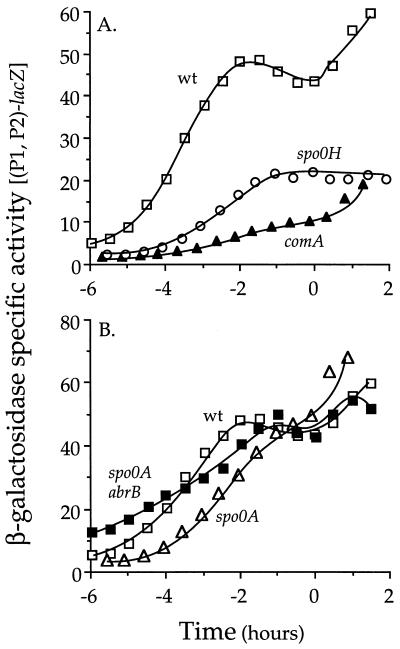
Expression of (P1, P2)-lacZ. Strains containing the (P1, P2)-lacZ fusion were grown in defined minimal medium, and β-galactosidase specific activity is plotted as a function of time. Shown are data from one of at least three independent experiments. Time zero is defined as the end of exponential growth. (A) wt, wild type (IRN235); comA, IRN277; spo0H, IRN273. (B) wt, wild type (IRN235); spo0A, IRN246; spo0A abrB, (BAL6).
FIG. 8
FIG. 8
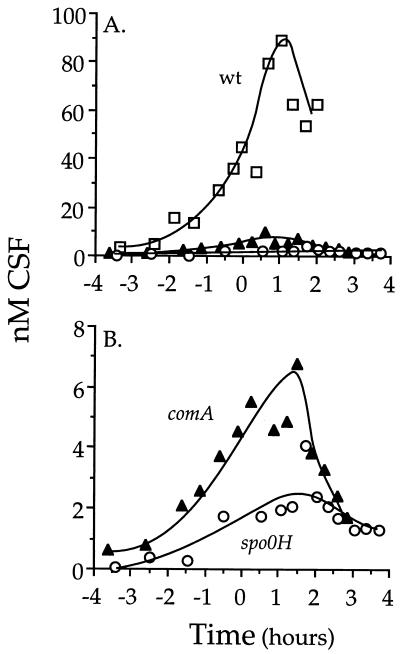
Accumulation of extracellular CSF. Conditioned medium was collected at different times during growth and assayed for CSF (Materials and Methods). Shown are data from one of three independent experiments. The levels of CSF measured for a particular strain during exponential growth varied by ∼10% from experiment to experiment. During stationary phase, this variability increased to ∼25%. Time zero is defined as the end of exponential growth. (A) open squares, wild type (wt; AG174); filled triangles, comA (JRL192); open circles, spo0H (AG665). (B) Data from panel A replotted to compare comA and spo0H mutants.

References

    1. Burbulys D, Trach K A, Hoch J A. Initiation of sporulation in B. subtilis is controlled by a multicomponent phosphorelay. Cell. 1991;64:545–552. - PubMed
    1. Carter H L, III, Tatti K M, Moran C P., Jr Cloning of a promoter used by sigma-H RNA polymerase in Bacillus subtilis. Gene. 1991;96:101–105. - PubMed
    1. D’Souza C, Nakano M M, Zuber P. Identification of comS, a gene of the srfA operon that regulates the establishment of genetic competence in Bacillus subtilis. Proc Natl Acad Sci USA. 1994;91:9397–9401. - PMC - PubMed
    1. Grossman A D. Genetic networks controlling the initiation of sporulation and the development of genetic competence in Bacillus subtilis. Annu Rev Genet. 1995;29:477–508. - PubMed
    1. Hahn J, Dubnau D. Growth stage signal transduction and the requirements for srfA induction in development of competence. J Bacteriol. 1991;173:7275–7282. - PMC - PubMed

Publication types

MeSH terms

LinkOut - more resources