


doi: 10.1128/JB.181.17.5219-5224.1999.
The dual-specificity protein phosphatase Yvh1p acts upstream of the protein kinase mck1p in promoting spore development in Saccharomyces cerevisiae
Affiliations
- PMID: 10464190
- PMCID: PMC94025
- DOI: 10.1128/JB.181.17.5219-5224.1999
Item in Clipboard
The dual-specificity protein phosphatase Yvh1p acts upstream of the protein kinase mck1p in promoting spore development in Saccharomyces cerevisiae
J Bacteriol.
1999 Sep.
Abstract
Diploid Saccharomyces cerevisiae cells induce YVH1 expression and enter the developmental pathway, leading to sporulation when starved for nitrogen. We show that yvh1 disruption causes a defect in spore maturation; overexpression of MCK1 or IME1 suppresses this yvh1 phenotype. While mck1 mutations are epistatic to those in yvh1 relative to spore maturation, overexpression of MCK1 does not suppress the yvh1 slow-vegetative-growth phenotype. We conclude that (i) Yvh1p functions earlier than Mck1p and Ime1p in the signal transduction cascade that regulates sporulation and is triggered by nitrogen starvation and (ii) the role of Yvh1p in gametogenesis can be genetically distinguished from its role in vegetative growth.
Figures

(A) Strain- and cell-type-restricted dityrosine production. Wild-type (WT) diploid (2n; GYC86), wild-type haploid (n; GYC121 and GYC122), yvh1 disruption diploid (2n; HPY120), yvh1 disruption haploid (n; GYC123 and GYC124), and diploid ptp2 deletion (2n; HPY123) strains were assayed after 144 h on sporulation medium as described in Materials and Methods. (B) Genetic screen for suppressors of a yvh1 disruption. The fluorescence assay was as described for the larger lifts in Materials and Methods. The presence of fluorescent colonies (arrows) in a background of nonfluorescing colonies was taken as indicative of suppression.
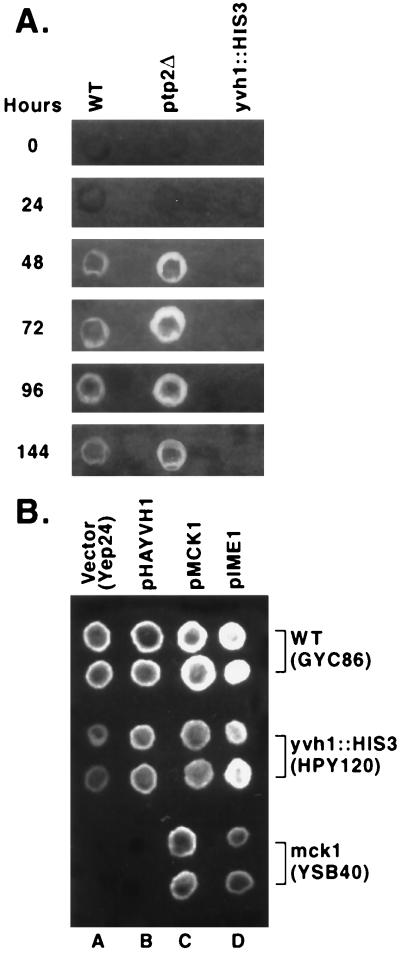
(A) Appearance of dityrosine fluorescence in diploid wild-type (WT; GYC86), ptp2 deletion (HPY123), and yvh1 disruption (HPY120) strains incubated for increasing amounts of time on sporulation plates. (B) Epistatic relationships of three genes which regulate sporulation in S. cerevisiae. Wild-type (GYC86), yvh1 disruption (HPY120), and mck1 deletion (YSB40) strains were transformed with parent vector plasmid Yep24 alone (column A) or carrying HA-tagged YVH1 (pHAYVH1; column B), MCK1 (pMCK1; column C), or IME1 (pIME1; column D). All three genes were expressed from their native promoters. Each assay appears in duplicate. There were reproducible strain-specific differences in the vector plasmid lane (column A); the mck1 deletion exhibited a more extreme phenotype than the yvh1 deletion mutant. The total lack of fluorescence with the mck1 deletion (column A) did not derive from a lack of cells on the membrane. Suppression capacity was always scored with respect to the test strain carrying the parent vector plasmid (Yep24 [column A]).

Effect of episomal expression of fluorescence suppressors on sporulation. Strain HPY120 cells transformed with parent vector Yep24 or plasmid Yep24-IME1, Yep24-MCK1, or Yep24-YVH1 were processed as described in Materials and Methods. The extent of sporulation, determined as cells which contained three or four spores, was determined by visual inspection of at least 1,000 cells per determination.

Mck1 protein kinase activity is required to suppress the fluorescence defect of a yvh1 disruption (HPY120) or mck1 YSB40 (YSB40) mutations. The strains were transformed the vector (plasmid Yep24), wild-type MCK1 (plasmid Yep24MCK1), or mck1 catalytic null allele (plasmid Yep24MCK1K68R), and the fluorescence assay was performed as described in Materials and Methods; each transformant was assayed in duplicate. The degree to which fluorescence is lacking in a mck1 mutant is similar to that seen in Fig. 2B; i.e., deletion of MCK1 has a stronger fluorescence defect than disruption of YVH1.

The slow-growth phenotype of a yvh1 disruption mutant cannot be suppressed by overexpression of MCK1. (A) Strain HPY120 was transformed with plasmids Yep24, pHAYVH1, and pHAyvh1. All plasmids were Yep24 vector based. Transformants were streaked onto yeast nitrogen base-glucose-ammonia-Casamino Acids medium. Both plates were incubated for the same length of time. a.a., amino acids. (B) Strain HPY120 was transformed with plasmids pRS316 (centromere [CEN]-based vector plasmid) (27), pYVH1 (22), and p316AB27 (Materials and Methods). The latter two plasmids contain wild-type alleles of YVH1 and MCK1, respectively, cloned into plasmid pRS316. Transformation and plating conditions are as for panel A.
References
-
- Bianchi M W, Plyte S E, Kreis M, Woodgett J R. A Saccharomyces cerevisiae protein-serine kinase related to mammalian glycogen synthase kinase-3 and the Drosophila melanogaster gene shaggy product. Gene. 1993;134:51–56. - PubMed
-
- Briza P, Breitenbach M, Ellinger A, Segall J. Isolation of two developmentally regulated genes involved in spore wall maturation in Saccharomyces cerevisiae. Genes Dev. 1990;4:1775–1789. - PubMed
Publication types
MeSH terms
Substances
Grants and funding
LinkOut - more resources
Full Text Sources
Molecular Biology Databases
