


Review
doi: 10.1073/pnas.96.18.9970.
Folding and binding cascades: shifts in energy landscapes
- PMID: 10468538
- PMCID: PMC33715
- DOI: 10.1073/pnas.96.18.9970
Item in Clipboard
Review
Folding and binding cascades: shifts in energy landscapes
Proc Natl Acad Sci U S A.
.
No abstract available
Figures
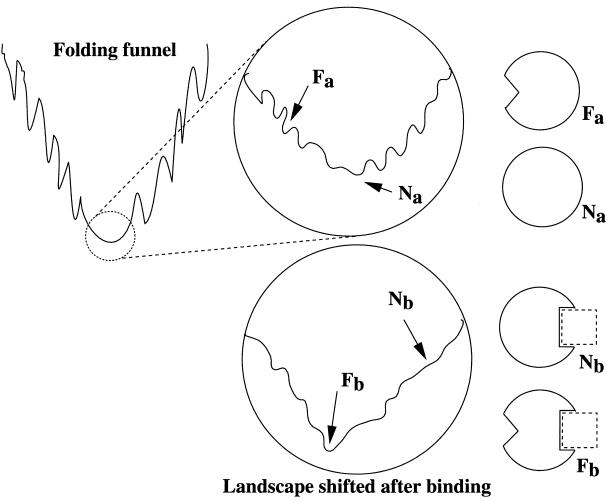
At the bottom of a folding funnel (shown enclosed
by a small circle, which is projected and magnified in the larger
circle), there are many distinctive, accessible conformations around
the most populated native structure. For clarity, only the native
structure and the functional conformation are highlighted in the
figure. They are indicated by the schematic drawings as Na
and Fa, respectively. The conformational change responsible
for the cascade reaction in binding is drawn opposite to the binding
site to reflect that it is remote from the binding site. On binding
(indicated by a dashed rectangle), the environment changes. The change
in the environment has the effect of making the folding energy surface
shift, to favor the functional conformation (Fb) instead of
the native structure (Nb). Hence, in terms of the free
energy landscape theory, the functional switch-on mechanism is not by
induced and propagated conformational change of the protein molecule
through binding; rather, it is a shift of the population toward the
functional conformer.
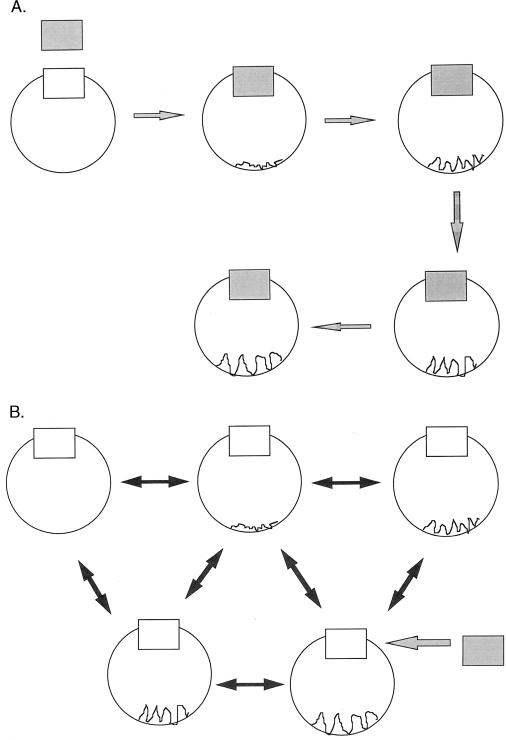
(A). The traditional view of induced
fit and allostery where binding in one site (shaded) causes changes at
a remote site (rugged). (B) The concept of conformational
substates described here, where preexisting conformations are in
equilibrium. The equilibrium shifts to one of conformations that fits
incoming ligand.
Comment on
-
The propagation of binding interactions to remote sites in proteins: analysis of the binding of the monoclonal antibody D1.3 to lysozyme.Proc Natl Acad Sci U S A. 1999 Aug 31;96(18):10118-22. doi: 10.1073/pnas.96.18.10118. Proc Natl Acad Sci U S A. 1999. PMID: 10468572 Free PMC article.
References
Publication types
MeSH terms
Substances
Grants and funding
LinkOut - more resources
Full Text Sources
