. 1999 Aug 31;96(18):10045-50.
doi: 10.1073/pnas.96.18.10045.

New routes for lignin biosynthesis defined by biochemical characterization of recombinant ferulate 5-hydroxylase, a multifunctional cytochrome P450-dependent monooxygenase

Affiliations

New routes for lignin biosynthesis defined by biochemical characterization of recombinant ferulate 5-hydroxylase, a multifunctional cytochrome P450-dependent monooxygenase

J M Humphreys et al. Proc Natl Acad Sci U S A. .

Abstract

The enzymes and genes of the lignin biosynthetic pathway have been studied for several decades, but the gene encoding ferulate 5-hydroxylase (F5H) was cloned only 3 years ago by T-DNA tagging in Arabidopsis. To characterize the enzyme in detail, we have expressed F5H in yeast. According to current models of the phenylpropanoid pathway, F5H catalyzes the hydroxylation of ferulate to 5-hydroxyferulate; however, our studies indicate that the enzyme also uses coniferaldehyde and coniferyl alcohol as substrates. Unexpectedly, the K(m) values measured for the latter two substrates are three orders of magnitude lower than that measured for ferulic acid, suggesting that in lignifying tissues, syringyl monomers may be derived from their guaiacyl counterparts by hydroxylation and subsequent methylation. Thus, F5H may function later in the lignin biosynthetic pathway than was originally proposed. To further test this model, recombinant F5H was incubated together with ferulic acid, coniferaldehyde, or coniferyl alcohol in the presence of native or recombinant Arabidopsis caffeic acid/5-hydroxyferulic acid O-methyltransferase and [(14)C]S-adenosylmethionine. In all cases, the corresponding radiolabeled sinapyl derivatives were synthesized, indicating that the necessary enzymes required for this pathway are present in Arabidopsis. Taken together, these data suggest that the previously accepted pathway for lignin biosynthesis is likely to be incorrect.


Figures
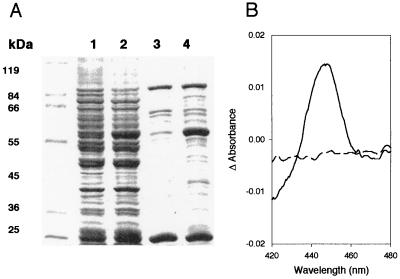
Figure 1
Figure 1
Analysis of F5H expressed in yeast. (A) SDS/PAGE analysis of microsomal and membrane proteins from yeast harboring pYeDP60 (lanes 1 and 3) and the F5H expression vector pYeDP60-F5H (lanes 2 and 4). Lanes 1 and 2, yeast microsomal proteins; lanes 3 and 4, membrane protein-enriched detergent phase from Triton X-114 phase-partitioning of yeast microsomal proteins. (B) Carbon monoxide difference spectrum of dithionite-reduced microsomes from yeast expressing F5H. Dotted line, baseline before CO treatment; solid line, difference spectrum after CO treatment.
Figure 2
Figure 2
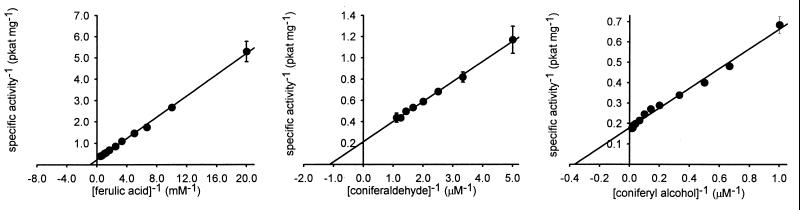
Kinetic analysis of F5H-catalyzed substrate 5-hydroxylation with ferulate, coniferaldehyde, and coniferyl alcohol as substrates. Error bars represent 1 SD for triplicate assays.
Figure 3
Figure 3
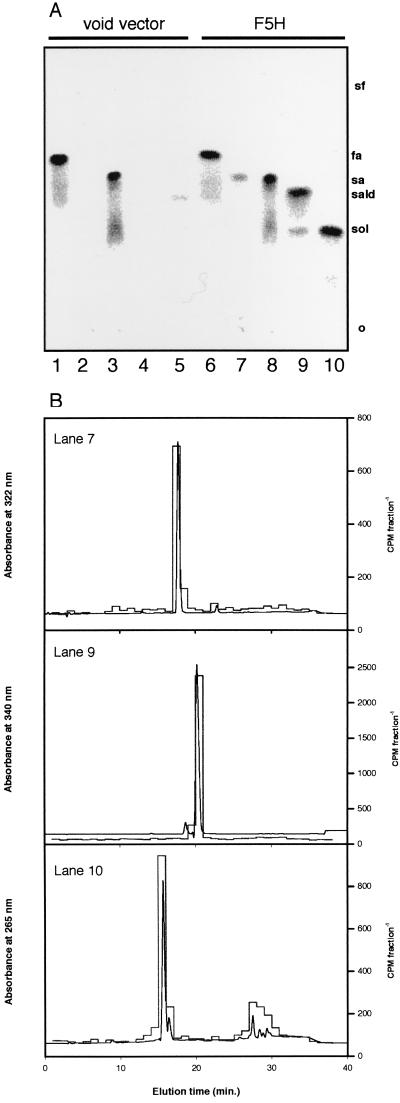
TLC/HPLC analysis of products from F5H assays coupled to OMT activity from Arabidopsis rachis extracts. (A) Ethyl acetate-soluble assay products were separated by TLC, and radioactive products labeled from S-adenosyl-l-[methyl-14C]methionine were visualized on a Packard Instant Imager. The substrates employed were caffeic acid (lanes 1 and 6), ferulic acid (lanes 2 and 7), 5-hydroxy- ferulic acid (lanes 3 and 8), coniferaldehyde (lanes 4 and 9), and coniferyl alcohol (lanes 5 and 10). Lanes 1–5, control yeast microsomes; lanes 6–10, microsomes from yeast expressing F5H. The relative mobilities of the putative products, ferulic acid (fa), sinapic acid (sa), sinapaldehyde (sald), and sinapyl alcohol (sol), were determined by observation of nonradioactive standards under UV light. (B) The identity of the products was confirmed by elution of the radiolabeled compounds from the TLC stationary phase and co-chromatography of the radiolabel with authentic standards on HPLC. UV absorbance is shown as a continuous line; radioactivity is shown as a histogram.
Figure 4
Figure 4
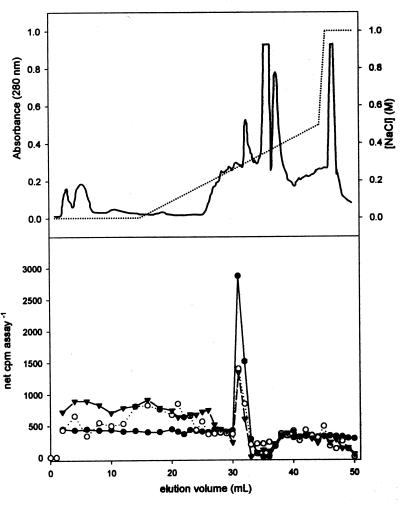
Separation of OMT activities from Arabidopsis rachis extracts by anion-exchange chromatography. Proteins were eluted from the column by using a salt gradient (dotted line), and monitored by the UV absorbance of the eluate (solid line) (Upper). Aliquots of individual fractions were used in coupled assays with F5H. Ethyl acetate-soluble assay products labeled from S-adenosyl-l-[methyl-14C]methionine were analyzed by liquid scintillation counting (Lower). The substrates used were caffeic acid (●), coniferaldehyde (○), and coniferyl alcohol (▴).
Figure 5
Figure 5
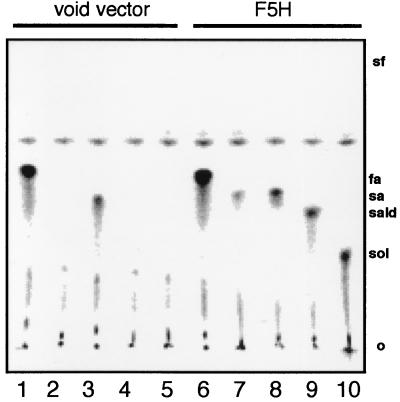
TLC analysis of products from F5H assays coupled to OMT activity from the Arabidopsis COMT expressed in E. coli. Ethyl acetate-soluble assay products were separated by TLC (A), and radioactive products labeled from S-adenosyl-l-[methyl-14C]-methionine were visualized on a Packard Instant Imager. The substrates used were caffeic acid (lanes 1 and 6), ferulic acid (lanes 2 and 7), 5-hydroxyferulic acid (lanes 3 and 8), coniferaldehyde (lanes 4 and 9), and coniferyl alcohol (lanes 5 and 10). Lanes 1–5, control yeast microsomes; lanes 6–10, microsomes from yeast expressing F5H. The relative mobilities of the putative products, ferulic acid (fa), sinapic acid (sa), sinapaldehyde (sald), and sinapyl alcohol (sol), were determined by observation of nonradioactive standards under UV light.
Figure 6
Figure 6
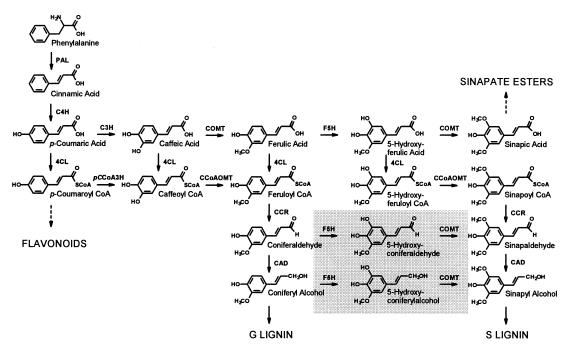
Revised pathway of phenylpropanoid biosynthesis in Arabidopsis including the reactions now known to be catalyzed by F5H and COMT (boxed in gray). The enzymes and their abbreviations are caffeoyl CoA O-methyltransferase (CCoAOMT), cinnamate 4-hydroxylase (C4H), cinnamoyl alcohol dehydrogenase (CAD), cinnamoyl CoA reductase (CCR), p-coumarate 3-hydroxylase (C3H), 4-(hydroxy)cinnamoyl CoA ligase (4CL), ferulate 5-hydroxylase (F5H), p-coumaroyl CoA 3-hydroxylase (pCCoA3H), phenylalanine ammonia-lyase (PAL), caffeic acid/5-hydroxyferulic acid O-methyltransferase (COMT).

References

    1. Lewis N G, Yamamoto E. Annu Rev Plant Physiol Plant Mol Biol. 1990;41:455–496. - PubMed
    1. Nicholson R L, Hammerschmidt R. Annu Rev Phytopathol. 1992;30:369–389.
    1. Whetten R, Sederoff R. Forest Ecol Management. 1991;43:301–316.
    1. Jung H G, Deetz D A. In: Forage Cell Wall Structure and Digestibility. Jung H G, Buxton D R, Hatfield R D, Ralph J, editors. Madison, WI: Am. Soc. Agron./Crop Sci. Soc. Am./Soil Sci. Soc. Am. Press; 1993. pp. 315–346.
    1. Campbell M M, Sederoff R R. Plant Physiol. 1996;110:3–13. - PMC - PubMed

Publication types

MeSH terms