. 1999 Aug 31;96(18):10290-5.
doi: 10.1073/pnas.96.18.10290.

An enhancer element located downstream of the major glutamate dehydrogenase gene of Bacillus subtilis

Affiliations

An enhancer element located downstream of the major glutamate dehydrogenase gene of Bacillus subtilis

B R Belitsky et al. Proc Natl Acad Sci U S A. .

Abstract

The rocG gene of Bacillus subtilis, encoding a catabolic glutamate dehydrogenase, is transcribed by SigL (sigma(54))-containing RNA polymerase and requires for its expression RocR, a member of the NtrC/NifA family of proteins that bind to enhancer-like elements, called upstream activating sequences (UAS). Unlike the case for other sigma(54)-dependent genes, rocG has no UAS; instead, its expression depends on a sequence located 1.5 kilobases downstream of the rocG promoter, beyond the end of the rocG coding region. The same sequence also serves as the UAS for the downstream rocABC operon and can activate rocG if moved upstream of its promoter. Furthermore, the activating sequence can be moved as far as 15 kilobases downstream of the rocG promoter and still retain partial activity.


Figures
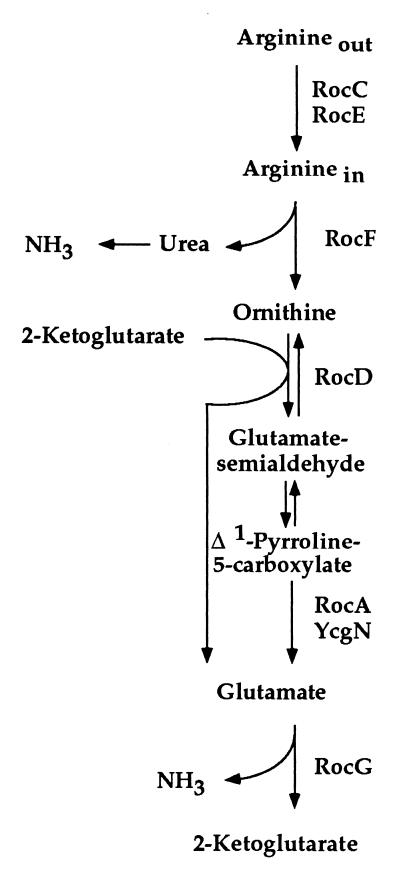
Figure 1
Figure 1
The pathway for arginine and ornithine use. The following enzymes are shown on this figure by the names of their corresponding genes: RocC and RocE, putative arginine/ornithine permeases; RocF, arginase; RocD, ornithine aminotransferase; RocA and YcgN, Δ1-pyrroline-5-carboxylate dehydrogenases; RocG, glutamate dehydrogenase. Proline is converted to glutamate via Δ1-pyrroline-5-carboxylate. The proline degradation pathway shares RocA/YcgN- and RocG-dependent steps with the roc-pathway.
Figure 2
Figure 2
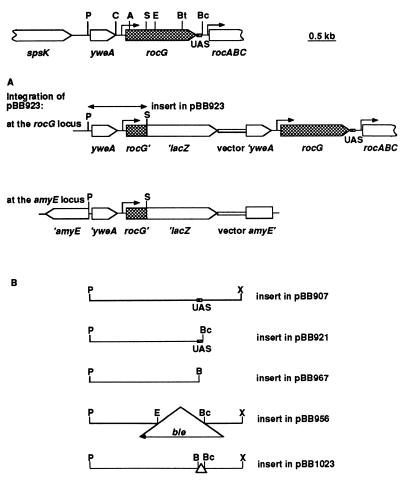
The genetic map of the rocG region (19) and plasmids carrying different parts of this region. The structure of the chromosome resulting from integration of pBB923 at the rocG or amyE locus is shown. For pBB956, pBB921, and pBB967, such integration events are shown in Fig. 4 (see strains BB1541, 1566, and 1568, respectively). Plasmids pBB907, 956, and 1023 are derivatives of pBB544 (20), and pBB921, pBB923, and pBB967 are derivatives of pJPM82 (20). Plasmid pBB907 was described previously (17). Restriction sites are abbreviated as follows: A, AccI; B, BamHI; Bc, BclI; Bt, BstYI; C, ClaI; E, EcoRI; P, PstI; S, SacII; X, XhoI. The XhoI and BamHI sites were constructed by PCR. The locations of the rocG and rocA promoter regions are indicated by right-angle arrows. The lacZ gene and the vector part of the plasmids are not to the scale.
Figure 3
Figure 3
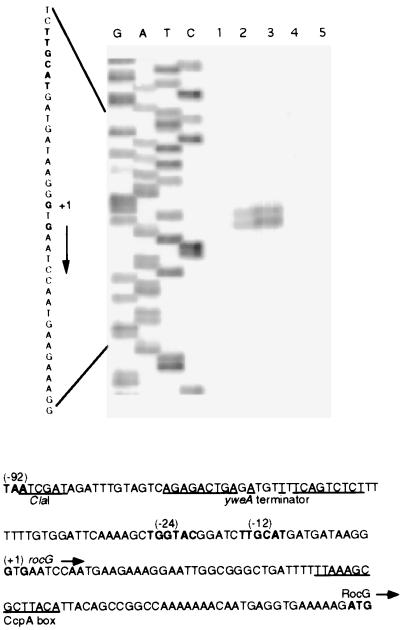
Determination of the rocG transcription start site. Primer oBB56 (5′CTTAATGATTGTTTGGGTAGAC), corresponding to positions +78 to +57 with respect to the rocG initiation codon, was extended (17) with Superscript II reverse transcriptase (GIBCO/BRL) by using total RNA (17) from the following sources: lane 1, B. subtilis strain SMY grown in glucose-ammonia medium; lane 2, strain SMY grown in glucose-ammonia-ornithine medium; lane 3, strain SMY grown with proline as sole carbon and nitrogen source; lane 4, a rocR null mutant grown in glucose-ammonia-ornithine medium; or lane 5, Saccharomyces cerevisiae (Sigma) as templates. The sequence of the nontemplate strand of plasmid pBB916 [contains the PstI-EcoRI fragment (Fig. 2)] obtained by using oBB56 as primer is shown to the left. The sequence of the rocG regulatory region (19) is shown at the bottom. The termination codon of yweA, the −12 and −24 promoter regions, the apparent transcription start points, and a likely initiation codon for the rocG gene are in bold. The directions of transcription and translation are indicated by horizontal arrows. The ClaI site used in plasmid construction, the dyad-symmetry sequence of a putative yweA transcriptional terminator, and a putative CcpA box (cre site) (24, 25) are underlined.
Figure 4
Figure 4
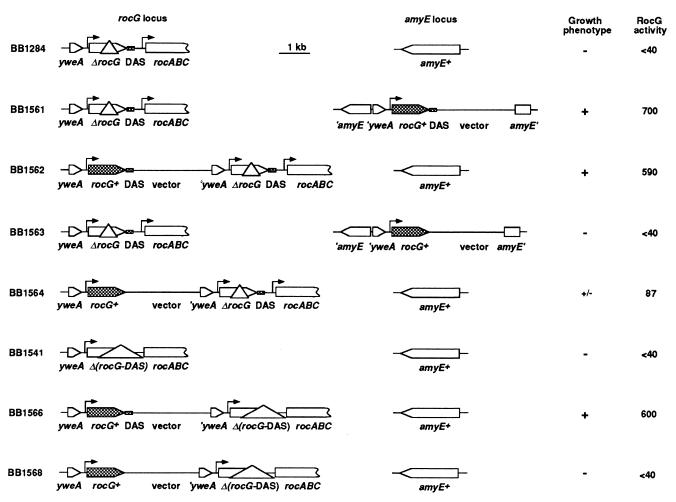
Requirement of DAS for complementation of rocG mutations. Plasmids pBB921 or pBB967 (Fig. 2B) were integrated in the chromosome of two different rocG deletion mutants (strains BB1284 and BB1541) either at the rocG locus or at the ectopic amyE locus. The full-length rocG allele and the DAS are presented as filled boxes. The vector part of the plasmids (10.5 kb) and the DAS (61 bp) are not to scale. The locations of the rocG and rocA promoter regions are indicated by right-angle arrows. Growth phenotype was scored as ability to use ornithine or proline as sole carbon and nitrogen source. GlutDH activity was determined in succinate-glutamate-ornithine medium.
Figure 5
Figure 5
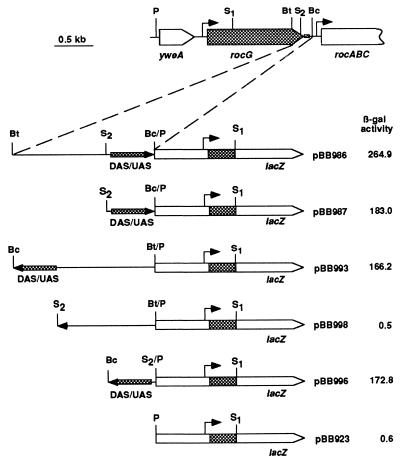
The rocG DAS behaves as a position- and orientation-independent enhancer. Derivatives of strain SMY carrying the corresponding rocG-lacZ fusions at the ectopic amyE locus were grown in succinate-glutamate-ornithine medium, and β-galactosidase activity was determined. The lacZ gene and the enlarged fragments of the DAS/UAS region are not to the scale. The arrows show orientation of the DAS/UAS region. The locations of the rocG and rocA promoter regions are indicated by right-angle arrows. The restriction sites are abbreviated as follows: Bc, BclI; Bt, BstYI; P, PstI; S, SacII.

References

    1. Müller M M, Gerster T, Schaffner W. Eur J Biochem. 1988;176:485–495. - PubMed
    1. Kustu S, Santero E, Keener J, Popham D, Weiss D. Microbiol Rev. 1989;53:367–376. - PMC - PubMed
    1. Kustu S, North A K, Weiss D. Trends Biochem Sci. 1991;16:397–402. - PubMed
    1. Morett E, Segovia L. J Bacteriol. 1993;175:6067–6074. - PMC - PubMed
    1. Merrick M J. Mol Microbiol. 1993;10:903–909. - PubMed

Publication types

MeSH terms

LinkOut - more resources