. 1999 Sep;98(1):71-9.
doi: 10.1046/j.1365-2567.1999.00844.x.

Impaired contact hypersensitivity to trinitrochlorobenzene in interleukin-4-deficient mice

Affiliations

Impaired contact hypersensitivity to trinitrochlorobenzene in interleukin-4-deficient mice

F Dieli et al. Immunology. 1999 Sep.

Abstract

We have examined the role of endogenously produced interleukin-4 (IL-4) in the contact hypersensitivity (CH) reaction to the haptene trinitrochlorobenzene (TNCB). The CH reaction was abolished in IL-4 genetically deficient mice (IL-4 KO), when compared to wild-type (wt) mice. The CH reaction was restored by treatment with IL-4 and further analysis revealed that IL-4 exerted its action both at the induction and effector stages of the CH reaction. Despite failure to develop a CH reaction, IL-4 KO mice developed a T helper type 1 (Th1) response to TNCB, in terms of lymphokine production in vitro. Furthermore, the number of Vgamma3+ cells accumulating in the lymph nodes of TNCB-immune IL-4 KO mice was normal. The recruitment of mononuclear cells and vascular leakage at the challenge site were consistently reduced in IL-4 KO mice and were restored by injection of IL-4. This suggests that IL-4 acts as a proinflammatory mediator in CH, perhaps favouring the accumulation of mononuclear cells at the site of inflammation. Among Th2-type cytokines, IL-13, but not IL-10, was shown to restore the CH reaction to TNCB in IL-4 KO mice. However, IL-4 KO mice developed a normal CH response to oxazolone, indicating that IL-4 was required for the CH reaction to TNCB, but not for that to oxazolone.


Figures
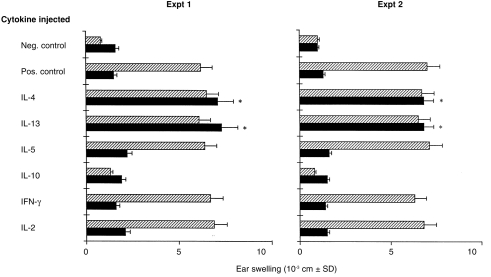
Figure 5
Figure 5
Both IL-4 and IL-13 restore CH in IL-4 KO mice. IL-4 KO (closed columns) and wt (hatched columns) mice were immunized with TNCB and challenged 5 days later. Mice were injected i.v. with 10 ng of several different recombinant cytokines both at the time of immunization and at the time of challenge. The increase in ear thickness was measured 24 hr after challenge. Positive control refers to mice sensitized with TNCB and challenged with TNCB, while negative control refers to mice which were not sensitized with TNCB, but were only challenged with TNCB. *P < 0·001 when compared to IL-4 KO mice sensitized and challenged with TNCB but not injected with IL-4.
Figure 1
Figure 1
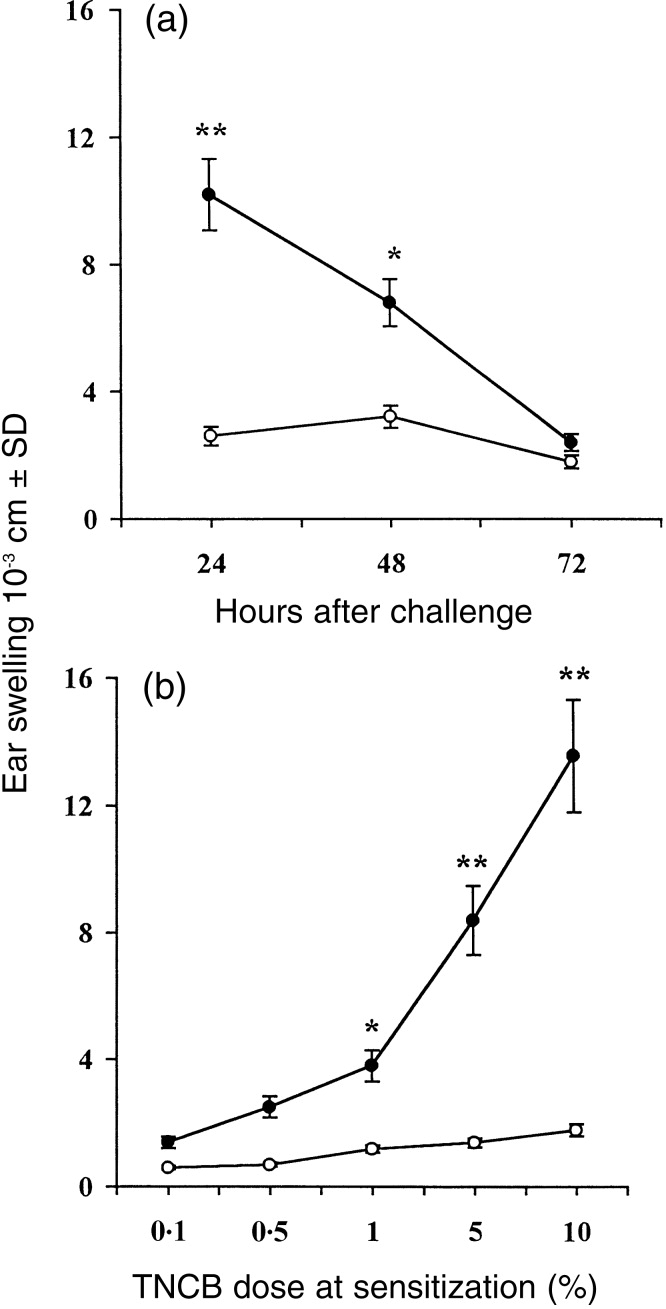
CH response in IL-4 KO and wt mice. In (a), IL-4 KO (○) and wt (•) mice were sensitized with TNCB and challenged 5 days later. The increases in ear thickness were measured 24, 48 and 72 hr after challenge. In (b), IL-4 KO (○) and wt (•) mice were sensitized with different TNCB concentrations and were challenged with a single dose of TNCB. The increase in ear thickness was measured 24 hr after challenge. Data presented are the mean values±SD of eight mice per data point. Mice that were not sensitized, but only challenged with TNCB (challenge only), gave the following results: IL-4 KO 24 hr, 2·1±0·4; 48 hr, 2·5±0·3; 72 hr, 1·7±0·6; and wt 24 hr, 2·0±1·1; 48 hr 1·9±0·5; 72 hr, 1·5±0·2. *P < 0·01 and **P < 0·001 as compared to the values detected in IL-4 KO mice.
Figure 2
Figure 2
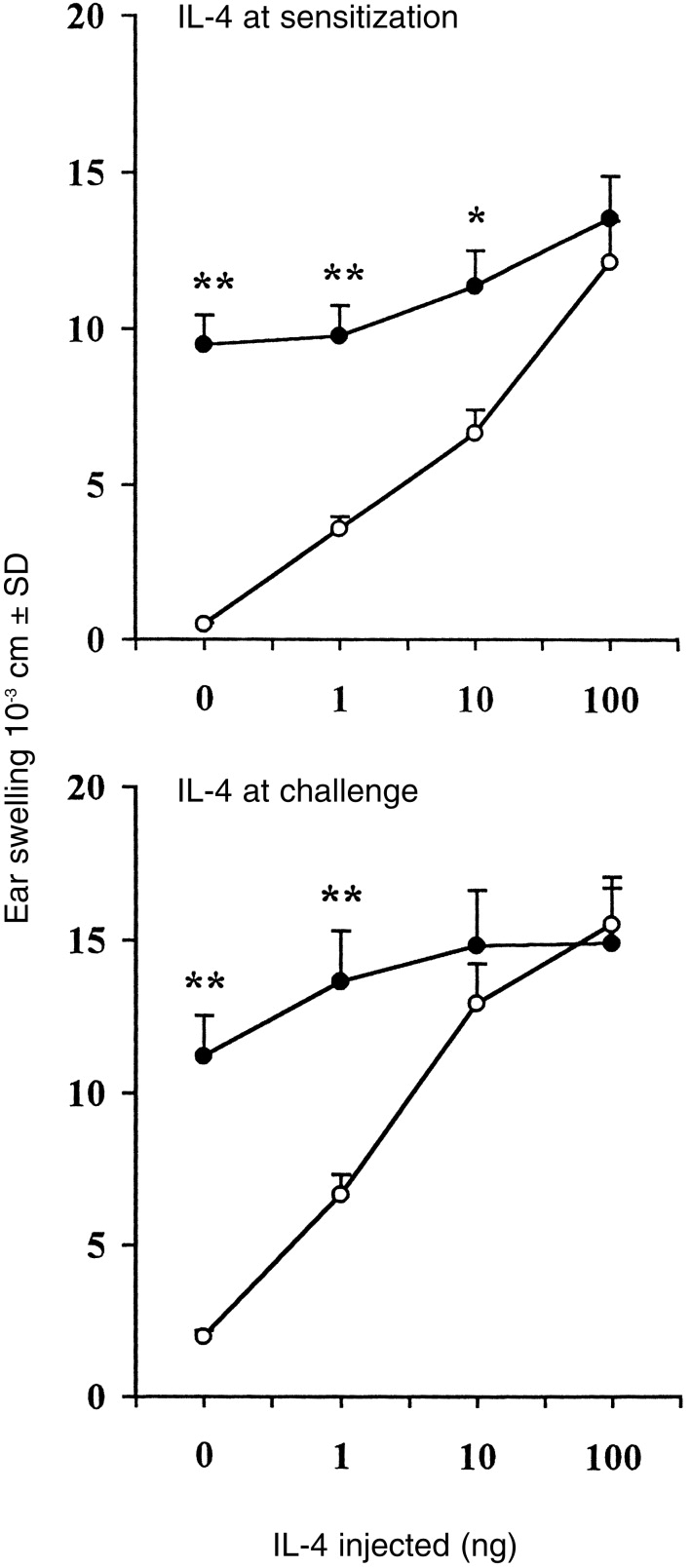
CH response in IL-4 KO mice can be restored by IL-4. IL-4 KO (○) and wt (•) mice were sensitized with TNCB and challenged 5 days later. Some groups of mice also received different amounts of IL-4 immediately before sensitization (upper panel) or immediately before challenge (lower panel). The increases in ear thickness were measured 24 hr after challenge. Mice that were not sensitized, but only challenged with TNCB (challenge only), gave the following results: IL-4 KO, 1·1±0·2; wt, 1·0±0·1. *P < 0·01 and **P < 0·001 as compared to the values detected in IL-4 KO mice.
Figure 3
Figure 3
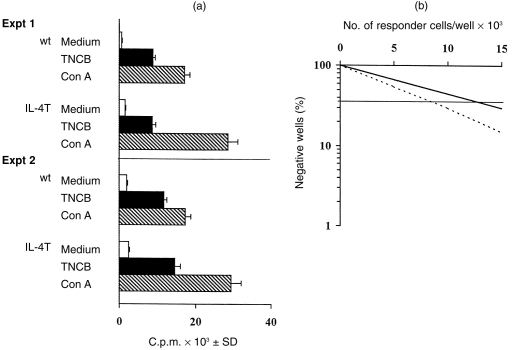
TNCB-specific proliferative response and precursor frequency analysis in IL-4 KO mice. IL-4 KO and wt mice were immunized with TNCB and the draining lymph nodes were harvested 4 days later. In (a), TNCB-immune lymph node cells were re-exposed to medium, TNCB-hapteneized APC or Con A in vitro and proliferation was measured 72 hr later. In (b), the frequency of TNCB-specific precurors in IL-4 KO (—) and wt (—) mice was estimated as described under the Materials and Methods.
Figure 4
Figure 4
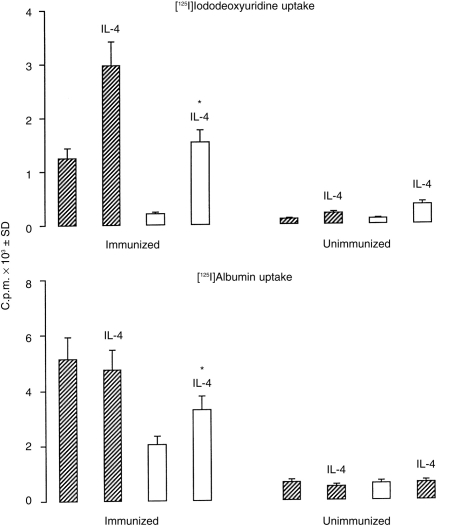
Infiltration of radiolabelled mononuclear cells and leakage of radiolabelled albumin in IL-4 KO mice. TNCB-sensitized (immunized) or not sensitized (unimmunized) wt (hatched columns) and IL-4 KO (open columns) mice were challenged 5 days later with TNCB on their left ears. [125I]IUdr was injected 8 hr later to label dividing mononuclear cells (top panel), while [125I]albumin was injected 16 hr later (lower panel). Where indicated (i.e. IL-4) mice were injected i.v. with 10 ng IL-4 immediately before challenge. Ears were cut off 24 hr after challenge (see the Materials and Methods) and radioactivity incorporation was determined. Counts of the non-challenged right ears were subtracted from those of the challenged ears. *P < 0·0001 when compared to IL-4 KO mice not injected with IL-4.
Figure 6
Figure 6
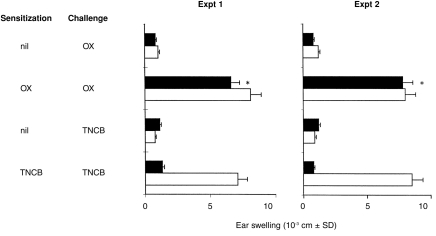
IL-4 KO mice fail to develop CH to TNCB, but not to OX. IL-4 KO (closed columns) and wt (open columns) mice were sensitized with TNCB or OX and challenged 5 days later with the specific antigen. The increase in ear thickness was measured 24 hr after challenge. *P < 0·001 when compared to mice which were not sensitized with OX, but only challenged with OX.

References

    1. Friedmann PS. Contact hypersensitivity. Curr Opin Immunol. 1989;1:690. - PubMed
    1. Piguet PF, Grau GE, Hauser C, Vassalli P. Tumor necrosis factor is a critical mediator in haptene-induced irritant and contact hypersensitivity reactions. J Exp Med. 1991;173:673. - PMC - PubMed
    1. Gautam S, Matriano J, Chikkala N, Edinger M, Tubbs R. L3T4 (CD4+) T cells that mediate contact sensitivity to trinitrochlorobenzene express I-A determinants. Cell Immunol. 1991;135:27. - PubMed
    1. Miller SD, Jenkins MK. In vivo effects of GK1.5 (anti-L3T4a) monoclonal antibody on induction and expression of delayed-type hypersensitivity. Cell Immunol. 1985;92:414. - PubMed
    1. Issekutz TB, Stolz JM, Van Der Meide P. Lymphocyte recruitment in delayed-type hypersensitivity: the role of IFN-γ. J Immunol. 1988;140:2989. - PubMed

Publication types

LinkOut - more resources