


Characterization and quantitation of the pharmacodynamics of fluconazole in a neutropenic murine disseminated candidiasis infection model
- PMID: 10471550
- PMCID: PMC89432
- DOI: 10.1128/AAC.43.9.2116
Characterization and quantitation of the pharmacodynamics of fluconazole in a neutropenic murine disseminated candidiasis infection model
Abstract
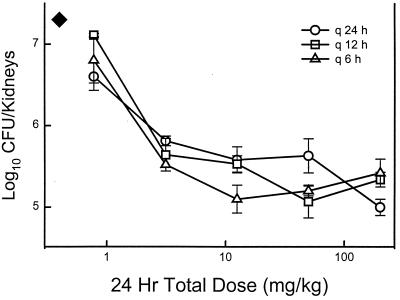
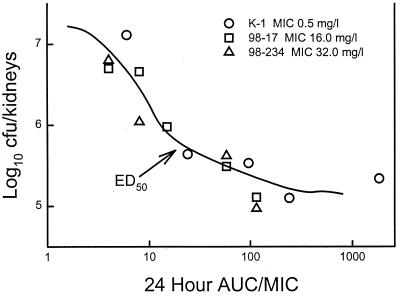
We determined the pharmacodynamic parameter and the magnitude of that parameter that was predictive of the efficacy of fluconazole in the treatment of disseminated candidiasis. We used a neutropenic murine model of disseminated Candida albicans infection to characterize the time course of activity of fluconazole. Quantitation of colony counts in kidneys after 24 h of therapy with a wide range of doses and three dosing intervals was used to determine the dose required to achieve 50% of the maximal effect (ED(50)). The ED(50) was similar for each of the dosing intervals studied, supporting the area under the concentration-time curve (AUC) MIC ratio as the parameter that predicts the efficacy of fluconazole. Similar studies were performed with C. albicans strains for which fluconazole MICs are in the susceptible-dose-dependent range (MICs, 16 to 32 mg/liter). We found that the magnitude of the AUC/MIC ratio required to reach the ED(50) was similar for all three organisms studied, ranging from 12 to 25. When the pharmacokinetics of fluconazole in humans are considered, these AUC/MIC ratios would support in vitro susceptibility breakpoints of 8 mg/liter for dosages of 200 mg/day and susceptibility breakpoints of 16 to 32 mg/liter for dosages of 400 to 800 mg/day.
Figures
References
-
- Anaissie E J, Karyotakis N C, Hachem R, Dignani M C, Rex J H, Paetznick V. Correlation between in vitro and in vivo activity of antifungal agents against Candida species. J Infect Dis. 1994;170:384–389. - PubMed
-
- Blaser J, Stone B B, Groner M C, Zinner S H. Comparative study with enoxacin and netilmicin in a pharmacodynamic model to determine importance of ratio of antibiotic peak concentration to MIC for bactericidal activity and emergence of resistance. Antimicrob Agents Chemother. 1987;31:1054–1060. - PMC - PubMed
-
- Brammer K W, Farrow P R, Faulkner J K. Pharmacokinetics and tissue penetration of fluconazole in humans. Rev Infect Dis. 1990;12(Suppl. 3):318–326. - PubMed
-
- Craig W A, Gudmundsson S. Postantibiotic effect. In: Lorlan V, editor. Antibiotics in laboratory medicine. 4th ed. Baltimore, Md: The Williams & Wilkins Co.; 1996. pp. 296–329.
Publication types
MeSH terms
Substances
LinkOut - more resources
Full Text Sources
Medical
