. 1999 Sep;43(9):2256-62.
doi: 10.1128/AAC.43.9.2256.

Histatin 3-mediated killing of Candida albicans: effect of extracellular salt concentration on binding and internalization

Affiliations

Histatin 3-mediated killing of Candida albicans: effect of extracellular salt concentration on binding and internalization

Y Xu et al. Antimicrob Agents Chemother. 1999 Sep.

Abstract

Human saliva contains histidine-rich proteins, histatins, which have antifungal activity in vitro. The mechanism by which histatins are able to kill Candida albicans may have clinical significance but is currently unknown. Using radiolabeled histatin 3, we show that the protein binds to C. albicans spheroplasts in a manner that is dependent on time and concentration. Binding to the spheroplasts was saturable and could be competed with unlabeled histatin 3. A single histatin 3 binding site with a K(d) = 5.1 microM was detected. Histatin 3 binding resulted in potassium and magnesium efflux, predominantly within the first 30 min of incubation. Studies with fluorescent histatin 3 demonstrate that the protein is internalized by C. albicans and that translocation of histatin inside the cell is closely associated with cell death. Histatin binding, internalization, and cell death are accelerated in low-ionic-strength conditions. Indeed, a low extracellular salt concentration was essential for cell death to occur, even when histatin 3 was already bound to the cell. The interaction of histatin 3 with C. albicans, and subsequent cell death, is inhibited at low temperature. These results demonstrate that the candidacidal activity of histatin 3 is not due exclusively to binding at the cell surface but also involves subsequent interactions with the cell.


Figures
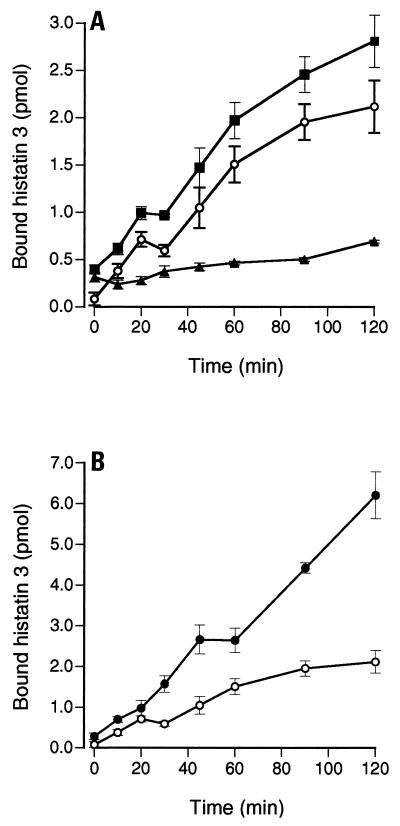
FIG. 1
FIG. 1
Time course of [14C]histatin 3 binding to C. albicans in PBS and 35 mM PBS. (A) A total of 2 × 10⁵ spheroplasts (CA8621) were incubated in 2 μM labeled histatin in PBS (pH 7.0), at 30°C, for up to 120 min. After the cells were washed, the total amount of bound [14C]histatin 3 was calculated (■). In order to measure the nonspecific binding of histatin 3 to C. albicans spheroplasts, the same reaction mixtures were prepared with the addition of 400 μM unlabeled histatin 3 protein (▴). Hence, the specific binding of [14C]histatin 3 was calculated to be the total binding minus the nonspecific binding (○). (B) Specific binding of [14C]histatin 3 in 35 mM PBS (●) and in PBS (○). The data shown are the means of at least two experiments performed in triplicate ± standard errors of the means.
FIG. 2
FIG. 2
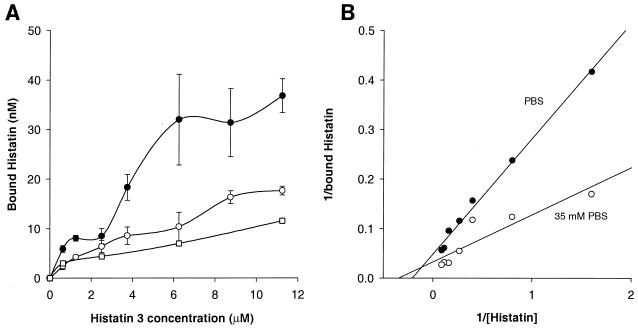
Characteristics of initial [14C]histatin 3 binding to C. albicans spheroplasts. A total of 2 × 10⁵ spheroplasts were incubated for 10 min with 0 to 11.25 μM [14C]histatin 3. The assays were performed in PBS at 4°C (□) and 30°C (○) and in 35 mM PBS at 30°C (●). Nonspecific binding was determined by the addition of a 100-fold excess concentration of unlabeled histatin 3. (A) Specific binding under these conditions (means of three experiments ± standard errors of the means). (B) Data collected at 30°C are shown as Lineweaver-Burke plots, from which the dissociation constant and maximal binding were calculated. The Kd of histatin 3 in PBS and 35 mM PBS was 5.1 and 2.52 μM, respectively. The maximal binding (Vmax) of histatin 3 was 22.85 and 28.9 nM, respectively.
FIG. 3
FIG. 3
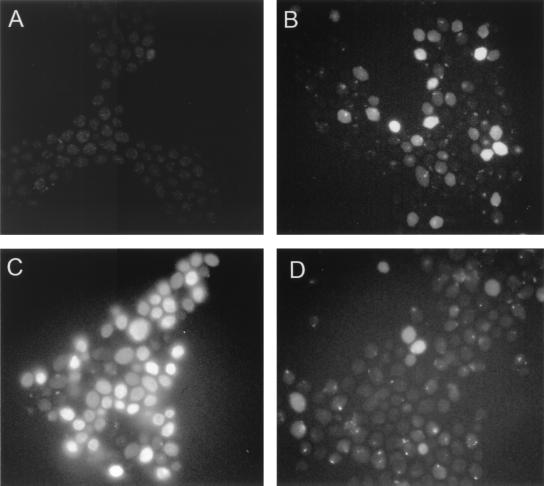
Binding of fluorescently labeled histatin 3 to C. albicans. Freshly prepared C. albicans spheroplasts were incubated at 30°C in the presence of 12 μM F-histatin 3. Progressive binding of histatin to the cells was seen in 35 mM PBS at 10 min (A), 45 min (B), and 90 min (C). Little binding of histatin 3 to Candida was observed in PBS by the 90-min point (D). The binding of F-histatin 3 to the cells could be eliminated by competition with unlabeled histatin 3 (data not shown). The same film exposure was used for each panel of the figure.
FIG. 4
FIG. 4
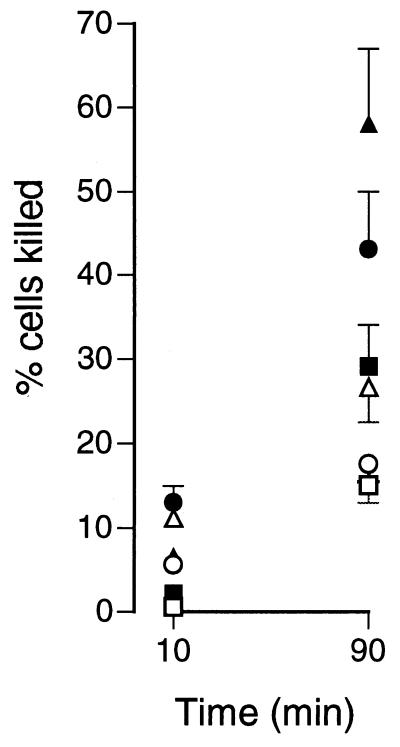
Histatin 3-induced killing of C. albicans. Whole C. albicans cells were treated with increasing concentrations of histatin 3 in PBS or 35 mM PBS, for 10 or 90 min, at 37°C. The viability of Candida after treatment was determined by plating the cells onto Sabouraud dextrose agar and then counting the number of colonies after 48 h. The percentage of cells killed was calculated as [1 − (number with histatin/number without histatin)] × 100. Results are shown for cells incubated in PBS plus 12.5 (□), 25 (○), and 50 (▵) μM histatin 3 and for cells incubated in 35 mM PBS plus 12.5 (■), 25 (●), and 50 (▴) μM histatin 3. The data are from a representative experiment performed in triplicate (means ± standard errors of the means).
FIG. 5
FIG. 5
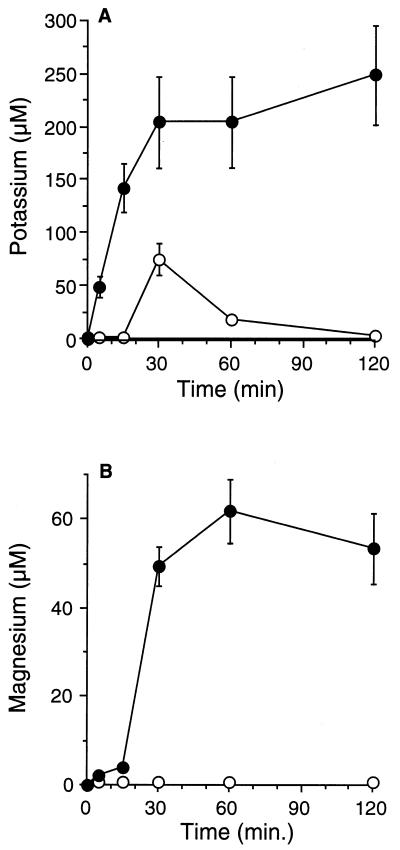
Kinetics of potassium and magnesium efflux from C. albicans. Efflux of potassium (A) and magnesium (B) from C. albicans during incubation with 100 μM histatin 3. Potassium and magnesium release was significantly increased when cells were incubated with histatin 3 (●), compared with incubation with water only (○) (P ≤ 0.0001 [analysis of variance]; values are shown as means ± standard errors of the means).
FIG. 6
FIG. 6
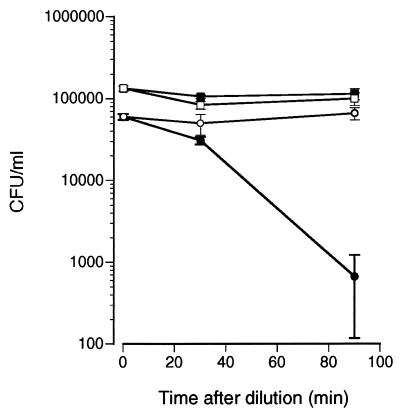
Effect of extracellular ion concentration on C. albicans viability after binding of histatin 3. Whole C. albicans cells were first treated with 50 μM histatin 3 for 60 min in PBS. Control cells were incubated without histatin 3. Treated and control cells were washed once in PBS and then diluted approximately 10-fold in either PBS or water. Cell viability was measured immediately after dilution and then measured again 30 and 90 min later. The figure shows the number of CFU ± standard errors of the means of a representative experiment performed in triplicate. ○, histatin 3-treated cells in PBS; ●, histatin 3-treated cells in water; □, control cells in PBS; ■, control cells in water.
FIG. 7
FIG. 7
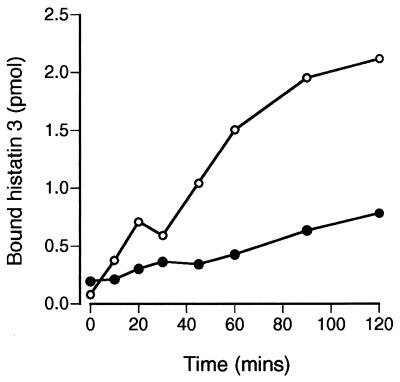
[14C]histatin 3 binding to C. albicans is temperature dependent. Binding of [14C]histatin 3 to spheroplasts was determined at 30 and 0°C. A total of 2 × 10⁵ cells were incubated in 35 mM PBS containing 2 μM labeled histatin 3 for 0 to 120 min. The specific binding of [14C]histatin 3 was calculated at 0°C (●) and 30°C (○). The data are derived from triplicate measurements in two experiments.
FIG. 8
FIG. 8
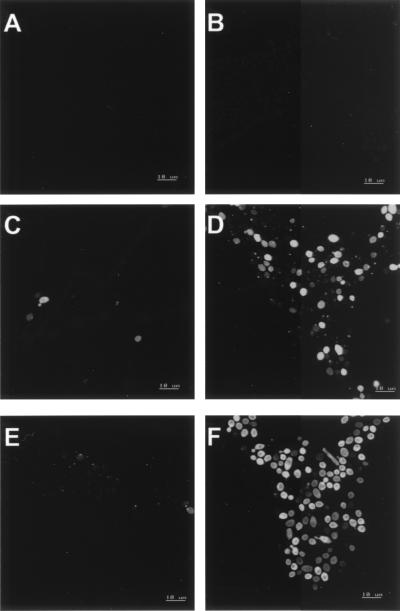
Internalization of histatin 3 by C. albicans is temperature dependent. Whole cells were treated with fluorescently labeled histatin 3 at either 0 or 30°C, in 35 mM PBS. After rinsing and fixation of the cells, 0.2-μm optical sections were generated for each sample. By using a similar instrument gain, the most positive section representing each experimental condition was selected: 10 min at 0°C (A), 10 min at 30°C (B), 45 min at 0°C (C), 45 min at 30°C (D), 90 min at 0°C (E), and 90 min at 30°C (F).
FIG. 9
FIG. 9
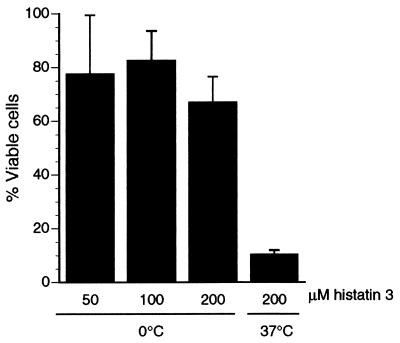
C. albicans is resistant to histatin 3-mediated killing at low temperatures. C. albicans cells were treated with up to 200 μM histatin 3 at 0 or 37°C, and their viability was determined by measuring colony formation. Control cells were incubated without histatin. The percentage of viable cells was calculated as (number with histatin/number without histatin) × 100. The data shown are the means from triplicate measurements in two experiments ± standard errors of the means.

References

    1. Azen E A, Leutenegger W, Peters E H. Evolutionary and dietary aspects of salivary basic (Pb) and post Pb (PPb) proteins in anthropod primates. Nature. 1978;273:775–778. - PubMed
    1. Balekjian A Y, Longton R W. Histones isolated from human parotid fluid. Biochem Biophys Res Commun. 1973;50:676–682. - PubMed
    1. Brant E C, Santarpia R P, Pollock J J. Role of pH in salivary histidine-rich polypeptide antifungal germ tube inhibitory activity. Oral Microbiol Immunol. 1990;5:336–339. - PubMed
    1. Dawes C. The effects of flow rate and duration of stimulation on the concentrations of protein and the main electrolytes in human submandibular saliva. Arch Oral Biol. 1974;19:887–895. - PubMed
    1. De Lucca A J, Walsh T J. Antifungal peptides: novel therapeutic compounds against emerging pathogens. Antimicrob Agents Chemother. 1999;43:1–11. - PMC - PubMed

Publication types

LinkOut - more resources