Review
. 1999 Sep;43(9):2307-10.
doi: 10.1128/AAC.43.9.2307.

Cefoperazone prevents the inactivation of alpha(1)-antitrypsin by activated neutrophils

Affiliations
Review

Cefoperazone prevents the inactivation of alpha(1)-antitrypsin by activated neutrophils

F Dallegri et al. Antimicrob Agents Chemother. 1999 Sep.

Abstract

At sites of neutrophilic inflammation, tissue injury by neutrophil elastase is favored by phagocyte-induced hypochlorous acid-dependent inactivation of the natural elastase inhibitor alpha(1)-antitrypsin. In the present study, cefoperazone prevented alpha(1)-antitrypsin inactivation by neutrophils and reduced the recovery of hypochlorous acid from these cells. Moreover, the antibiotic reduced the free elastase activity in a neutrophil suspension supplemented with alpha(1)-antitrypsin without affecting the cells' ability to release elastase. These data suggest that the drug inactivates hypochlorous acid before its reaction with alpha(1)-antitrypsin, thereby permitting the antiprotease-mediated blockade of released elastase. In conclusion, cefoperazone appears to have the potential for limiting elastase-antielastase imbalances, attenuating the related tissue injury at sites of inflammation.


Figures
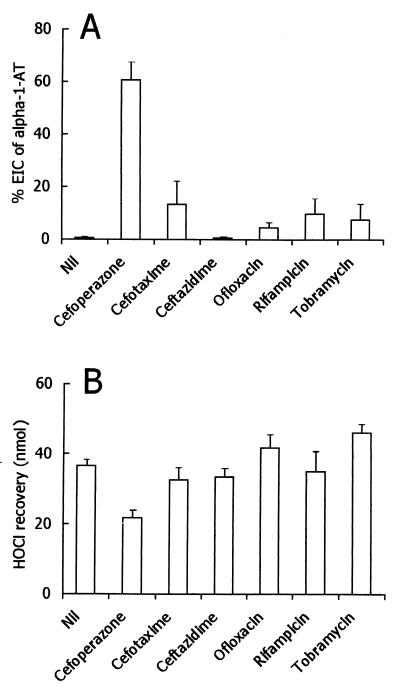
FIG. 1
FIG. 1
Effects of various antibiotics on inactivation of α1-AT by neutrophils and on HOCl recovery from activated cells. Each antibiotic was tested at 100 μg/ml, i.e., at micromolar concentrations of 155 (cefoperazone), 219 (cefotaxime), 183 (ceftazidime), 277 (ofloxacin), 122 (rifampin), and 214 (tobramycin). (A) Inactivation of α1-AT in the presence of various antibiotics. Results are expressed as means ± 1 standard error of the mean of four or five determinations, depending on the antibiotic. Nil (no antibiotic) versus cefoperazone, P < 0.01; Nil versus other compounds, P > 0.05 (Kruskal-Wallis nonparametric analysis-of-variance test followed by Dunn’s multiple comparisons). EIC, elastase inhibitory capacity. (B) Effects of various antibiotics on HOCl recovery from 106 neutrophils. Results are expressed as means ± 1 standard error of the mean of three to seven determinations, depending on the antibiotic. Nil versus cefoperazone, P < 0.05; Nil versus other antibiotics, P > 0.05 (Kruskal-Wallis nonparametric analysis-of-variance test followed by Dunn’s multiple comparisons).
FIG. 2
FIG. 2
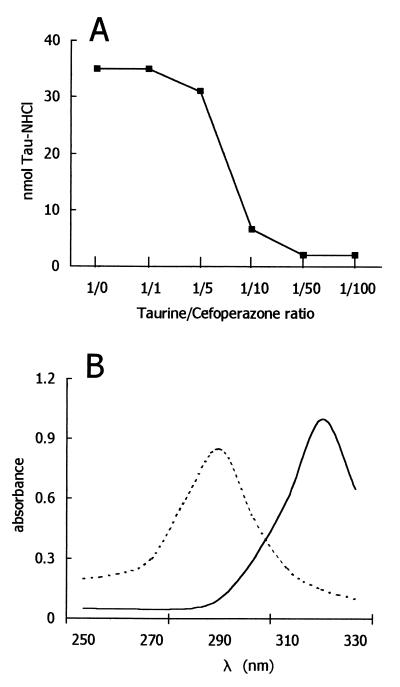
Cell-free interactions between HOCl and cefoperazone. (A) Effects of different doses of cefoperazone on the recovery of taurine monochloramine (Tau-NHCl) from a mixture of HOCl and taurine. The experiments were carried out by adding ∼35 nmol of HOCl to mixtures of taurine plus cefoperazone (final volume of 1 ml). The taurine concentration was 100 μM (constant). (B) Absorbance spectrum of HOCl alone (- - - ) and in presence of cefoperazone (—). HOCl and cefoperazone concentrations were 1 mM in phosphate-buffered saline, pH 7.4; final solution, pH 7.4.
FIG. 3
FIG. 3
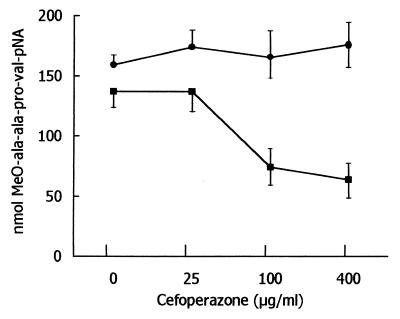
Effects of various doses of cefoperazone on elastase activity detectable in supernatants of neutrophils incubated in the presence (■) or absence (●) of α1-AT (3.5 μg) under the following conditions: neutrophils, 2 × 10⁵; phorbol myristate acetate, 10 ng/ml; final volume, 175 μl; and incubation time, 60 min. Results are expressed as nanomoles of substrate cleaved per hour by supernatants of neutrophils (mean ± 1 standard error of the mean, n – 4).
FIG. 4
FIG. 4
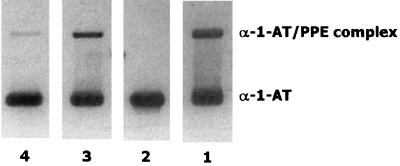
Analysis of the interaction of α1-AT incubated with HOCl in the presence of cefoperazone or cefotaxime. The experiments were carried out by adding HOCl (80 μM) to mixtures of α1-AT (50 μg/ml) plus cefoperazone or cefotaxime (100 μg/ml). After incubation (15 min), the preparations were treated with methionine, and aliquots containing 4 μg of α1-AT were incubated with 1.6 μg of PPE for 30 min and analyzed by SDS-PAGE. Lane 1, α1-AT plus PPE; lane 2, HOCl plus α1-AT and PPE; lane 3, HOCl plus cefoperazone, α1-AT, and PPE; lane 4, HOCl plus cefotaxime, α1-AT, and PPE.

References

    1. Abbink J J, Kamp A M, Nuijens J H, Swaak T J G, Hack E C. Proteolytic inactivation of α1-antitrypsin and α1-antichymotrypsin by neutrophils in arthritic joints. Arthritis Rheum. 1993;36:168–180. - PubMed
    1. Cantin A, Woods D E. Protection by antibiotics against myeloperoxidase-dependent cytotoxicity to lung epithelial cells in vitro. J Clin Investig. 1993;91:38–45. - PMC - PubMed
    1. Carreer R, Deby-Dupont G, Deby C, Jadoul L, Mathy M. Oxidant-scavenging activities of beta-lactam agents. Eur J Clin Microbiol Infect Dis. 1998;17:43–46. - PubMed
    1. Carrell R W. Alpha-1-antitrypsin: molecular pathology, leukocytes and tissue damage. J Clin Investig. 1986;78:1427–1431. - PMC - PubMed
    1. Clark R A, Stone P J, Hag A E, Calore J D, Franzblau C. Myeloperoxidase-catalyzed inactivation of α1-protease inhibitor by human neutrophils. J Biol Chem. 1981;256:3348–3353. - PubMed

Publication types

MeSH terms

LinkOut - more resources