. 1999 Sep;65(9):3774-9.
doi: 10.1128/AEM.65.9.3774-3779.1999.

Role of Ngamma-acetyldiaminobutyrate as an enzyme stabilizer and an intermediate in the biosynthesis of hydroxyectoine

Affiliations

Role of Ngamma-acetyldiaminobutyrate as an enzyme stabilizer and an intermediate in the biosynthesis of hydroxyectoine

D Cánovas et al. Appl Environ Microbiol. 1999 Sep.

Abstract

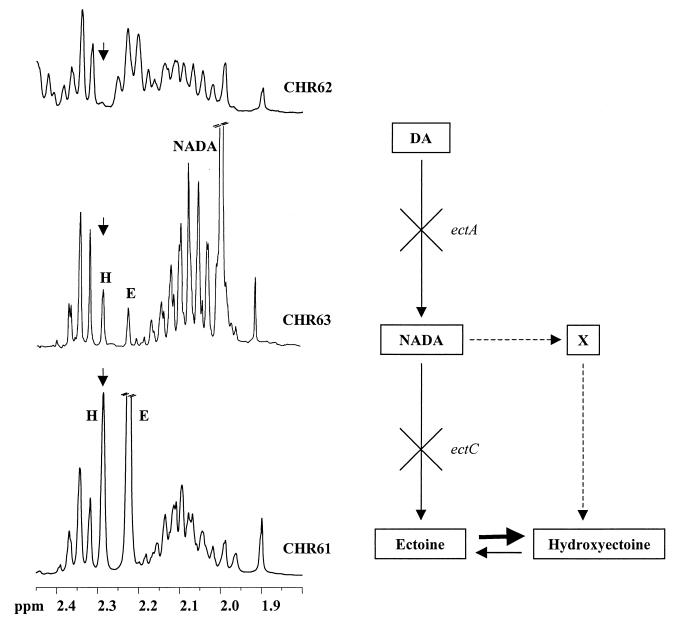
Strain CHR63 is a salt-sensitive mutant of the moderately halophilic wild-type strain Halomonas elongata DSM 3043 that is affected in the ectoine synthase gene (ectC). This strain accumulates large amounts of Ngamma-acetyldiaminobutyrate (NADA), the precursor of ectoine (D. Cánovas, C. Vargas, F. Iglesias-Guerra, L. N. Csonka, D. Rhodes, A. Ventosa, and J. J. Nieto, J. Biol. Chem. 272:25794-25801, 1997). Hydroxyectoine, ectoine, and glucosylglycerate were also identified by nuclear magnetic resonance (NMR) as cytoplasmic organic solutes in this mutant. Accumulation of NADA, hydroxyectoine, and ectoine was osmoregulated, whereas the levels of glucosylglycerate decreased at higher salinities. The effect of the growth stage on the accumulation of solutes was also investigated. NADA was purified from strain CHR63 and was shown to protect the thermolabile enzyme rabbit muscle lactate dehydrogenase against thermal inactivation. The stabilizing effect of NADA was greater than the stabilizing effect of ectoine or potassium diaminobutyrate. A (1)H NMR analysis of the solutes accumulated by the wild-type strain and mutants CHR62 (ectA::Tn1732) and CHR63 (ectC::Tn1732) indicated that H. elongata can synthesize hydroxyectoine by two different pathways-directly from ectoine or via an alternative pathway that converts NADA into hydroxyectoine without the involvement of ectoine.


Figures

FIG. 1
FIG. 1
Ectoine biosynthetic pathway. See reference . The genes for the three enzymes involved in ectoine synthesis, DA acetyltransferase, l-DA transaminase, and ectoine synthase, are designated ectA, ectB, and ectC, respectively (3). CoA, coenzyme A.
FIG. 2
FIG. 2
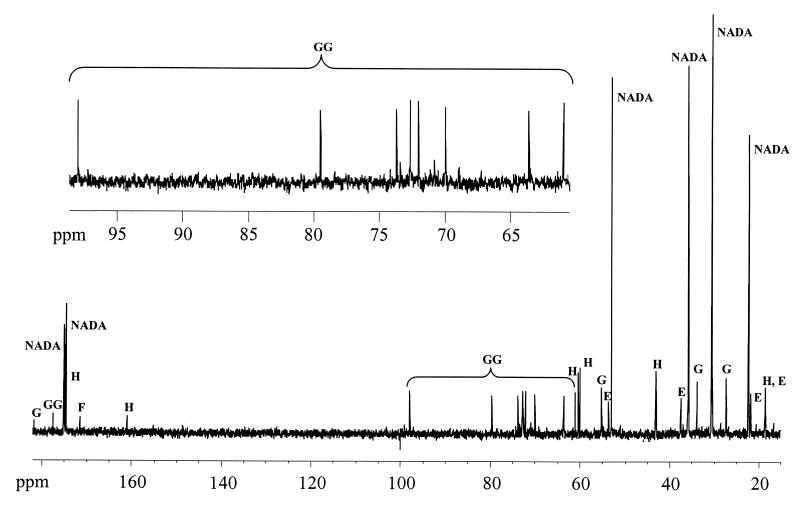
13C NMR spectrum of the crude extract of H. elongata mutant strain CHR63 grown in M63 medium supplemented with 1.5 M NaCl. The major solutes were NADA, hydroxyectoine (H), ectoine (E), glutamate (G), and glucosylglycerate (GG). Formate (F) was added to the sample as an internal concentration standard.
FIG. 3
FIG. 3
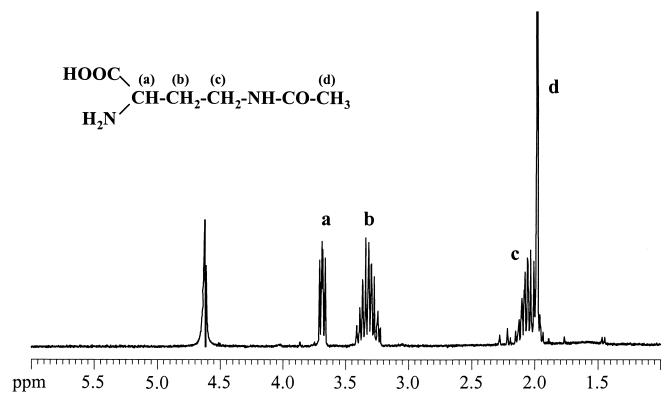
1H NMR (300-MHz) spectrum of NADA after purification from H. elongata CHR63.
FIG. 4
FIG. 4
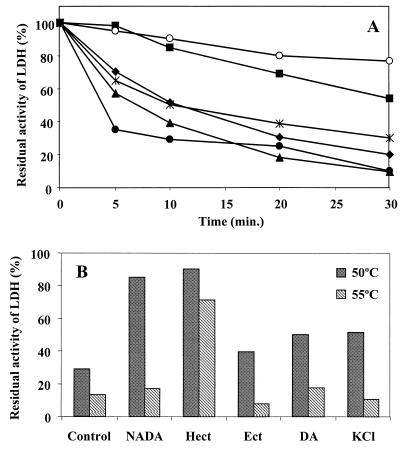
Effects of NADA (■), ectoine (Ect) (▴), hydroxyectoine (Hect) (○), potassium DA (✠), and potassium chloride (⧫) on thermal inactivation of rabbit muscle LDH. (A) The enzyme was incubated at 50°C in the absence (●) or in the presence of one of the solutes, and samples were withdrawn at different times. (B) The enzyme was incubated at 50 or 55°C for 10 min in the presence or in the absence of one of the solutes. The activity of the enzyme was immediately assayed. Values are expressed as percentages of activity compared to the activity of the enzyme incubated at room temperature. All of the results are averages of the values from at least two independent experiments. The standard deviation was equal to or less than 10%.
FIG. 5
FIG. 5
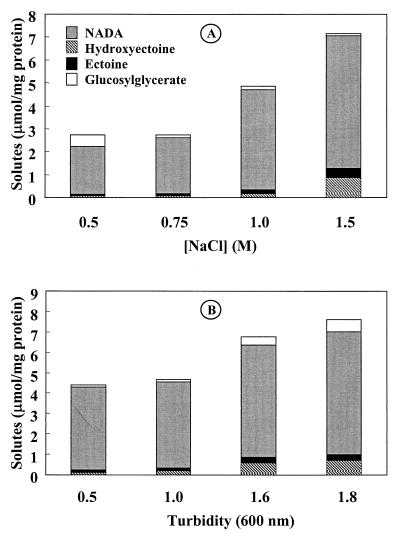
Accumulation of solutes in H. elongata CHR63. (A) Cells were grown in M63 medium supplemented with different salt concentrations and samples were withdrawn in the late exponential phase. (B) Cells were grown in M63 medium supplemented with 1.0 M NaCl, and samples were taken at different growth stages. Turbidity (OD600) values of 0.5 and 1.0 correspond to the early and late exponential phases of growth, respectively, and values of 1.6 and 1.8 correspond to the stationary phase. The solutes were identified and quantified by 1H NMR by using ethanol cell extracts. The values are the means of values from at least two independent determinations, and the individual values did not differ by more than 20%.
FIG. 6
FIG. 6
1H NMR (300-MHz) spectra of ethanol extracts of H. elongata salt-sensitive mutant strains CHR62 (ectA::Tn1732) and CHR63 (ectC::Tn1732) and of CHR61 (wild-type strain) grown in M63 medium supplemented with 0.65 M NaCl. The arrows indicate the position of the hydroxyectoine resonance. Abbreviations: H, hydroxyectoine; E, ectoine. The biosynthetic pathway for ectoines from DA is also shown. The solid and dashed lines indicate established and proposed steps, respectively. The letter X represents an intermediate in hydroxyectoine biosynthesis that has not been identified so far.

References

    1. Bradford M M. A rapid and sensitive method for the quantitation of microgram quantities of protein utilizing the principle of protein-dye binding. Anal Biochem. 1976;72:248–254. - PubMed
    1. Brown A D. Microbial water stress. Bacteriol Rev. 1976;40:803–846. - PMC - PubMed
    1. Cánovas D, Vargas C, Calderón M I, Ventosa A, Nieto J J. Characterization of the genes for the biosynthesis of the compatible solute ectoine in the moderately halophilic bacterium Halomonas elongata DSM 3043. Syst Appl Microbiol. 1998;21:487–497. - PubMed
    1. Cánovas D, Vargas C, Csonka L N, Ventosa A, Nieto J J. Osmoprotectants in Halomonas elongata: high-affinity betaine transport system and choline-betaine pathway. J Bacteriol. 1996;178:7221–7226. - PMC - PubMed
    1. Cánovas D, Vargas C, Csonka L N, Ventosa A, Nieto J J. Synthesis of glycine betaine from exogenous choline in the moderately halophilic bacterium Halomonas elongata. Appl Environ Microbiol. 1998;64:4095–4097. - PMC - PubMed

Publication types

LinkOut - more resources