


Expression of the isoamylase gene of Flavobacterium odoratum KU in Escherichia coli and identification of essential residues of the enzyme by site-directed mutagenesis
- PMID: 10473430
- PMCID: PMC99755
- DOI: 10.1128/AEM.65.9.4163-4170.1999
Expression of the isoamylase gene of Flavobacterium odoratum KU in Escherichia coli and identification of essential residues of the enzyme by site-directed mutagenesis
Abstract
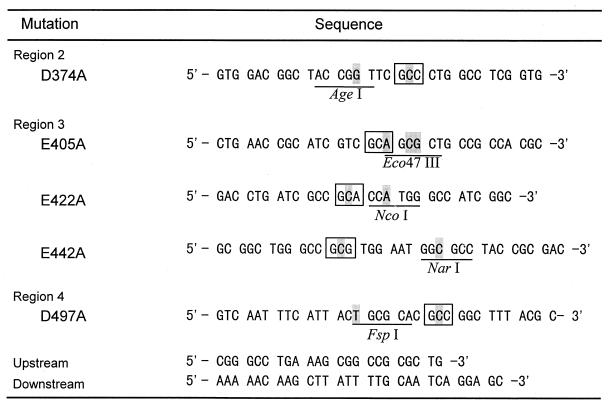
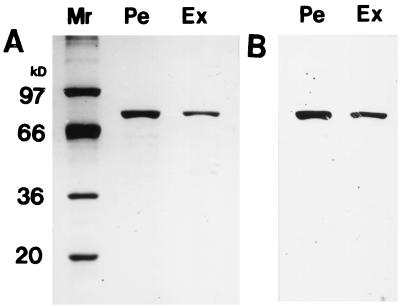
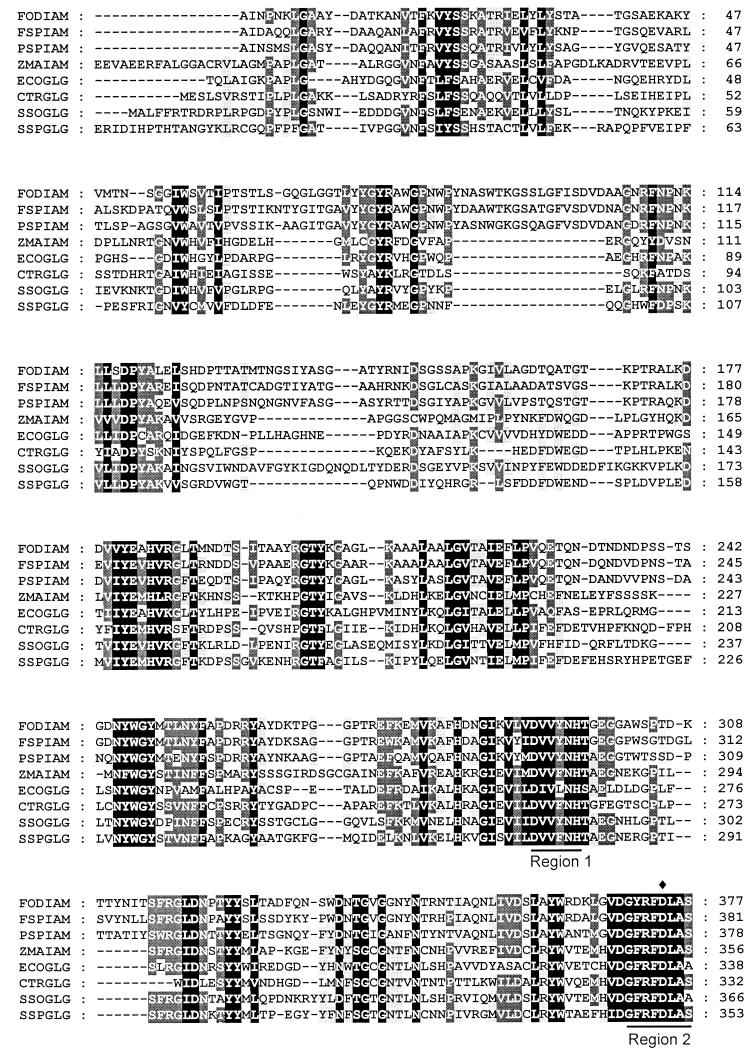
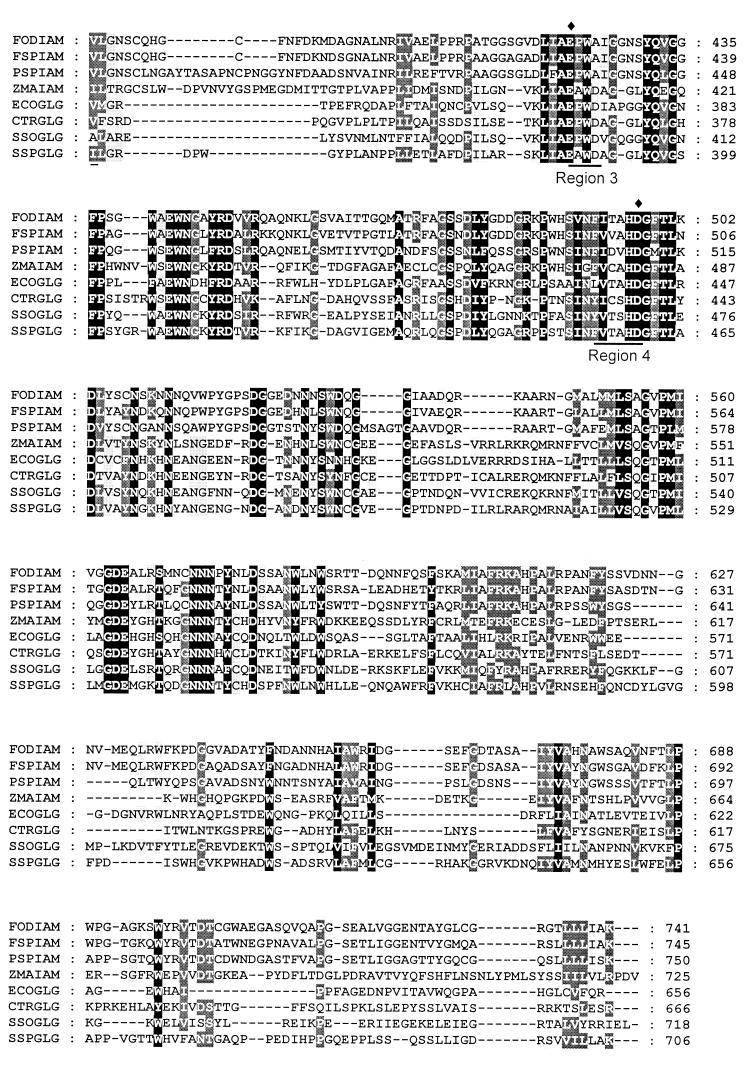
The isoamylase gene from Flavobacterium odoratum KU was cloned into and expressed in Escherichia coli JM109. The promoter of the gene was successful in E. coli, and the enzyme produced was excreted into the culture medium, depending on the amount of the enzyme expressed. The enzyme found in the culture medium showed almost the same M(r), heat-inactivating constant, and N-terminal sequence as those of the enzyme accumulated in the periplasmic space. This result indicated that the enzyme accumulated in an active form at the periplasm was transported out of the cell. The primary sequence of the enzyme, which was deduced from its nucleotide sequence, showed that the mature enzyme consisted of 741 amino acid residues. By changing five possible residues to Ala independently, it was found that Asp-374, Glu-422, and Asp-497 were essential. The sequences around those residues were highly conserved in isoamylases of different origins and the glycogen operon protein X, GlgX. The comparison of the distance between these essential residues with those of various amylases suggested that the bacterial and plant isoamylase but not GlgX had a longer fourth loop than the other amylases. This longer fourth loop had a possible role in accommodating the long branched chains of native glycogens and starches.
Figures
References
-
- Abe J, Mizowaki N, Hizukuri S, Koizumi K, Utamura T. Synthesis of branched cyclomalto-oligosaccharides using Pseudomonas isoamylase. Carbohydr Res. 1986;154:81–92. - PubMed
-
- Abe J, Shibata Y, Fujisue M, Hizukuri S. Expression of periplasmic α-amylase of Xanthomonas campestris K-11151 in Escherichia coli and its action on maltose. Microbiology. 1996;142:1505–1512. - PubMed
-
- Amemura A, Chakraborty R, Fujita M, Noumi T, Futai M. Cloning and nucleotide sequence of the isoamylase gene from Pseudomonas amyloderamosa SB-15. J Biol Chem. 1988;263:9271–9275. - PubMed
-
- Ara K, Saeki K, Ito S. Purification and characterization of an alkaline isoamylase from an alkalophilic strain of Bacillus. J Gen Microbiol. 1993;139:781–786.
-
- Barsomian G D, Johnson T L, Borowski M, Denman J, Ollington J, Hirani S, McNeilly D S, Rasmussen J R. Cloning and expression of peptide-N4-(N-acetyl-beta-D-glucosaminyl)asparagine amidase F in Escherichia coli. J Biol Chem. 1990;265:6967–6972. - PubMed
Publication types
MeSH terms
Substances
Associated data
- Actions
LinkOut - more resources
Full Text Sources
Other Literature Sources
