


doi: 10.1128/AEM.65.9.4234-4238.1999.
Clostridium difficile cell attachment is modified by environmental factors
Affiliations
- PMID: 10473442
- PMCID: PMC99767
- DOI: 10.1128/AEM.65.9.4234-4238.1999
Item in Clipboard
Clostridium difficile cell attachment is modified by environmental factors
Appl Environ Microbiol.
1999 Sep.
Free PMC article
Abstract
Adherence of Clostridium difficile to Vero cells under anaerobic conditions was increased by a high sodium concentration, calcium-rich medium, an acidic pH, and iron starvation. The level of adhesion of nontoxigenic strains was comparable to that of toxigenic strains. Depending on the bacterial culture conditions, Vero cells could bind to one, two, or three bacterial surface proteins with molecular masses of 70, 50, and 40 kDa.
Figures
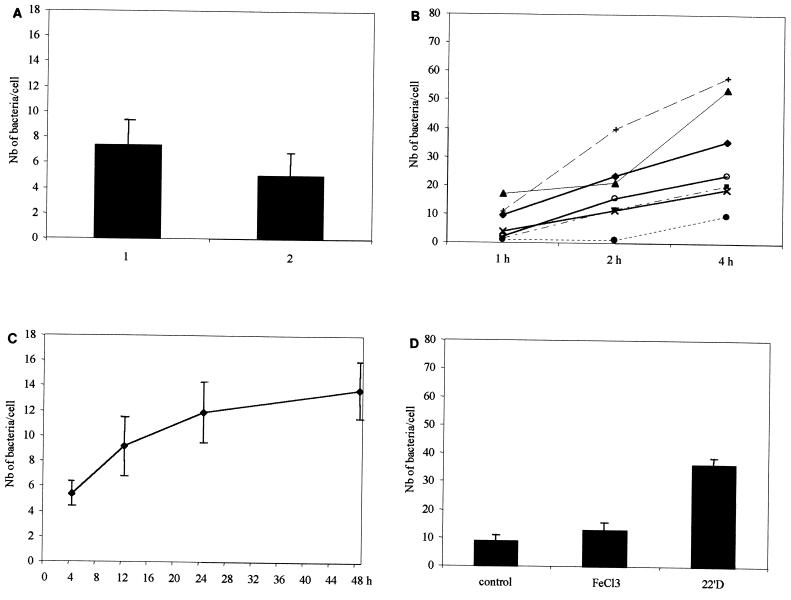
(A) Adherence of C. difficile to Vero cells
under anaerobic conditions (part 1) or after a heat shock under aerobic
(with CO2) conditions (part 2). (B) Adherence to Vero cells
of seven C. difficile strains as a function of time. Symbols
for toxigenic strains: ⧫, 79-685; ■, VPI-10409. Symbols for
nontoxigenic strains: ▴, 90-111; ×, 93-136; ○, 93-226; ●,
93-296; +, 93-379. (C) Effect of growth phase on the adherence of
C. difficile to Vero cells. (D) Effect of iron in the
culture medium on the adherence of C. difficile to Vero
cells. The control was TGY, the concentration of FeCl3 was
50 μM, and that of 2,2′-dipyridyl (22′D) was 200 μM. Nb, number.
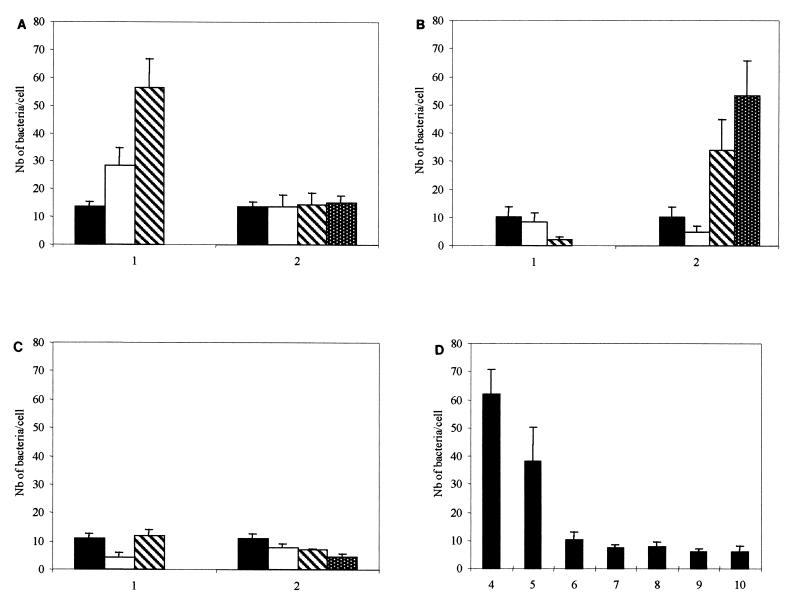
Effects of cations and pH on C. difficile
adherence to Vero cells. (A) Part 1, NaCl concentrations in growth
medium: ■ (control [TGY broth]), 50 mM; □, 150 mM; ▧, 500 mM.
Part 2, NaCl concentrations in adhesion medium: ■, control; □, 50
mM; ▧, 150 mM; ▩, 500 mM. (B) Part 1, CaCl2
concentrations in growth medium: ■ (control [TGY broth]), 1 mM;
□, 12.5 mM; ▧, 25 mM. Part 2, CaCl2 concentration in
adhesion medium: ■, control; □, 1 mM; ▧, 12.5 mM; ▩, 25 mM. (C)
Part 1 MgCl2 concentrations in growth medium: ■ (control
[TGY broth]), 1 mM; □, 22.5 mM; ▧, 45 mM. Part 2,
MgCl2 concentrations in adhesion medium: ■, control; □,
1 mM; ▧, 22.5 mM; ▩, 45 mM. (D) Treatment of C.
difficile at pHs 4 to 10 before adhesion assay. Nb, number.
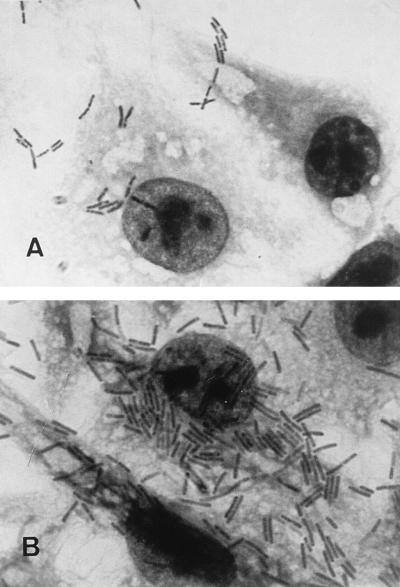
Patterns of C. difficile adherence to Vero
cells examined by light microscopy (magnification, ×1,000). Panels: A,
control (C. difficile treated at pH 7.0 before adhesion
assay); B, C. difficile treated at pH 4 before adhesion
assay.
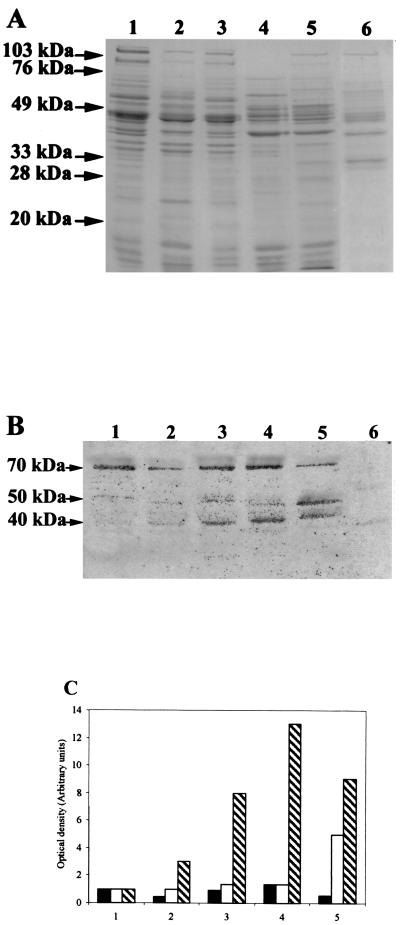
Adhesins involved in cell attachment. (A) Surface
proteins from C. difficile grown under various conditions
(sodium dodecyl sulfate-polyacrylamide gel electrophoresis). (B)
Proteins on membrane which bound Vero cells (autoradiography). (C)
Optical density determined by densitometric scanning of autoradiograms
for the 70-kDa (■), 50-kDa (□), and 40-kDa (▧) proteins
(expressed in comparison with the control). Lanes: 1, non-heat-shocked
C. difficile; 2, C. difficile heat shocked under
partial anaerobic conditions; 3, C. difficile treated at pH
4; 4, C. difficile grown in the presence of 200 μM
2,2′-dipyridyl; 5, C. difficile grown in the presence of 500
mM NaCl; 6, negative control (Clostridium indolis proteins
[nonadherent, normal-flora bacterial strain]).
References
-
- Borriello S P. Clostridium difficileand its toxins in the gastrointestinal tract in health and disease. Res Clin Forums. 1979;1:33–35.
-
- Borriello S P. Pathogenesis of Clostridium difficileinfection of the gut. J Med Microbiol. 1990;33:207–215. - PubMed
-
- Borriello S P, Davies H A, Barclay F E. Detection of fimbriae amongst strains of Clostridium difficile. FEMS Microbiol Lett. 1988;49:65–67.
-
- Borriello S P, Welch A R, Barclay F E, Davies M A. Mucosal association by Clostridium difficilein the hamster gastrointestinal tract. J Med Microbiol. 1988;25:191–196. - PubMed
Publication types
MeSH terms
Substances
LinkOut - more resources
Full Text Sources
Other Literature Sources
Molecular Biology Databases
