. 1999 Sep 6;190(5):651-67.
doi: 10.1084/jem.190.5.651.

An expanded peripheral T cell population to a cytotoxic T lymphocyte (CTL)-defined, melanocyte-specific antigen in metastatic melanoma patients impacts on generation of peptide-specific CTLs but does not overcome tumor escape from immune surveillance in metastatic lesions

Affiliations

An expanded peripheral T cell population to a cytotoxic T lymphocyte (CTL)-defined, melanocyte-specific antigen in metastatic melanoma patients impacts on generation of peptide-specific CTLs but does not overcome tumor escape from immune surveillance in metastatic lesions

A Anichini et al. J Exp Med. .

Abstract

It is not known if immune response to T cell-defined human histocompatibility leukocyte antigen (HLA) class I-restricted melanoma antigens leads to an expanded peripheral pool of T cells in all patients, affects cytotoxic T lymphocyte (CTL) generation, and correlates with anti-tumor response in metastatic lesions. To this end, a limiting dilution analysis technique was developed that allowed us to evaluate the same frequency of peptide-specific T cells as by staining T cells with HLA-peptide tetrameric complexes. In four out of nine patients, Melan-A/Mart-1(27-35)-specific CTL precursors (CTLp) were >/=1/2,000 peripheral blood lymphocytes and found mostly or only in the CD45RO(+) memory T cell subset. In the remaining five patients, a low (<1/40,000) peptide-specific CTLp frequency was measured, and the precursors were only in the CD45RA(+) naive T cell subset. Evaluation of CTL effector frequency after bulk culture indicated that peptide-specific CTLs could be activated in all patients by using professional antigen-presenting cells as dendritic cells, but CTLp frequency determined the kinetics of generation of specificity and the final number of effectors as evaluated by both limiting dilution analysis and staining with HLA-A*0201-Melan-A/Mart-1 tetrameric complexes. Immunohistochemical analysis of 26 neoplastic lesions from the nine patients indicated absence of tumor regression in most instances, even in patients with an expanded peripheral T cell pool to Melan-A/Mart-1 and whose neoplastic lesions contained a high frequency of tetramer-positive Melan-A/Mart-1-specific T cells. Furthermore, frequent lack of a "brisk" or "nonbrisk" CD3(+)CD8(+) T cell infiltrate or reduced/absent Melan-A/Mart-1 expression in several lesions and lack of HLA class I antigens were found in some instances. Thus, expansion of peripheral immune repertoire to Melan-A/Mart-1 takes place in some metastatic patients and leads to enhanced CTL induction after antigen-presenting cell-mediated selection, but, in most metastatic lesions, it does not overcome tumor escape from immune surveillance.


Figures
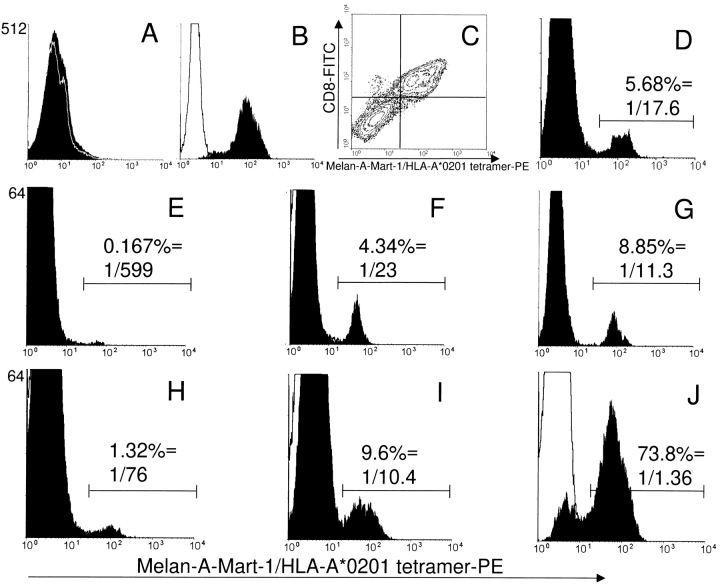
Figure 1
Figure 1
Identification of Melan-A/Mart-1–specific T cells in T cell lines from melanoma patients by Melan-A/Mart-126–35–HLA-A*0201 tetrameric complexes. Lymphocytes from peripheral blood of an HLA-A*0201 healthy donor (A) did not stain with the tetramer–PE, whereas 100% of cells from a Melan-A/Mart-127–35–specific CTL clone A83 (B) were tetramer positive. In a T cell line selected in vitro for Melan-A/Mart-127–35 specificity (from patient 2, week 5 of culture), all tetramer-positive cells were within the CD8+ subset (C). Fresh TILs from a subcutaneous metastatic lesion (lesion 3) of patient 1 contained 5.68% of tetramer-positive T cells (D). T cell lines from two melanoma patients were selected in vitro with Melan-A/Mart-127–35–loaded T2 line as APCs and analyzed for tetramer staining at different times during culture (E–J). A T cell line from patient 6 was analyzed on weeks 2 (E), 4 (F), and 8 (G) of culture, and a T cell line from patient 2 was analyzed on weeks 2 (H), 4 (I), and 6 (J) of culture. The proportion of Mart-126–35–HLA-A*0201 tetramer–PE-positive T cells in each line is shown together with conversion to frequency. At least 105 cells were analyzed in each panel. The proportion of CD3+ T cells was 97% in fresh TILs from patient 1 (D) and >99% in all T cell lines from the two patients (C, E–J), with the exception of the line shown in H (CD3+ = 78.4%).
Figure 2
Figure 2
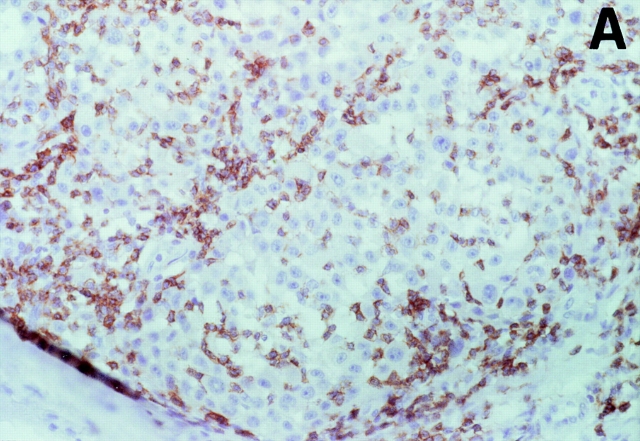
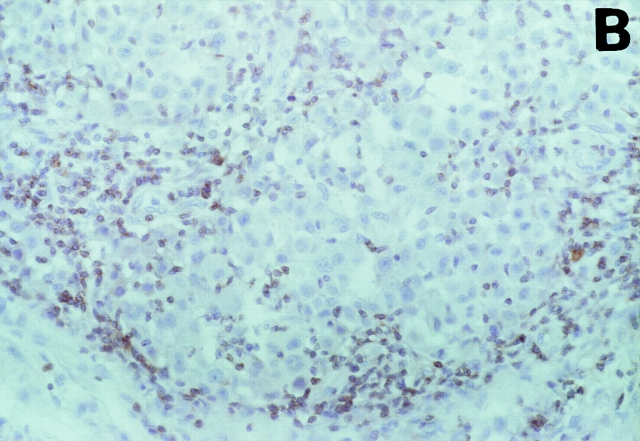
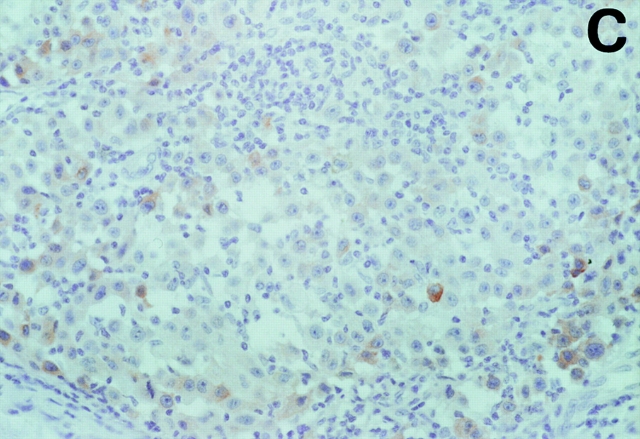
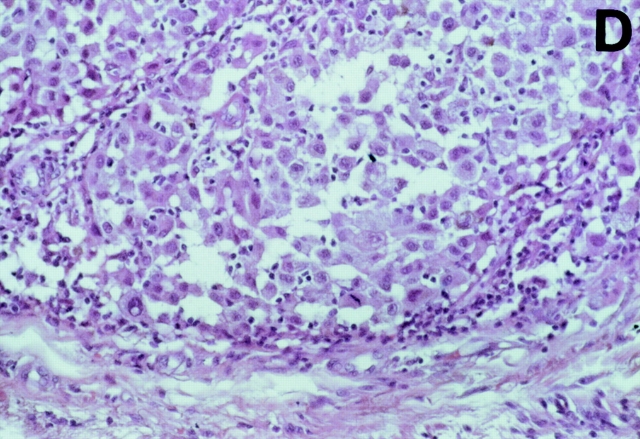
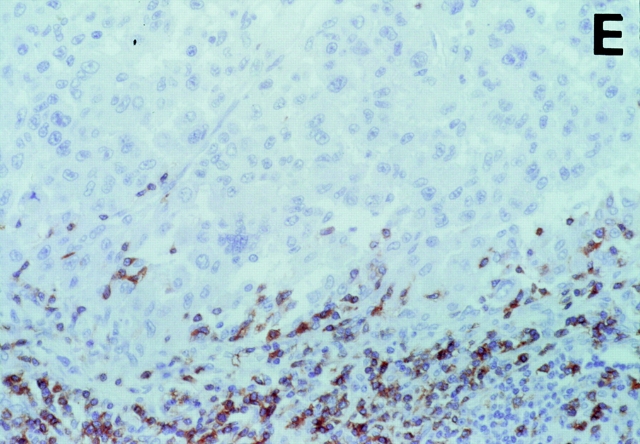
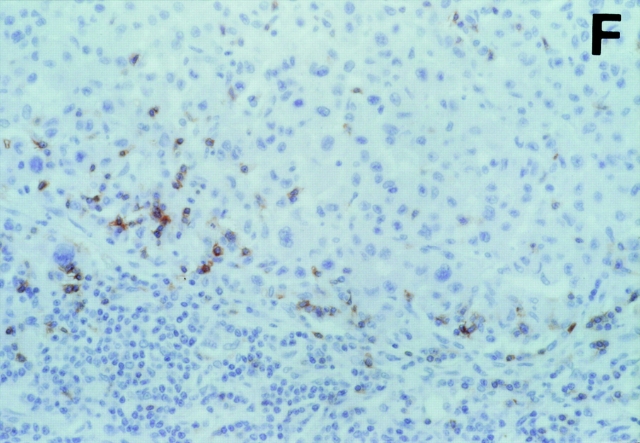
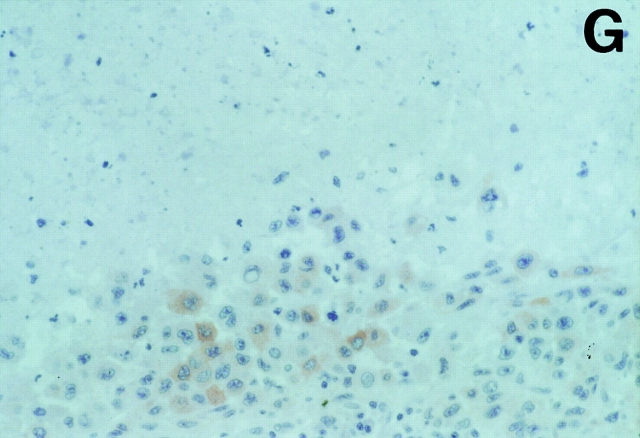
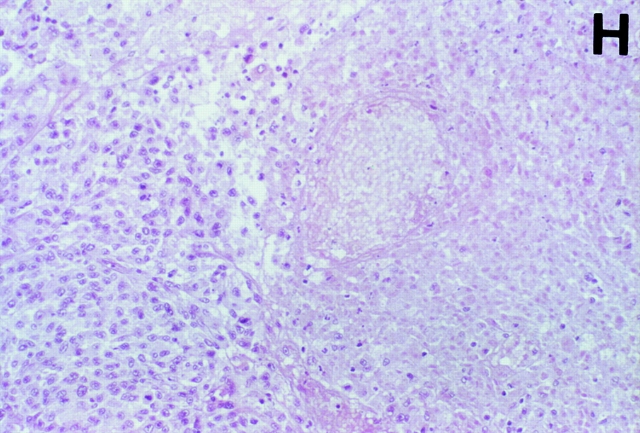
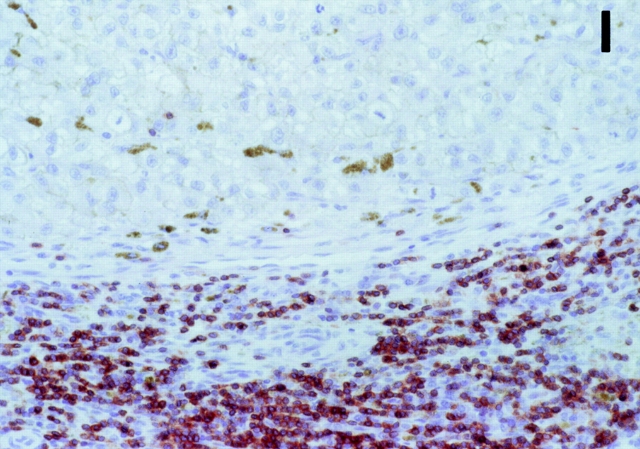
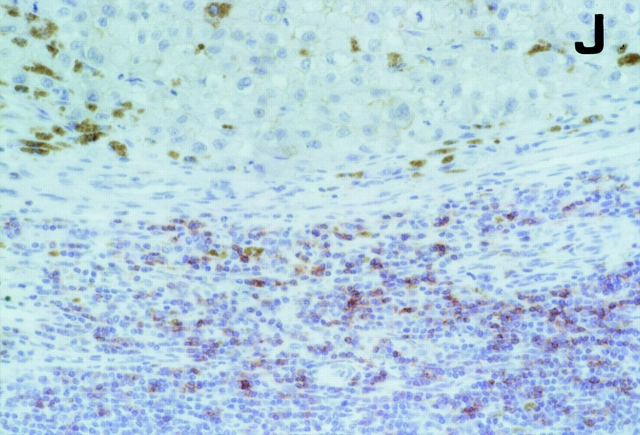
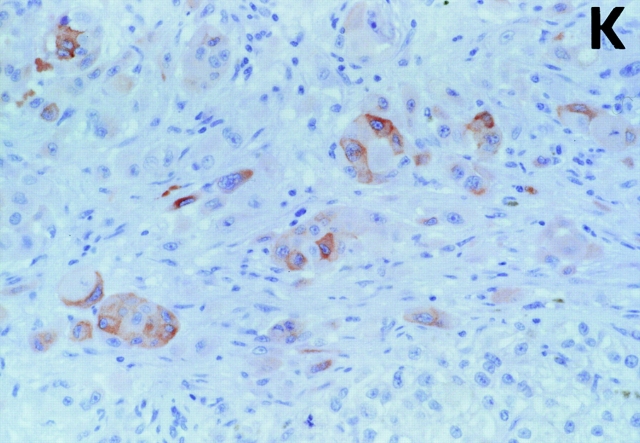
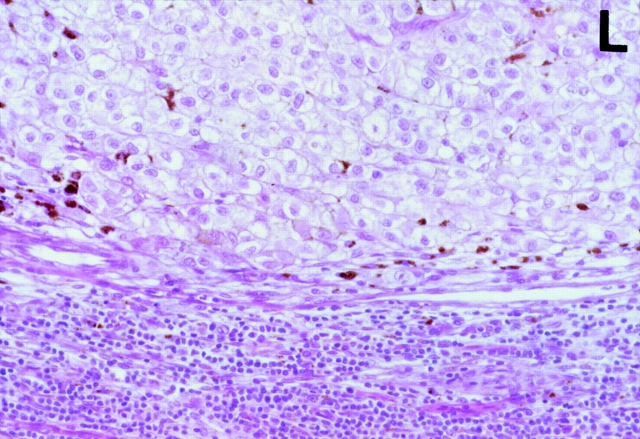
Immunohistochemical analysis of neoplastic lesions. Three examples of immunohistochemical analysis of neoplastic lesions from three patients are reported. Consecutive sections of paraffin-embedded tumor fragments were subjected to immunohistochemical staining with anti-CD3 (A, E, and I), anti-CD8 (B, F, and J) and anti–Melan-A/Mart-1 mAbs (C, G, and K) or conventionally stained with hematoxylin and eosin (D, H, and L). Patient 1 (Table , lesion 7), A–D: a subcutaneous lesion showed no evidence of tumor regression or necrosis but did show an intense intratumoral lymphocytic infiltrate (D) characterized by CD3+ (A) and CD8+ (B) cells in the presence of heterogeneous cytoplasmatic reactivity for Melan-A/Mart-1 in tumor cells (C). Patient 2 (lesion 9), E–H: a nodal metastasis with extended coagulative necrosis with strong cytoplasmic eosinophilia of cell shadows lacking nuclei and scattered granulocytes infiltrating the border of the necrotic area (H, right side). The left side of the lesion, containing vital tumor cells, showed a nonbrisk lymphocytic infiltrate (H) mostly characterized by CD3+ T cells (E) but with a few CD8+ lymphocytes (F). In this lesion, heterogeneous cytoplasmatic positivity for Melan-A/Mart-1 in neoplastic cells was confined to a small area (G). Patient 3 (lesion 16), I–L: a nodal metastasis without evidence of tumor regression and lacking intratumoral lymphocytes (L), either CD3+ (I) or CD8+ (J), showed intense cytoplasmatic reactivity for Melan-A/Mart-1 limited to a few neoplastic cells (K). Original magnification was 400 for all panels except for H, magnification 250).
Figure 2
Figure 2
Immunohistochemical analysis of neoplastic lesions. Three examples of immunohistochemical analysis of neoplastic lesions from three patients are reported. Consecutive sections of paraffin-embedded tumor fragments were subjected to immunohistochemical staining with anti-CD3 (A, E, and I), anti-CD8 (B, F, and J) and anti–Melan-A/Mart-1 mAbs (C, G, and K) or conventionally stained with hematoxylin and eosin (D, H, and L). Patient 1 (Table , lesion 7), A–D: a subcutaneous lesion showed no evidence of tumor regression or necrosis but did show an intense intratumoral lymphocytic infiltrate (D) characterized by CD3+ (A) and CD8+ (B) cells in the presence of heterogeneous cytoplasmatic reactivity for Melan-A/Mart-1 in tumor cells (C). Patient 2 (lesion 9), E–H: a nodal metastasis with extended coagulative necrosis with strong cytoplasmic eosinophilia of cell shadows lacking nuclei and scattered granulocytes infiltrating the border of the necrotic area (H, right side). The left side of the lesion, containing vital tumor cells, showed a nonbrisk lymphocytic infiltrate (H) mostly characterized by CD3+ T cells (E) but with a few CD8+ lymphocytes (F). In this lesion, heterogeneous cytoplasmatic positivity for Melan-A/Mart-1 in neoplastic cells was confined to a small area (G). Patient 3 (lesion 16), I–L: a nodal metastasis without evidence of tumor regression and lacking intratumoral lymphocytes (L), either CD3+ (I) or CD8+ (J), showed intense cytoplasmatic reactivity for Melan-A/Mart-1 limited to a few neoplastic cells (K). Original magnification was 400 for all panels except for H, magnification 250).
Figure 2
Figure 2
Immunohistochemical analysis of neoplastic lesions. Three examples of immunohistochemical analysis of neoplastic lesions from three patients are reported. Consecutive sections of paraffin-embedded tumor fragments were subjected to immunohistochemical staining with anti-CD3 (A, E, and I), anti-CD8 (B, F, and J) and anti–Melan-A/Mart-1 mAbs (C, G, and K) or conventionally stained with hematoxylin and eosin (D, H, and L). Patient 1 (Table , lesion 7), A–D: a subcutaneous lesion showed no evidence of tumor regression or necrosis but did show an intense intratumoral lymphocytic infiltrate (D) characterized by CD3+ (A) and CD8+ (B) cells in the presence of heterogeneous cytoplasmatic reactivity for Melan-A/Mart-1 in tumor cells (C). Patient 2 (lesion 9), E–H: a nodal metastasis with extended coagulative necrosis with strong cytoplasmic eosinophilia of cell shadows lacking nuclei and scattered granulocytes infiltrating the border of the necrotic area (H, right side). The left side of the lesion, containing vital tumor cells, showed a nonbrisk lymphocytic infiltrate (H) mostly characterized by CD3+ T cells (E) but with a few CD8+ lymphocytes (F). In this lesion, heterogeneous cytoplasmatic positivity for Melan-A/Mart-1 in neoplastic cells was confined to a small area (G). Patient 3 (lesion 16), I–L: a nodal metastasis without evidence of tumor regression and lacking intratumoral lymphocytes (L), either CD3+ (I) or CD8+ (J), showed intense cytoplasmatic reactivity for Melan-A/Mart-1 limited to a few neoplastic cells (K). Original magnification was 400 for all panels except for H, magnification 250).
Figure 2
Figure 2
Immunohistochemical analysis of neoplastic lesions. Three examples of immunohistochemical analysis of neoplastic lesions from three patients are reported. Consecutive sections of paraffin-embedded tumor fragments were subjected to immunohistochemical staining with anti-CD3 (A, E, and I), anti-CD8 (B, F, and J) and anti–Melan-A/Mart-1 mAbs (C, G, and K) or conventionally stained with hematoxylin and eosin (D, H, and L). Patient 1 (Table , lesion 7), A–D: a subcutaneous lesion showed no evidence of tumor regression or necrosis but did show an intense intratumoral lymphocytic infiltrate (D) characterized by CD3+ (A) and CD8+ (B) cells in the presence of heterogeneous cytoplasmatic reactivity for Melan-A/Mart-1 in tumor cells (C). Patient 2 (lesion 9), E–H: a nodal metastasis with extended coagulative necrosis with strong cytoplasmic eosinophilia of cell shadows lacking nuclei and scattered granulocytes infiltrating the border of the necrotic area (H, right side). The left side of the lesion, containing vital tumor cells, showed a nonbrisk lymphocytic infiltrate (H) mostly characterized by CD3+ T cells (E) but with a few CD8+ lymphocytes (F). In this lesion, heterogeneous cytoplasmatic positivity for Melan-A/Mart-1 in neoplastic cells was confined to a small area (G). Patient 3 (lesion 16), I–L: a nodal metastasis without evidence of tumor regression and lacking intratumoral lymphocytes (L), either CD3+ (I) or CD8+ (J), showed intense cytoplasmatic reactivity for Melan-A/Mart-1 limited to a few neoplastic cells (K). Original magnification was 400 for all panels except for H, magnification 250).
Figure 2
Figure 2
Immunohistochemical analysis of neoplastic lesions. Three examples of immunohistochemical analysis of neoplastic lesions from three patients are reported. Consecutive sections of paraffin-embedded tumor fragments were subjected to immunohistochemical staining with anti-CD3 (A, E, and I), anti-CD8 (B, F, and J) and anti–Melan-A/Mart-1 mAbs (C, G, and K) or conventionally stained with hematoxylin and eosin (D, H, and L). Patient 1 (Table , lesion 7), A–D: a subcutaneous lesion showed no evidence of tumor regression or necrosis but did show an intense intratumoral lymphocytic infiltrate (D) characterized by CD3+ (A) and CD8+ (B) cells in the presence of heterogeneous cytoplasmatic reactivity for Melan-A/Mart-1 in tumor cells (C). Patient 2 (lesion 9), E–H: a nodal metastasis with extended coagulative necrosis with strong cytoplasmic eosinophilia of cell shadows lacking nuclei and scattered granulocytes infiltrating the border of the necrotic area (H, right side). The left side of the lesion, containing vital tumor cells, showed a nonbrisk lymphocytic infiltrate (H) mostly characterized by CD3+ T cells (E) but with a few CD8+ lymphocytes (F). In this lesion, heterogeneous cytoplasmatic positivity for Melan-A/Mart-1 in neoplastic cells was confined to a small area (G). Patient 3 (lesion 16), I–L: a nodal metastasis without evidence of tumor regression and lacking intratumoral lymphocytes (L), either CD3+ (I) or CD8+ (J), showed intense cytoplasmatic reactivity for Melan-A/Mart-1 limited to a few neoplastic cells (K). Original magnification was 400 for all panels except for H, magnification 250).
Figure 2
Figure 2
Immunohistochemical analysis of neoplastic lesions. Three examples of immunohistochemical analysis of neoplastic lesions from three patients are reported. Consecutive sections of paraffin-embedded tumor fragments were subjected to immunohistochemical staining with anti-CD3 (A, E, and I), anti-CD8 (B, F, and J) and anti–Melan-A/Mart-1 mAbs (C, G, and K) or conventionally stained with hematoxylin and eosin (D, H, and L). Patient 1 (Table , lesion 7), A–D: a subcutaneous lesion showed no evidence of tumor regression or necrosis but did show an intense intratumoral lymphocytic infiltrate (D) characterized by CD3+ (A) and CD8+ (B) cells in the presence of heterogeneous cytoplasmatic reactivity for Melan-A/Mart-1 in tumor cells (C). Patient 2 (lesion 9), E–H: a nodal metastasis with extended coagulative necrosis with strong cytoplasmic eosinophilia of cell shadows lacking nuclei and scattered granulocytes infiltrating the border of the necrotic area (H, right side). The left side of the lesion, containing vital tumor cells, showed a nonbrisk lymphocytic infiltrate (H) mostly characterized by CD3+ T cells (E) but with a few CD8+ lymphocytes (F). In this lesion, heterogeneous cytoplasmatic positivity for Melan-A/Mart-1 in neoplastic cells was confined to a small area (G). Patient 3 (lesion 16), I–L: a nodal metastasis without evidence of tumor regression and lacking intratumoral lymphocytes (L), either CD3+ (I) or CD8+ (J), showed intense cytoplasmatic reactivity for Melan-A/Mart-1 limited to a few neoplastic cells (K). Original magnification was 400 for all panels except for H, magnification 250).
Figure 2
Figure 2
Immunohistochemical analysis of neoplastic lesions. Three examples of immunohistochemical analysis of neoplastic lesions from three patients are reported. Consecutive sections of paraffin-embedded tumor fragments were subjected to immunohistochemical staining with anti-CD3 (A, E, and I), anti-CD8 (B, F, and J) and anti–Melan-A/Mart-1 mAbs (C, G, and K) or conventionally stained with hematoxylin and eosin (D, H, and L). Patient 1 (Table , lesion 7), A–D: a subcutaneous lesion showed no evidence of tumor regression or necrosis but did show an intense intratumoral lymphocytic infiltrate (D) characterized by CD3+ (A) and CD8+ (B) cells in the presence of heterogeneous cytoplasmatic reactivity for Melan-A/Mart-1 in tumor cells (C). Patient 2 (lesion 9), E–H: a nodal metastasis with extended coagulative necrosis with strong cytoplasmic eosinophilia of cell shadows lacking nuclei and scattered granulocytes infiltrating the border of the necrotic area (H, right side). The left side of the lesion, containing vital tumor cells, showed a nonbrisk lymphocytic infiltrate (H) mostly characterized by CD3+ T cells (E) but with a few CD8+ lymphocytes (F). In this lesion, heterogeneous cytoplasmatic positivity for Melan-A/Mart-1 in neoplastic cells was confined to a small area (G). Patient 3 (lesion 16), I–L: a nodal metastasis without evidence of tumor regression and lacking intratumoral lymphocytes (L), either CD3+ (I) or CD8+ (J), showed intense cytoplasmatic reactivity for Melan-A/Mart-1 limited to a few neoplastic cells (K). Original magnification was 400 for all panels except for H, magnification 250).
Figure 2
Figure 2
Immunohistochemical analysis of neoplastic lesions. Three examples of immunohistochemical analysis of neoplastic lesions from three patients are reported. Consecutive sections of paraffin-embedded tumor fragments were subjected to immunohistochemical staining with anti-CD3 (A, E, and I), anti-CD8 (B, F, and J) and anti–Melan-A/Mart-1 mAbs (C, G, and K) or conventionally stained with hematoxylin and eosin (D, H, and L). Patient 1 (Table , lesion 7), A–D: a subcutaneous lesion showed no evidence of tumor regression or necrosis but did show an intense intratumoral lymphocytic infiltrate (D) characterized by CD3+ (A) and CD8+ (B) cells in the presence of heterogeneous cytoplasmatic reactivity for Melan-A/Mart-1 in tumor cells (C). Patient 2 (lesion 9), E–H: a nodal metastasis with extended coagulative necrosis with strong cytoplasmic eosinophilia of cell shadows lacking nuclei and scattered granulocytes infiltrating the border of the necrotic area (H, right side). The left side of the lesion, containing vital tumor cells, showed a nonbrisk lymphocytic infiltrate (H) mostly characterized by CD3+ T cells (E) but with a few CD8+ lymphocytes (F). In this lesion, heterogeneous cytoplasmatic positivity for Melan-A/Mart-1 in neoplastic cells was confined to a small area (G). Patient 3 (lesion 16), I–L: a nodal metastasis without evidence of tumor regression and lacking intratumoral lymphocytes (L), either CD3+ (I) or CD8+ (J), showed intense cytoplasmatic reactivity for Melan-A/Mart-1 limited to a few neoplastic cells (K). Original magnification was 400 for all panels except for H, magnification 250).
Figure 2
Figure 2
Immunohistochemical analysis of neoplastic lesions. Three examples of immunohistochemical analysis of neoplastic lesions from three patients are reported. Consecutive sections of paraffin-embedded tumor fragments were subjected to immunohistochemical staining with anti-CD3 (A, E, and I), anti-CD8 (B, F, and J) and anti–Melan-A/Mart-1 mAbs (C, G, and K) or conventionally stained with hematoxylin and eosin (D, H, and L). Patient 1 (Table , lesion 7), A–D: a subcutaneous lesion showed no evidence of tumor regression or necrosis but did show an intense intratumoral lymphocytic infiltrate (D) characterized by CD3+ (A) and CD8+ (B) cells in the presence of heterogeneous cytoplasmatic reactivity for Melan-A/Mart-1 in tumor cells (C). Patient 2 (lesion 9), E–H: a nodal metastasis with extended coagulative necrosis with strong cytoplasmic eosinophilia of cell shadows lacking nuclei and scattered granulocytes infiltrating the border of the necrotic area (H, right side). The left side of the lesion, containing vital tumor cells, showed a nonbrisk lymphocytic infiltrate (H) mostly characterized by CD3+ T cells (E) but with a few CD8+ lymphocytes (F). In this lesion, heterogeneous cytoplasmatic positivity for Melan-A/Mart-1 in neoplastic cells was confined to a small area (G). Patient 3 (lesion 16), I–L: a nodal metastasis without evidence of tumor regression and lacking intratumoral lymphocytes (L), either CD3+ (I) or CD8+ (J), showed intense cytoplasmatic reactivity for Melan-A/Mart-1 limited to a few neoplastic cells (K). Original magnification was 400 for all panels except for H, magnification 250).
Figure 2
Figure 2
Immunohistochemical analysis of neoplastic lesions. Three examples of immunohistochemical analysis of neoplastic lesions from three patients are reported. Consecutive sections of paraffin-embedded tumor fragments were subjected to immunohistochemical staining with anti-CD3 (A, E, and I), anti-CD8 (B, F, and J) and anti–Melan-A/Mart-1 mAbs (C, G, and K) or conventionally stained with hematoxylin and eosin (D, H, and L). Patient 1 (Table , lesion 7), A–D: a subcutaneous lesion showed no evidence of tumor regression or necrosis but did show an intense intratumoral lymphocytic infiltrate (D) characterized by CD3+ (A) and CD8+ (B) cells in the presence of heterogeneous cytoplasmatic reactivity for Melan-A/Mart-1 in tumor cells (C). Patient 2 (lesion 9), E–H: a nodal metastasis with extended coagulative necrosis with strong cytoplasmic eosinophilia of cell shadows lacking nuclei and scattered granulocytes infiltrating the border of the necrotic area (H, right side). The left side of the lesion, containing vital tumor cells, showed a nonbrisk lymphocytic infiltrate (H) mostly characterized by CD3+ T cells (E) but with a few CD8+ lymphocytes (F). In this lesion, heterogeneous cytoplasmatic positivity for Melan-A/Mart-1 in neoplastic cells was confined to a small area (G). Patient 3 (lesion 16), I–L: a nodal metastasis without evidence of tumor regression and lacking intratumoral lymphocytes (L), either CD3+ (I) or CD8+ (J), showed intense cytoplasmatic reactivity for Melan-A/Mart-1 limited to a few neoplastic cells (K). Original magnification was 400 for all panels except for H, magnification 250).
Figure 2
Figure 2
Immunohistochemical analysis of neoplastic lesions. Three examples of immunohistochemical analysis of neoplastic lesions from three patients are reported. Consecutive sections of paraffin-embedded tumor fragments were subjected to immunohistochemical staining with anti-CD3 (A, E, and I), anti-CD8 (B, F, and J) and anti–Melan-A/Mart-1 mAbs (C, G, and K) or conventionally stained with hematoxylin and eosin (D, H, and L). Patient 1 (Table , lesion 7), A–D: a subcutaneous lesion showed no evidence of tumor regression or necrosis but did show an intense intratumoral lymphocytic infiltrate (D) characterized by CD3+ (A) and CD8+ (B) cells in the presence of heterogeneous cytoplasmatic reactivity for Melan-A/Mart-1 in tumor cells (C). Patient 2 (lesion 9), E–H: a nodal metastasis with extended coagulative necrosis with strong cytoplasmic eosinophilia of cell shadows lacking nuclei and scattered granulocytes infiltrating the border of the necrotic area (H, right side). The left side of the lesion, containing vital tumor cells, showed a nonbrisk lymphocytic infiltrate (H) mostly characterized by CD3+ T cells (E) but with a few CD8+ lymphocytes (F). In this lesion, heterogeneous cytoplasmatic positivity for Melan-A/Mart-1 in neoplastic cells was confined to a small area (G). Patient 3 (lesion 16), I–L: a nodal metastasis without evidence of tumor regression and lacking intratumoral lymphocytes (L), either CD3+ (I) or CD8+ (J), showed intense cytoplasmatic reactivity for Melan-A/Mart-1 limited to a few neoplastic cells (K). Original magnification was 400 for all panels except for H, magnification 250).
Figure 2
Figure 2
Immunohistochemical analysis of neoplastic lesions. Three examples of immunohistochemical analysis of neoplastic lesions from three patients are reported. Consecutive sections of paraffin-embedded tumor fragments were subjected to immunohistochemical staining with anti-CD3 (A, E, and I), anti-CD8 (B, F, and J) and anti–Melan-A/Mart-1 mAbs (C, G, and K) or conventionally stained with hematoxylin and eosin (D, H, and L). Patient 1 (Table , lesion 7), A–D: a subcutaneous lesion showed no evidence of tumor regression or necrosis but did show an intense intratumoral lymphocytic infiltrate (D) characterized by CD3+ (A) and CD8+ (B) cells in the presence of heterogeneous cytoplasmatic reactivity for Melan-A/Mart-1 in tumor cells (C). Patient 2 (lesion 9), E–H: a nodal metastasis with extended coagulative necrosis with strong cytoplasmic eosinophilia of cell shadows lacking nuclei and scattered granulocytes infiltrating the border of the necrotic area (H, right side). The left side of the lesion, containing vital tumor cells, showed a nonbrisk lymphocytic infiltrate (H) mostly characterized by CD3+ T cells (E) but with a few CD8+ lymphocytes (F). In this lesion, heterogeneous cytoplasmatic positivity for Melan-A/Mart-1 in neoplastic cells was confined to a small area (G). Patient 3 (lesion 16), I–L: a nodal metastasis without evidence of tumor regression and lacking intratumoral lymphocytes (L), either CD3+ (I) or CD8+ (J), showed intense cytoplasmatic reactivity for Melan-A/Mart-1 limited to a few neoplastic cells (K). Original magnification was 400 for all panels except for H, magnification 250).

References

    1. Clark W.H., Jr., Elder D.E., Guerry D., IV, Braitman L.E., Trock B.J., Schultz D., Synnestvedt M., Halpern A.C. Model predicting survival in stage I melanoma based on tumor progression. J. Natl. Cancer Inst. 1989;81:1893–1904. - PubMed
    1. Mihm M., Clemente C., Cascinelli N. Tumor infiltrating lymphocytes in lymph node melanoma metastasesa histopathologic prognostic indicator and an expression of local immune response. Lab. Invest. 1996;74:43–47. - PubMed
    1. Sensi M.L., Parmiani G. Analysis of TCR usage in human tumorsa new tool for assessing tumor-specific immune responses. Immunol. Today. 1995;16:588–595. - PubMed
    1. Rivoltini L., Kawakami Y., Sakaguchi K., Southwood S., Sette A., Robbins P.F., Marincola F.M., Salgaller M.L., Yannelli J.R., Appella E. Induction of tumor-reactive CTL from peripheral blood and tumor-infiltrating lymphocytes of melanoma patients by in-vitro stimulation with an immunodominant peptide of the human melanoma antigen MART-1. J. Immunol. 1995;154:2257–2265. - PubMed
    1. Salgaller M.L., Afshar A., Marincola F.M., Rivoltini L., Kawakami Y., Rosenberg S.A. Recognition of multiple epitopes in the human melanoma antigen gp100 by peripheral blood lymphocytes stimulated in-vitro with synthetic peptides. Cancer Res. 1995;55:4972–4979. - PubMed

Publication types

MeSH terms