. 1999 Sep;181(18):5860-4.
doi: 10.1128/JB.181.18.5860-5864.1999.

Synthetic lethal phenotypes caused by mutations affecting chromosome partitioning in Bacillus subtilis

Affiliations

Synthetic lethal phenotypes caused by mutations affecting chromosome partitioning in Bacillus subtilis

R A Britton et al. J Bacteriol. 1999 Sep.

Abstract

We investigated the genetic interactions between mutations affecting chromosome structure and partitioning in Bacillus subtilis. Loss-of-function mutations in spoIIIE (encoding a putative DNA translocase) and smc (involved in chromosome structure and partitioning) caused a synthetic lethal phenotype. We constructed a conditional mutation in smc and found that many of the spoIIIE smc double-mutant cells had a chromosome bisected by a division septum. The growth defect of the double mutant was exacerbated by a null mutation in the chromosome partitioning gene spo0J. These results suggest that mutants defective in nucleoid structure are unable to move chromosomes out of the way of the invaginating septum and that SpoIIIE is involved in repositioning these bisected chromosomes during vegetative growth.


Figures
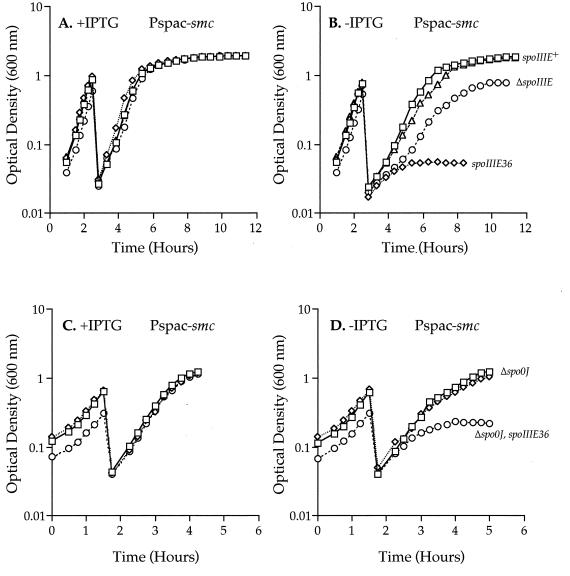
FIG. 1
FIG. 1
Growth of Pspac-smc strains. Cells were grown overnight on solid LB medium with 1 mM IPTG and then inoculated into prewarmed (37°C) LB medium containing 5 μg of chloramphenicol/ml with (+) (A and C) or without (−) (B and D) 1 mM IPTG. Cultures were diluted once during the experiments (note the drops in optical density at around 2 h) to keep the cells in the exponential phase of growth. It takes several generations of growth in the absence of IPTG to express the Smc mutant phenotype. (A and B) Effects of depleting SMC from spoIIIE mutant cells. Symbols: Pspac-smc spoIIIE+ (RB68), squares; Pspac-srb ΔspoIIIE (RB91), triangles; Pspac-smc spoIIIE36 (RB69), diamonds; Pspac-smc ΔspoIIIE (RB82), circles. (C and D) Effect of Δspo0J on the Pspac-smc spoIIIE mutants. Symbols: Pspac-smc spoIIIE+ (RB68), squares; Pspac-smc Δspo0J (RB74), diamonds; Pspac-smc Δspo0J spoIIIE36 (RB75), circles. Note that the scales on the x axes in the top and bottom panels are different. To place the smc gene under the control of the Pspac promoter, a PCR fragment including the ribosome binding site and the 5′ end of smc was generated and directionally cloned into the HindIII and SphI sites of pAG58 (primer sequences are available on request). The resulting plasmid, pRB21, was integrated into the chromosome by a single crossover. pRB21 (Pspac-smc) was transformed into AG174 (wild type) to generate strain RB68 (Pspac-smc), into PL656 (spoIIIE36) to generate RB69 (Pspac-smc spoIIIE36), and into strain PL422 (ΔspoIIIE) to generate strain RB82 (Pspac-smc ΔspoIIIE). RB74 (Pspac-smc Δspo0J) was constructed by integrating pRB21 by a single crossover into strain AG1468 (Δspo0J). RB75 (Pspac-smc Δspo0J spoIIIE36) was constructed by integrating pRB21 by a single crossover into strain RB1 (Δspo0J spoIIIE36). The srb gene was placed under the control of the Pspac promoter by PCR amplifying the ribosome binding site and 5′ end of srb and cloning the fragment into pAG58. This plasmid was integrated into the chromosome by a single crossover into strain PL422 to generate RB91 (Pspac-srb ΔspoIIIE).
FIG. 2
FIG. 2
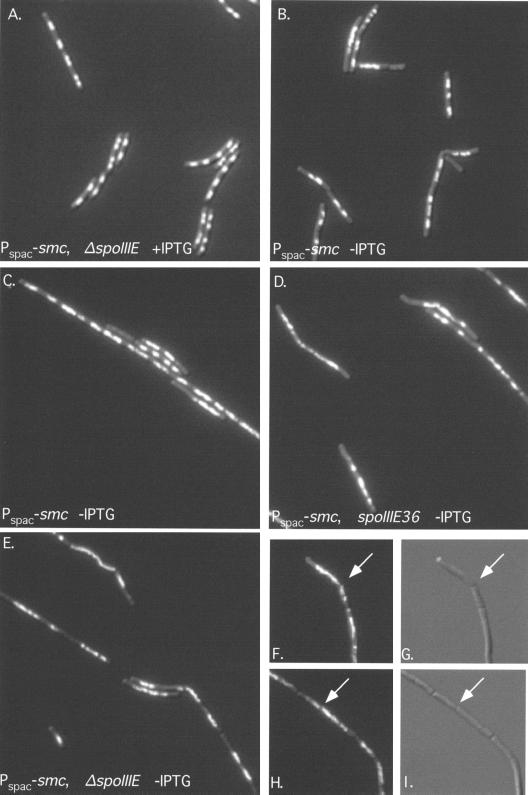
Chromosome partitioning phenotypes of Pspac-smc strains. Cells were grown as described in the legend to Fig. 1 and in the text. Cells were fixed with methanol and visualized by a combination of fluorescence and Nomarski microscopy as described elsewhere (1). The DNA was stained with the DNA-specific dye 4′,6-diamidino-2-phenylindole (DAPI). (A) RB82 (Pspac-smc ΔspoIIIE) grown in the presence of IPTG; (B) Pspac-smc spoIIIE+ (RB68) grown without IPTG for six generations; (C) Pspac-smc spoIIIE+ (RB68) grown without IPTG for nine generations; (D) Pspac-smc spoIIIE36 (RB69) grown without IPTG (cells taken approximately one generation before the cessation of growth); (E) Pspac-smc ΔspoIIIE (RB82) grown without IPTG (cells taken approximately one generation before the cessation of growth); (F to I) Examples of the CUT phenotype: combination Nomarski and fluorescence microscopy of smc spoIIIE double-mutant cells (F and H), and Nomarski images only of the same cells (G and I). Arrows indicate examples of a nucleoid bisected by a septum.

References

    1. Britton R A, Lin D C, Grossman A D. Characterization of a prokaryotic SMC protein involved in chromosome partitioning. Genes Dev. 1998;12:1254–1259. - PMC - PubMed
    1. Cheo D L, Bayles K W, Yasbin R E. Cloning and characterization of DNA damage-inducible promoter regions from Bacillus subtilis. J Bacteriol. 1991;173:1696–1703. - PMC - PubMed
    1. Chuang P T, Albertson D G, Meyer B J. DPY-27: a chromosome condensation protein homolog that regulates C. elegans dosage compensation through association with the X chromosome. Cell. 1994;79:459–474. - PubMed
    1. Glaser P, Sharpe M E, Raether B, Perego M, Ohlsen K, Errington J. Dynamic, mitotic-like behavior of a bacterial protein required for accurate chromosome partitioning. Genes Dev. 1997;11:1160–1168. - PubMed
    1. Guacci V, Koshland D, Strunnikov A. A direct link between sister chromatid cohesion and chromosome condensation revealed through the analysis of MCD1 in S. cerevisiae. Cell. 1997;91:47–57. - PMC - PubMed

Publication types

LinkOut - more resources