


Genetic reassortment of Rift Valley fever virus in nature
- PMID: 10482570
- PMCID: PMC112837
- DOI: 10.1128/JVI.73.10.8196-8200.1999
Genetic reassortment of Rift Valley fever virus in nature
Abstract
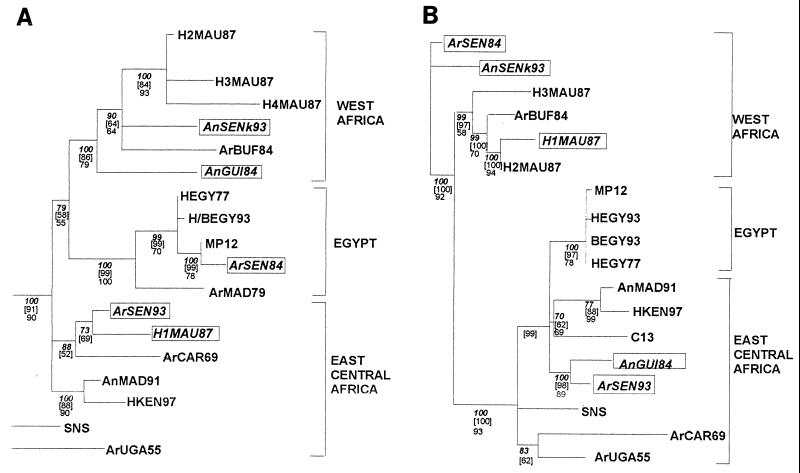
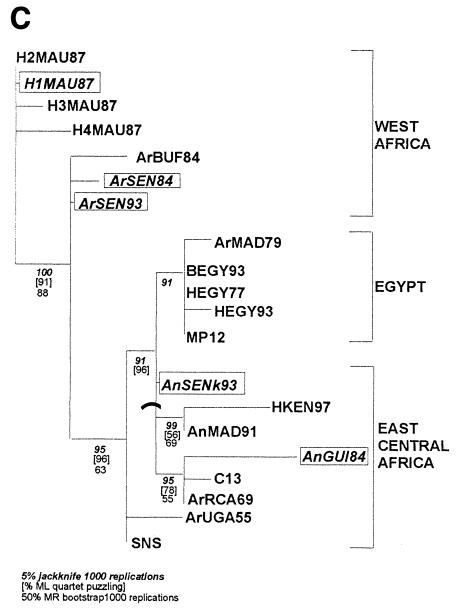
Rift Valley fever virus (RVFV), a phlebovirus of the Bunyaviridae family, is an arthropod-borne virus which emerges periodically throughout Africa, emphasizing that it poses a major threat for animal and human populations. To assess the genetic variability of RVFV, several isolates from diverse localities of Africa were investigated by means of reverse transcription-PCR followed by direct sequencing of a region of the small (S), medium (M), and large (L) genomic segments. Phylogenetic analysis showed the existence of three major lineages corresponding to geographic variants from West Africa, Egypt, and Central-East Africa. However, incongruences detected between the L, M, and S phylogenies suggested that genetic exchange via reassortment occurred between strains from different lineages. This hypothesis, depicted by parallel phylogenies, was further confirmed by statistical tests. Our findings, which strongly suggest exchanges between strains from areas of endemicity in West and East Africa, strengthen the potential existence of a sylvatic cycle in the tropical rain forest. This also emphasizes the risk of generating uncontrolled chimeric viruses by using live attenuated vaccines in areas of endemicity.
Figures
References
-
- Anonymous. An outbreak of Rift Valley fever, Eastern Africa, 1997–98. WHO Weekly Epidemiol Rep. 1998;73:105–112. - PubMed
-
- Arthur R R, el-Sharkawy M S, Cope S E, Botros B A, Oun S, Morrill J C, Shope R E, Hibbs R G, Darwish M A, Imam I Z. Recurrence of Rift Valley fever in Egypt. Lancet. 1993;342:1149–1150. - PubMed
-
- Bandelt H J, Dress A W. Split decomposition: a new and useful approach to phylogenetic analysis of distance data. Mol Phylogenet Evol. 1992;1:242–252. - PubMed
-
- Beaty B J, Borucki M, Farfan J, White D. Arbovirus-vector interactions: determinants of arbovirus evolution. In: Saluzzo J F, Dodet B, editors. Factors in the emergence of arbovirus disease. Paris, France: Elsevier; 1997. pp. 23–35.
-
- Boiro I, Konstaninov O K, Numerov A D. Isolement du virus de la fièvre de la vallée du Rift à partir de chéiroptères en République de Guinée. Bull Soc Pathol Exot Fil. 1987;80:62–67. - PubMed
Publication types
MeSH terms
Associated data
- Actions
- Actions
- Actions
- Actions
- Actions
- Actions
- Actions
- Actions
- Actions
- Actions
- Actions
- Actions
- Actions
- Actions
- Actions
- Actions
- Actions
- Actions
- Actions
- Actions
- Actions
- Actions
- Actions
- Actions
- Actions
- Actions
- Actions
- Actions
- Actions
- Actions
LinkOut - more resources
Full Text Sources
Other Literature Sources
Molecular Biology Databases
