. 1999 Oct;73(10):8330-7.
doi: 10.1128/JVI.73.10.8330-8337.1999.

Translational effects of mutations and polymorphisms in a repressive upstream open reading frame of the human cytomegalovirus UL4 gene

Affiliations

Translational effects of mutations and polymorphisms in a repressive upstream open reading frame of the human cytomegalovirus UL4 gene

J P Alderete et al. J Virol. 1999 Oct.

Abstract

The human cytomegalovirus (HCMV) gpUL4 mRNA contains a 22-codon upstream open reading frame (uORF2), the peptide product of which represses downstream translation by blocking translation termination at its own stop codon and by causing ribosomes to stall on the mRNA. A distinctive feature of this unusual mechanism is its strict dependence on the uORF2 peptide sequence. To delineate sequence elements that function in the inhibitory mechanism, deletions and missense mutations affecting the previously uncharacterized amino-terminal region of uORF2 were analyzed in transient-transfection and infection assays. These experiments identified multiple codons in this region that are necessary for inhibition of downstream translation by uORF2 and, in conjunction with previous results, demonstrated that amino acids dispersed throughout the uORF2 peptide participate in the repressive mechanism. In contrast to the highly conserved carboxy terminus, the amino-terminal portion of the uORF2 peptide is polymorphic. A survey of uORF2 sequences in HCMV clinical isolates revealed that although most have uORF2 sequences that are predicted to retain the uORF2 inhibitory activity, approximately 15% contain polymorphisms at codons that are essential for full inhibition by uORF2. Consistent with predictions based on analyses of engineered mutations, two viral isolates with uORF2 sequences that do not inhibit downstream translation in transfection assays expressed much more gpUL4 protein but similar levels of UL4 mRNA compared to the levels produced by the prototypic laboratory strain HCMV (Towne) and another clinical isolate with an inhibitory variant uORF2. These results demonstrate that uORF2 is polymorphic in sequence and repressive activity and suggest that the uORF2 regulatory mechanism, although prevalent among natural HCMV isolates, is not absolutely essential for viral replication.


Figures
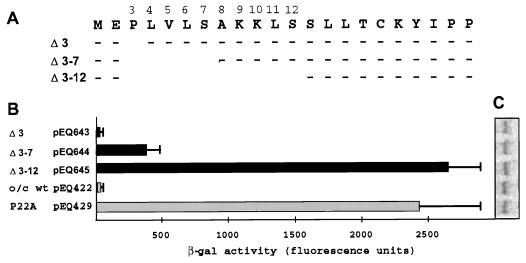
FIG. 1
FIG. 1
Effects of deletion of codons 3 through 12 on uORF2 inhibitory activity. (A) Plasmids containing deletions of codon 3 (Δ 3, pEQ643), codons 3 through 7 (Δ 3–7, pEQ644), and codons 3 through 12 (Δ 3–12, pEQ645) of uORF2 were transfected into triplicate dishes of HF. Control plasmids were pEQ422, which contains an optimal-context AUG codon (o/c) but otherwise wild-type uORF2 (wt), and pEQ429, which contains an optimal-context AUG codon and a missense mutation of proline to alanine at codon 22 (P22A). Subsequent to HCMV infection, β-Gal activity (B) and lacZ mRNA levels (C) were measured as described in Materials and Methods.
FIG. 2
FIG. 2
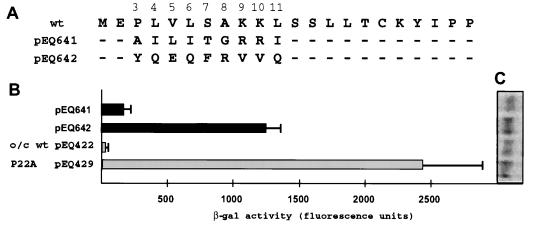
Missense mutations of codons 3 through 11 reduce uORF2 inhibitory activity. (A) Plasmids having conservative (pEQ641) and nonconservative (pEQ642) substitutions in uORF2 and the same control plasmids as those used for the Fig. 1 experiments were transfected into HF. After HCMV infection, β-Gal activity (B) and lacZ mRNA levels (C) were measured as described in Materials and Methods. o/c, optimal-context AUG codon; wt, wild-type uORF2.
FIG. 3
FIG. 3
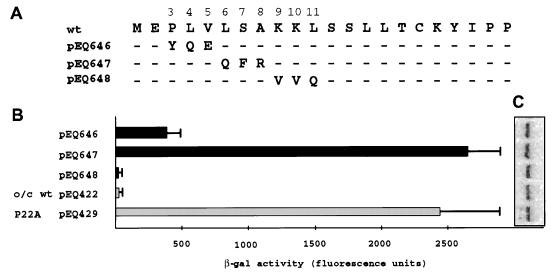
At least two codons, one in positions 3 through 5 and one in positions 6 through 8, are required for full uORF2 inhibitory activity. (A) Plasmids containing triple amino acid uORF2 substitutions derived from subsets of the nonconservative missense mutations in pEQ642 (Fig. 2) were transfected into HF. Following infection with HCMV, β-Gal activity (B) and lacZ mRNA levels (C) were measured as described in Materials and Methods. o/c, optimal-context AUG codon; wt, wild-type uORF2.
FIG. 4
FIG. 4
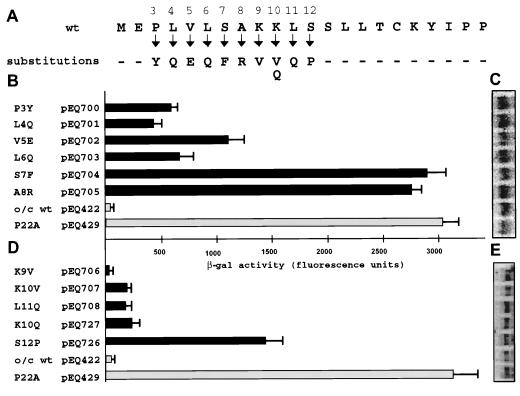
Individual codons within the amino-terminal portion of uORF2 are important for inhibitory activity. Plasmids containing individual missense mutations (A) were transfected into HF in two separate experiments (B and C; D and E). Following infection with HCMV, β-Gal activity (B and D) and lacZ mRNA levels (C and E) were measured as described in Materials and Methods. o/c, optimal-context AUG codon; wt, wild-type uORF2.
FIG. 5
FIG. 5
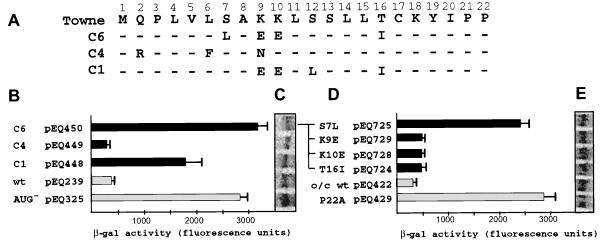
Effects of polymorphisms found in clinical isolates on uORF2 inhibitory activity. (A) Deduced amino acid sequence of clinical isolates C6, C4, and C1. Dashes indicate amino acid identity with HCMV (Towne). Plasmids containing the gpUL4 leader from these clinical isolates (B and C) or containing individual mutations found in isolate C6 (D and E) were transfected into HF. After infection with HCMV, β-Gal activity (B and D) and lacZ mRNA levels (C and E) were measured as described in Materials and Methods. o/c, optimal-context AUG codon; wt, wild-type uORF2.
FIG. 6
FIG. 6
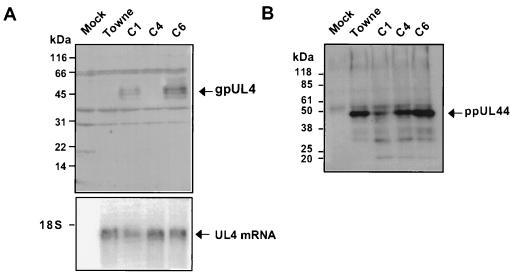
gpUL4 expression after infection with HCMV (Towne) and clinical isolates. HF extracts obtained 18 days after mock infection or after infection with the HCMV isolate C1, C4, C6, or Towne were separated by SDS-polyacrylamide gel electrophoresis and transferred to polyvinylidene difluoride membranes. Immunoblots were probed with a polyclonal antiserum to gpUL4 (A) or an anti-ppUL44 monoclonal antibody (B) as described in Materials and Methods. Molecular size markers are indicated on the left of each blot. Whole-cell mRNA was examined by Northern blot analysis with a UL4 probe (A, bottom). The position of the 18S rRNA migration is indicated.
FIG. 7
FIG. 7
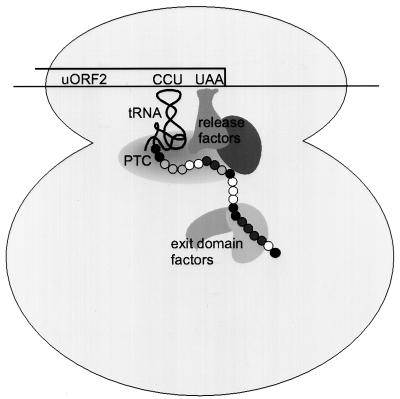
Model of uORF2 peptide interactions with ribosomes or ribosome-associated translation factors. When a ribosome reaches the uORF2 termination codon (UAA), the nascent uORF peptide (chain of circles) remains linked to the tRNA decoding the final uORF2 proline codon, CCU. The ribosome stalls at this site, creating a roadblock that obstructs other ribosomes from scanning to the downstream cistron. Changes in uORF2 amino acids that fully (black circles) or partially (dark-gray circles) alleviate uORF2 inhibitory function, do not affect it (white circles), or for which insufficient data are available (light-gray circles) are shown. The repressive effects of uORF2 may be mediated through its interactions with ribosomal components, such as the peptidyl transferase center (PTC) and the peptide exit domain, or translation factors involved in peptidyl-tRNA hydrolysis, such as eukaryotic release factors.

References

    1. Biegalke B J, Geballe A P. Translational inhibition by cytomegalovirus transcript leaders. Virology. 1990;177:657–667. - PubMed
    1. Cao J, Geballe A P. Coding sequence-dependent ribosomal arrest at termination of translation. Mol Cell Biol. 1996;16:603–608. - PMC - PubMed
    1. Cao J, Geballe A P. Inhibition of nascent-peptide release at translation termination. Mol Cell Biol. 1996;16:7109–7114. - PMC - PubMed
    1. Cao J, Geballe A P. Translational inhibition by a human cytomegalovirus upstream open reading frame despite inefficient utilization of its AUG codon. J Virol. 1995;69:1030–1036. - PMC - PubMed
    1. Child, S. J., M. K. Miller, and A. P. Geballe. Translational control by an upstream open reading frame in the HER-2/neu transcript. J. Biol. Chem., in press. - PubMed

Publication types

Substances

LinkOut - more resources