. 1999 Sep;121(1):123-34.
doi: 10.1104/pp.121.1.123.

Antisense repression of hexokinase 1 leads to an overaccumulation of starch in leaves of transgenic potato plants but not to significant changes in tuber carbohydrate metabolism

Affiliations

Antisense repression of hexokinase 1 leads to an overaccumulation of starch in leaves of transgenic potato plants but not to significant changes in tuber carbohydrate metabolism

J Veramendi et al. Plant Physiol. 1999 Sep.

Abstract

Potato (Solanum tuberosum L.) plants transformed with sense and antisense constructs of a cDNA encoding the potato hexokinase 1 (StHK1) exhibited altered enzyme activities and expression of StHK1 mRNA. Measurements of the maximum catalytic activity of hexokinase revealed a 22-fold variation in leaves (from 22% of the wild-type activity in antisense transformants to 485% activity in sense transformants) and a 7-fold variation in developing tubers (from 32% of the wild-type activity in antisense transformants to 222% activity in sense transformants). Despite the wide range of hexokinase activities, no change was found in the fresh weight yield, starch, sugar, or metabolite levels of transgenic tubers. However, there was a 3-fold increase in the starch content of leaves from the antisense transformants after the dark period. Starch accumulation at the end of the night period was correlated with a 2-fold increase of glucose and a decrease of sucrose content. These results provide strong support for the hypothesis that glucose is a primary product of transitory starch degradation and is the sugar that is exported to the cytosol at night to support sucrose biosynthesis.


Figures
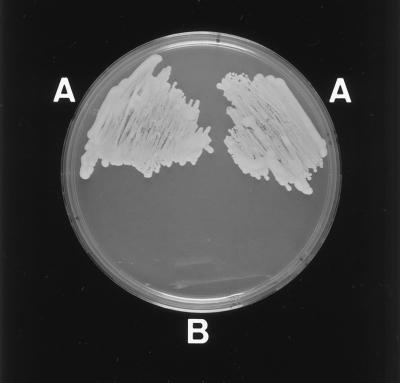
Figure 1
Figure 1
Complementation of the yeast YSH7.4-3C hxk1/hxk2/glk1 triple mutant. Potato HK1 cDNA provided catalytic activity to support the growth of the yeast mutant on the Glc plate. A, Two independent transformants; B, culture transformed with the empty plasmid p195XE.
Figure 2
Figure 2
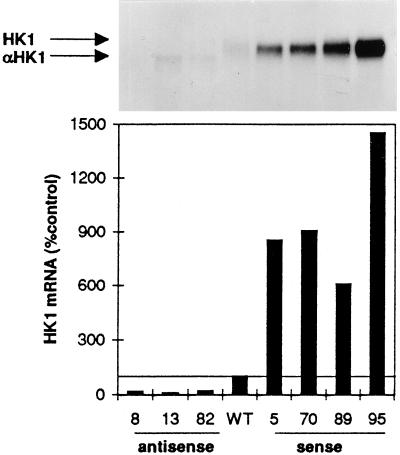
Northern-blot analysis of transgenic plants with altered expression of StHK1. mRNA was extracted from developing tubers of greenhouse-grown plants. The filter was hybridized with a 1.3-kb/HindIII cDNA fragment derived from the StHK1 cDNA. The histogram shows the ratio of StHK1 mRNA to potato ubiquitin mRNA (used as a control) in each transformed line (antisense lines 8, 13, and 82 and sense lines 5, 70, 89, and 95). WT, Wild type.
Figure 3
Figure 3
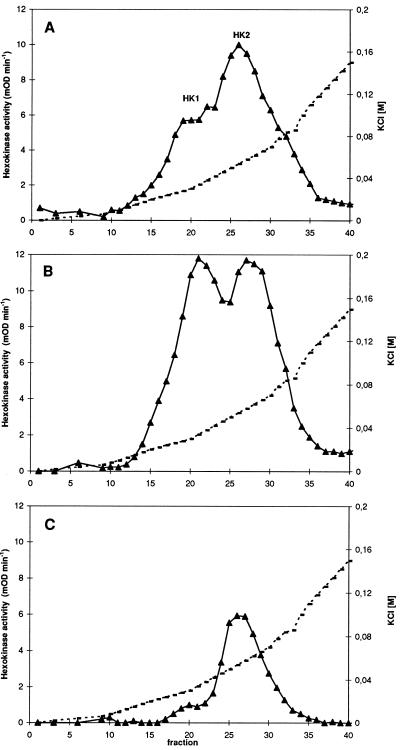
Separation of HK activities from developing potato tubers of the wild type (A), and the PHK1-70 (B) and αHK1-13 (C) lines after elution from a cellulose column with a KCl gradient. ▴, HK activity; dashed lines, KCl concentration.
Figure 4
Figure 4
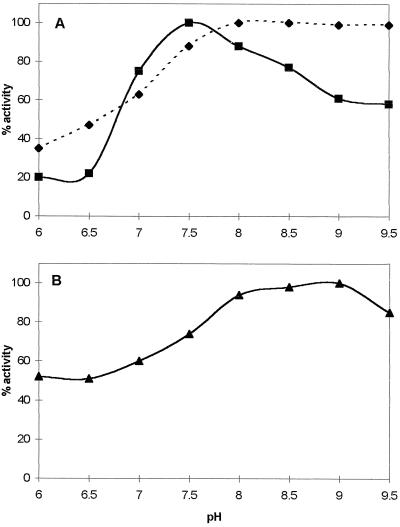
Dependence on pH of HK1 and HK2 activities purified from tubers of the HK1-70 line (A) and HK1 activity following expression of the StHK1 cDNA in the YSH7.4-3C yeast strain (B). The assays were carried out with 50 mm MES-KOH (pH 5.0–6.5), 50 mm imidazole (pH 6.0–7.4), or 50 mm Tris-HCl (pH 7.0–9.5). ▪, HK1; ♦, HK2; ▴, HK1 (yeast).
Figure 5
Figure 5
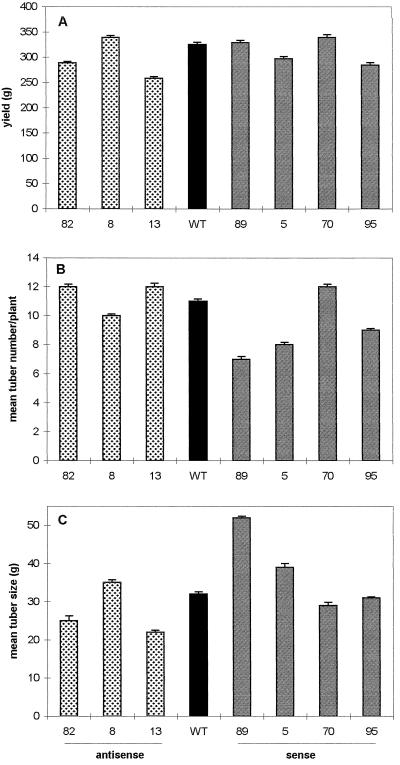
Yield (A), average tuber number (B), and average tuber size (C) of transgenic lines altered in HK activity (antisense lines 82, 8, and 13 and sense lines 89, 5, 70, and 95) and the wild type (WT). For each line, 15 plants were grown in 3.5-L pots in the greenhouse during the spring season. Mature tubers were harvested from senescent plants. Data are presented as the means ± se.
Figure 6
Figure 6
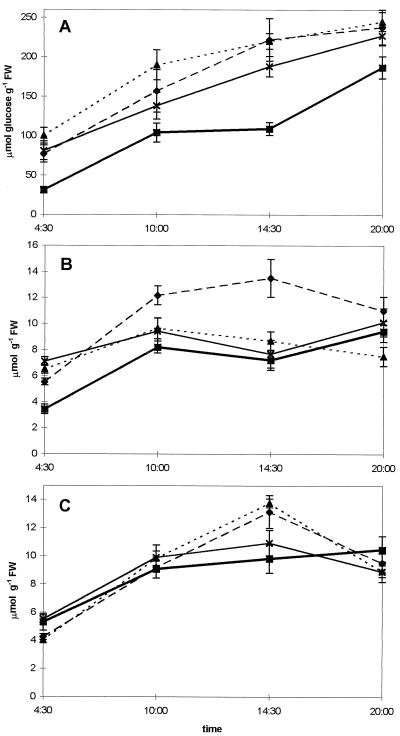
Diurnal changes in leaf starch (A), Glc (B), and Suc (C) in wild-type (▪) and in the αHK1 lines 8 (♦), 13 (▴), and 82 (×). At each time point, samples were taken from mature source leaves and the data presented represent the means ± se of measurements on 12 plants per line.

References

    1. Baldus B, Kelly GJ, Latzko E. Hexokinases of spinach leaves. Phytochemistry. 1981;20:1811–1814.
    1. Bell GI, Pilkis SJ, Weber IT, Polonsky KS. Glucokinase mutations, insulin secretion, and diabetes mellitus. Annu Rev Physiol. 1996;58:171–186. - PubMed
    1. Bork P, Sander C, Valencia A. Convergent evolution of similar enzymatic function on different protein fold: the hexokinase, ribokinase, and galactokinase families of sugar kinases. Prot Sci. 1993;2:31–40. - PMC - PubMed
    1. Burrell MM, Mooney PJ, Blundy M, Carter D, Wilson F, Green J, Blundy KS. Genetic manipulation of 6-phosphofructo-kinase in potato tubers. Planta. 1994;194:95–101.
    1. Caspar T, Lin T-P, Monroe J, Benbow L, Preiss J, Somerville CR. Mutants of Arabidopsis with altered regulation of starch degradation. Plant Physiol. 1991;95:1181–1188. - PMC - PubMed

Publication types

MeSH terms

LinkOut - more resources