. 1999 Sep;121(1):207-14.
doi: 10.1104/pp.121.1.207.

Developmental expression of violaxanthin de-epoxidase in leaves of tobacco growing under high and low light

Affiliations

Developmental expression of violaxanthin de-epoxidase in leaves of tobacco growing under high and low light

R C Bugos et al. Plant Physiol. 1999 Sep.

Abstract

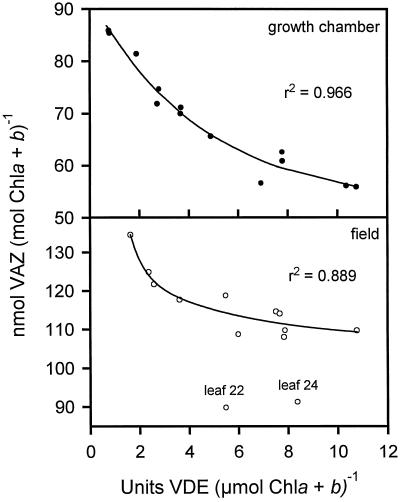
Violaxanthin de-epoxidase (VDE) is a lumen-localized enzyme that catalyzes the de-epoxidation of violaxanthin in the thylakoid membrane upon formation of a transthylakoid pH gradient. We investigated the developmental expression of VDE in leaves of mature tobacco (Nicotiana tabacum) plants grown under high-light conditions (in the field) and low-light conditions (in a growth chamber). The difference in light conditions was evident by the increased pool size (violaxanthin + antheraxanthin + zeaxanthin, VAZ) throughout leaf development in field-grown plants. VDE activity based on chlorophyll or leaf area was low in the youngest leaves, with the levels increasing with increasing leaf age in both high- and low-light-grown plants. However, in high-light-grown plants, the younger leaves in early leaf expansion showed a more rapid increase in VDE activity and maintained higher levels of VDE transcript in more leaves, indicating that high light may induce greater levels of VDE. VDE transcript levels decreased substantially in leaves of mid-leaf expansion, while the levels of enzyme continued to increase, suggesting that the VDE enzyme does not turn over rapidly. The level of VDE changed in an inverse, nonlinear relationship with respect to the VAZ pool, suggesting that enzyme levels could be indirectly regulated by the VAZ pool.


Figures
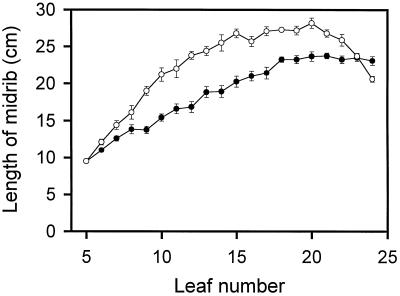
Figure 1
Figure 1
Leaf development in wild-type tobacco as measured by leaf midrib length. Plants were grown under nonsaturating light conditions in the growth chamber (•) or under saturating light conditions in the field (○). Leaf no. 5 was defined as the first leaf at the top of the plant to have a midrib length of 9.5 cm. Error bars represent se values (n = 6 individual plants). For points lacking error bars, the se was smaller than the symbol size.
Figure 2
Figure 2
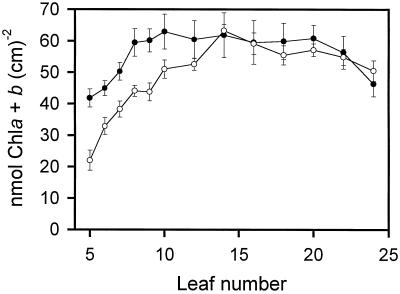
Development of total chlorophyll (Chl) content in wild-type tobacco plants grown under nonsaturating light conditions in the growth chamber (•) or under saturating light conditions in the field (○). Error bars represent se values (n = 5 individual plants).
Figure 3
Figure 3
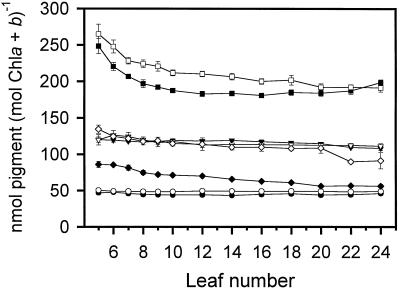
Pigment levels and VAZ pool of wild-type tobacco leaves based on total chlorophyll (Chl) determined by HPLC. Error bars represent se values (n = 5 individual plants). For points lacking error bars, the se was smaller than the symbol size. •, Neoxanthin, growth chamber; ○, neoxanthin, field; ▾, β-carotene, growth chamber; ▿, β-carotene, field; ▪, lutein, growth chamber; □, lutein, field; ♦, VAZ, growth chamber; ⋄, VAZ, field.
Figure 4
Figure 4
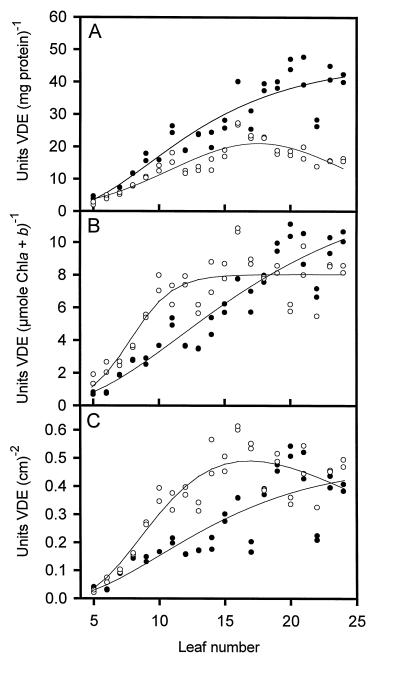
Violaxanthin de-epoxidase activity in wild-type tobacco leaves based on total protein (A), total chlorophyll (Chl) (B), and leaf area (C). Enzyme assays were performed in duplicate from enzyme extracted from a single tobacco plant, except for leaf nos. 5 through 8, which were a pooled sample from three tobacco plants. Regression curves were calculated using scientific graphing software (SigmaPlot, SPSS) ○, Field-grown plants; •, growth-chamber-grown plants.
Figure 5
Figure 5
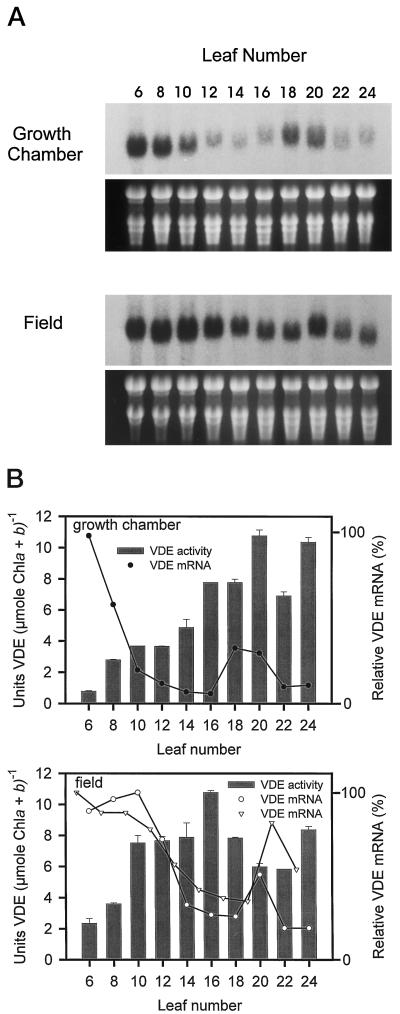
Developmental pattern of VDE transcript and activity in wild-type tobacco. A, RNA blots of total RNA (15 μg/lane) isolated from leaves of a growth-chamber-grown and a field-grown plant. RNA samples are from same leaf tissue used for determining VDE specific activity. The blots were probed with the full-length tobacco VDE cDNA. The hybridizing signals are approximately 1.7 kb. Ethidium bromide staining of rRNA is shown below each blot. B, VDE specific activity based on total chlorophyll (Chl) as reported in Figure 4B. The error bars represent se values (n = two assays). The relative VDE mRNA levels were determined from the RNA blots. The plot labeled with the open inverted triangles represents the relative VDE mRNA levels determined from another field-grown plant in which the odd-numbered leaves were analyzed to show the reproducibility of the RNA-blot analysis. The blots were digitized and the signals quantified according to area and average intensity using image analysis software. A value of 100% on the ordinate represents the maximum steady-state mRNA detected within the experiment.
Figure 6
Figure 6
Relationship between VDE specific activity based on total chlorophyll (Chl) (data from Fig. 4B) versus the VAZ pool based on total chlorophyll (data from Fig. 3) in leaves of both field-grown and growth-chamber-grown plants. Regression curves were calculated using scientific graphing software (SigmaPlot).

References

    1. Arvidsson P-O, Bratt CE, Carlsson M, Åkerlund H-E. Purification and identification of the violaxanthin deepoxidase as a 43 kDa protein. Photosynth Res. 1996;49:119–129. - PubMed
    1. Bugos RC, Hieber AD, Yamamoto HY. Xanthophyll cycle enzymes are members of the lipocalin family, the first identified from plants. J Biol Chem. 1998;273:15321–15324. - PubMed
    1. Bugos RC, Yamamoto HY. Molecular cloning of violaxanthin de-epoxidase from romaine lettuce and expression in Escherichia coli. Proc Natl Acad Sci USA. 1996;93:6320–6325. - PMC - PubMed
    1. Church GM, Gilbert W. Genomic sequencing. Proc Natl Acad Sci USA. 1984;81:1991–1995. - PMC - PubMed
    1. Demmig B, Winter K, Krüger A, Czygan F-C. Photoinhibition and zeaxanthin formation in intact leaves: a possible role of the xanthophyll cycle in the dissipation of excess light energy. Plant Physiol. 1987;84:218–224. - PMC - PubMed

Publication types

MeSH terms

LinkOut - more resources