


Cardiac endothelial transport and metabolism of adenosine and inosine
- PMID: 10484446
- PMCID: PMC3483093
- DOI: 10.1152/ajpheart.1999.277.3.H1241
Cardiac endothelial transport and metabolism of adenosine and inosine
Abstract
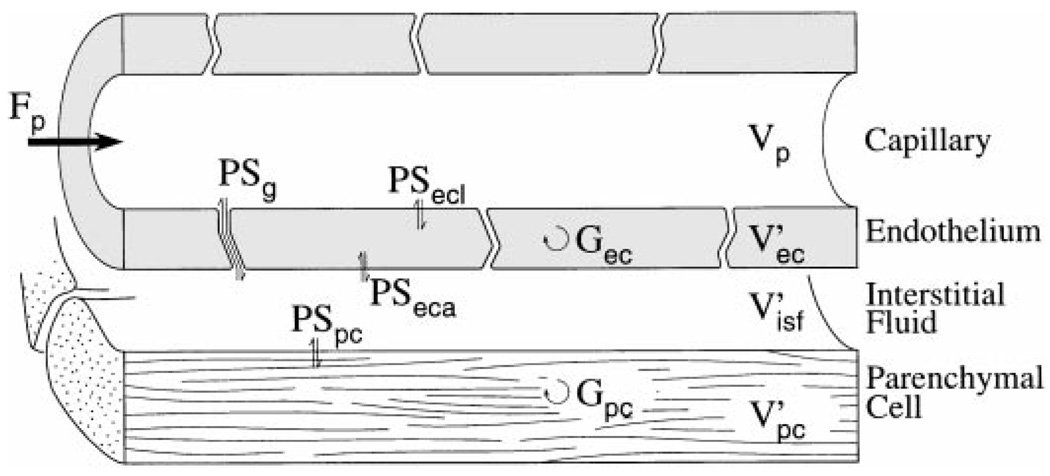
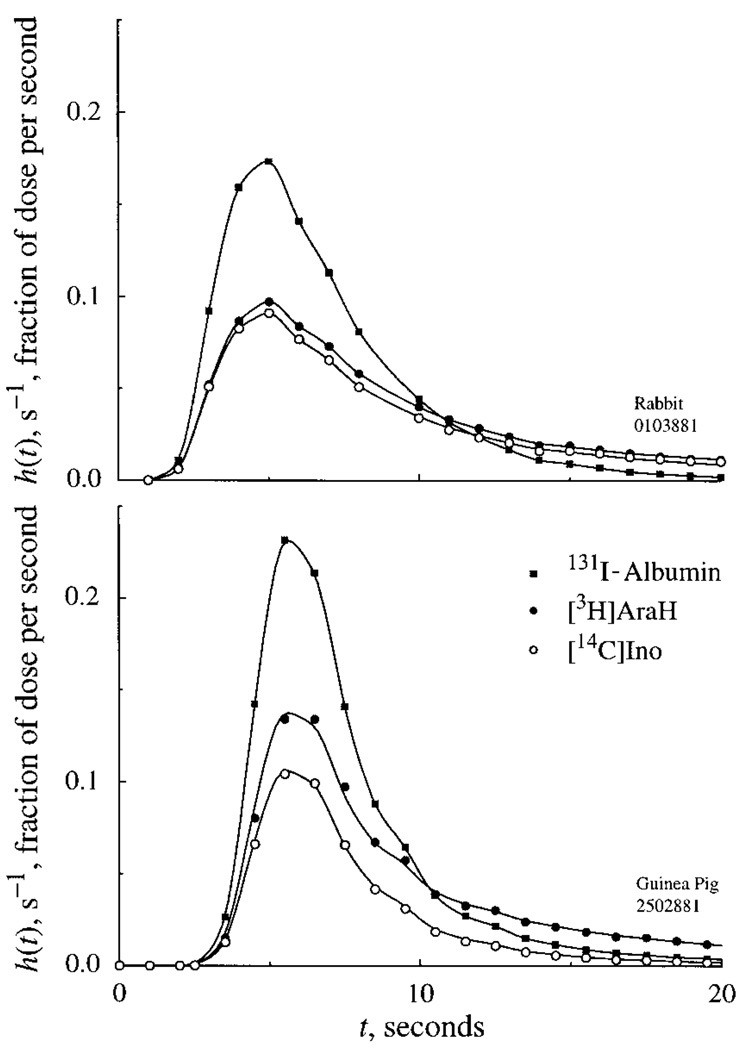
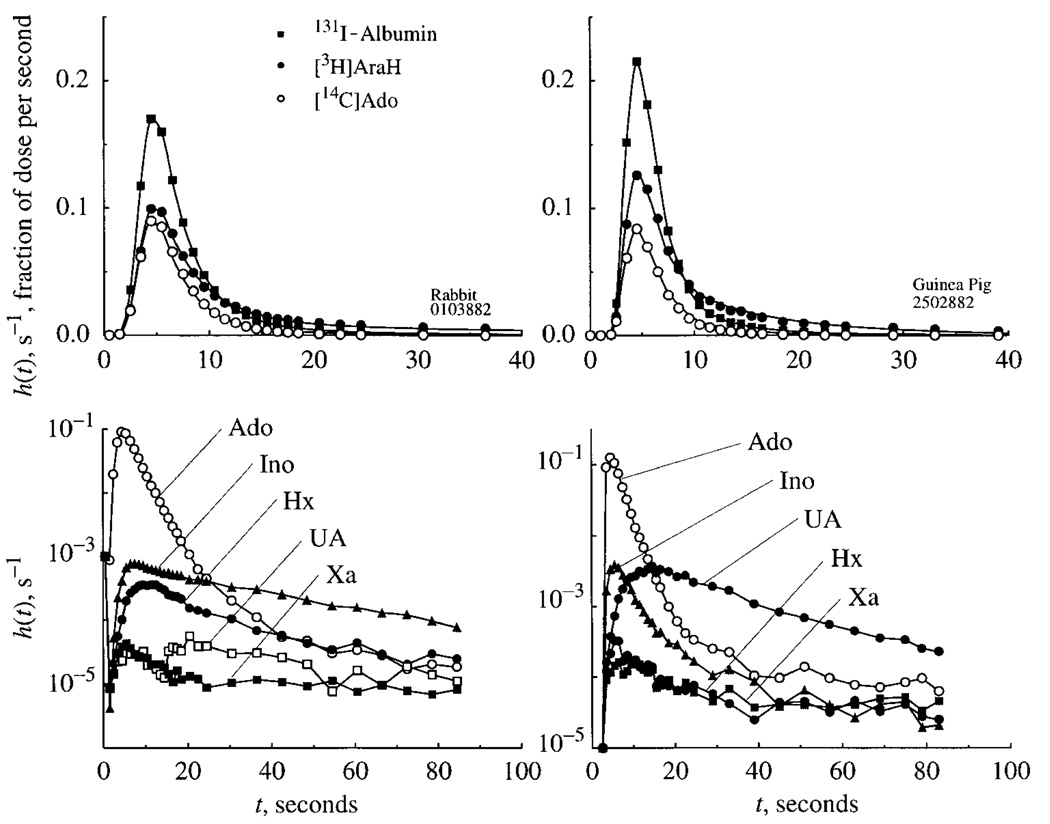
The influence of transmembrane flux limitations on cellular metabolism of purine nucleosides was assessed in whole organ studies. Transcapillary transport of the purine nucleosides adenosine (Ado) and inosine (Ino) via paracellular diffusion through interendothelial clefts in parallel with carrier-mediated transendothelial fluxes was studied in isolated, Krebs-Henseleit-perfused rabbit and guinea pig hearts. After injection into coronary inflow, multiple-indicator dilution curves were obtained from coronary outflow for 90 s for 131I-labeled albumin (intravascular reference tracer), [3H]arabinofuranosyl hypoxanthine (AraH; extracellular reference tracer and nonreactive adenosine analog), and either [14C]Ado or [14C]Ino. Ado or Ino was separated from their degradative products, hypoxanthine, xanthine, and uric acid, in each outflow sample by HPLC and radioisotope counting. Ado and Ino, but not AraH, permeate the luminal membrane of endothelial cells via a saturable transporter with permeability-surface area product PS(ecl) and also diffuse passively through interendothelial clefts with the same conductance (PSg) as AraH. These parallel conductances were estimated via fitting with an axially distributed, multi-pathway, four-region blood-tissue exchange model. PSg for AraH were approximately 4 and 2.5 ml. g(-1). min(-1) in rabbits and guinea pigs, respectively. In contrast, transplasmalemmal conductances (endothelial PS(ecl)) were approximately 0.2 ml. g(-1). min(-1) for both Ado and Ino in rabbit hearts but approximately 2 ml. g(-1). min(-1) in guinea pig hearts, an order of magnitude different. Purine nucleoside metabolism also differs between guinea pig and rabbit cardiac endothelium. In guinea pig heart, 50% of the tracer Ado bolus was retained, 35% was washed out as Ado, and 15% was lost as effluent metabolites; 25% of Ino was retained, 50% washed out, and 25% was lost as metabolites. In rabbit heart, 45% of Ado was retained and 5% lost as metabolites, and 7% of Ino was retained and 3% lost as metabolites. We conclude that endothelial transport of Ado and Ino is a prime determinant of their metabolic fates: where transport rates are high, metabolic transformation is high.
Figures
References
-
- Bardenheuer H, Whelton B, Sparks HV., Jr Adenosine release by the isolated guinea pig heart in response to isoproterenol, acetylcholine, and acidosis: the minimal role of vascular endothelium. Circ. Res. 1987;61:594–600. - PubMed
-
- Bassingthwaighte JB, Chan IS, Wang CY. Computationally efficient algorithms for capillary convection-permeation-diffusion models for blood-tissue exchange. Ann. Biomed. Eng. 1992;20:687–725. - PubMed
-
- Bassingthwaighte JB, Goresky CA. Handbook of Physiology. The Cardiovascular System. The Microcirculation. Bethesda, MD: Am. Physiol. Soc.; 1984. Modeling in the analysis of solute and water exchange in the microvasculature; pp. 549–626. sect. 2, vol. IV, pt. 1, chapt. 13.
Publication types
MeSH terms
Substances
Grants and funding
LinkOut - more resources
Full Text Sources
Miscellaneous
