. 1999 Oct;39(4):211-8.
doi: 10.1007/s002849900447.

Vacuolating cytotoxin (vacA) alleles of Helicobacter pylori comprise two geographically widespread types, m1 and m2, and have evolved through limited recombination

Affiliations

Vacuolating cytotoxin (vacA) alleles of Helicobacter pylori comprise two geographically widespread types, m1 and m2, and have evolved through limited recombination

J C Atherton et al. Curr Microbiol. 1999 Oct.

Abstract

Vacuolating cytotoxin (vacA) alleles of Helicobacter pylori vary, particularly in their mid region (which may be type m1 or m2) and their signal peptide coding region (type s1 or s2). We investigated nucleotide diversity among vacA alleles in strains from several locales in Asia, South America, and the USA. Phylogenetic analysis of vacA mid region sequences from 18 strains validated the division into two main groups (m1 and m2) and showed further significant divisions within these groups. Informative site analysis demonstrated one example of recombination between m1 and m2 alleles, and several examples of recombination among alleles within these groups. Recombination was not sufficiently extensive to destroy phylogenetic structure entirely. Synonymous nucleotide substitution rates were markedly different between regions of vacA, suggesting different evolutionary divergence times and implying horizontal transfer of genetic elements within vacA. Non-synonymous/synonymous rate ratios were greater between m1 and m2 sequences than among m1 sequences, consistent with m1 and m2 alleles encoding functions fitting strains for slightly different ecological niches.


Figures
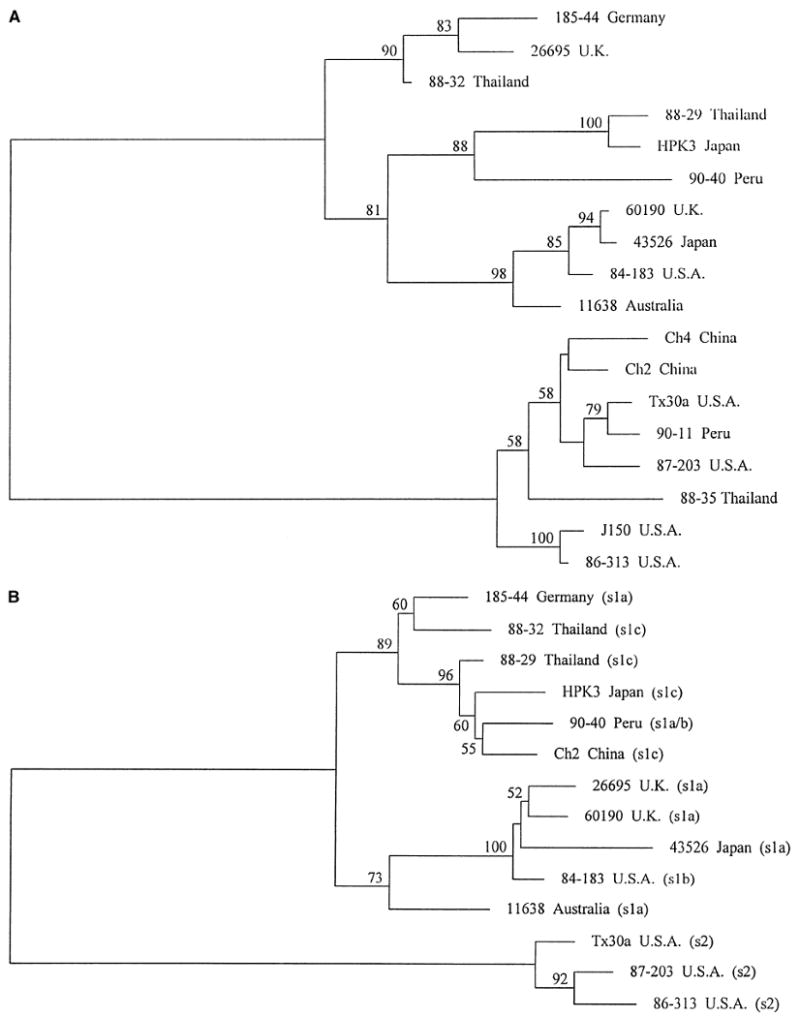
Fig. 1
Fig. 1
Phylogenetic relationships among strains based on two adjacent sections of the vacA mid region sequence. Trees were mid-pointed rooted, separating the vacA type m1 strains (upper cluster) from the vacA type m2 strains (lower cluster). Horizontal distances between strains indicate relatedness. Numbers on branches indicate the percentage of bootstrap replicates in which the clusters to the right were found (only values greater than 50% are shown); in both cases, the separation of the two main clusters occurred in 100% of bootstraps. Panel A is based on multiple sequence alignments of part of the distal mid region of vacA (region A, coordinates 1971–2259 bp in strain Tx30a [1]). Panel B is based on the part of the vacA mid region immediately 5′ region to that analyzed in Panel A (region B, coordinates 1606–1970 bp in strain Tx30a [1]). Five m2 strains are not included in Panel B because sequence data were not obtained for them for this region. The type of signal sequence coding region in each strain, as determined by nucleotide sequence analysis, is added in brackets. Strain 90-40 has a signal region type intermediate between s1a and s1b.
Fig. 2
Fig. 2
Region of vacA containing the recombination site in strain Ch2 (coordinates 1931–2030 bp in strain Tx30a [1]). Homologous sequence from the three ml (top) and three m2 (bottom) alleles that cluster most closely with sequence from strain Ch2 on either side of the recombination site are shown. Dots represent identity compared with the sequence from strain 90-40. For the first part of the sequence shown, up to the grey box, the Ch2 sequence is highly similar to that from vacA m1 strains. After the box, the sequence closely matches that from m2 strains. The box contains the likely recombination point.
Fig. 3
Fig. 3
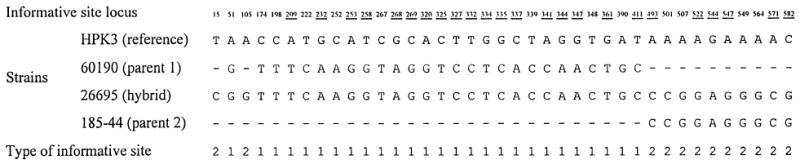
Informative site analysis to demonstrate the hybrid nature of vacA in strain 26695, the strain for which the complete genome sequence has been determined [25]. Dashes represent nucleotide identity with the reference sequence (HPK3). Strains 60190 and 185-44, which cluster most closely with 26695 in Fig. 1B and 1A, respectively, were taken as parent-like strains, and strain HPK3, which clusters distantly in both trees, was used as a reference strain. Only informative sites (sites where two pairs of strains have identical nucleotides) are shown, and these are numbered from the beginning of the concatenated sequence of regions A and B analyzed in Fig. 1 (coordinates 1606–2259 bp in strain Tx30a [1]). Type 1 sites suggest clustering of 26695 with 60190, type 2 with 185-44, and type 3 (of which there are none) with HPK3. Underlined and emboldened loci are non-synonymous substitutions compared with the other pair of sequences. The distribution of type 1 and 2 informative sites is clearly non-random (p < 10−4) and shows a recombination point somewhere between sites 411 and 493 of the concatenated sequence.

References

    1. Atherton JC, Cao P, Peek RM, Tummuru MKR, Blaser MJ, Cover TL. Mosaicism in vacuolating cytotoxin alleles of Helicobacter pylori. Association of specific vacA types with cytotoxin production and peptic ulceration. J Biol Chem. 1995;270:17771–17777. - PubMed
    1. Atherton JC, Peek RM, Tham KT, Cover TL, Blaser MJ. Clinical and pathological importance of heterogeneity in vacA, the vacuolating cytotoxin gene of Helicobacter pylori. Gastroenterology. 1997;112:92–99. - PubMed
    1. Blaser MJ. The changing relationship of Helicobacter pylori and humans: implications for health and disease. J Infect Dis. 1999 in press. - PubMed
    1. Cover TL, Blaser MJ. Helicobacter pylori infection, a paradigm for chronic mucosal inflammation: pathogenesis and implications for eradication and prevention. Adv Intern Med. 1996;41:85–117. - PubMed
    1. Cover TL, Tummuru MKR, Cao P, Thompson SA, Blaser MJ. Divergence of genetic sequences for the vacuolating cytotoxin among Helicobacter pylori strains. J Biol Chem. 1994;269:10566–10573. - PubMed

Publication types

LinkOut - more resources