Disturbance of cerebral function in people exposed to drinking water contaminated with aluminium sulphate: retrospective study of the Camelford water incident
- PMID: 10496822
- PMCID: PMC314205
- DOI: 10.1136/bmj.319.7213.807
Disturbance of cerebral function in people exposed to drinking water contaminated with aluminium sulphate: retrospective study of the Camelford water incident
Abstract
Objective: To establish whether people exposed to drinking water contaminated with 20 tonnes of aluminium sulphate in the Camelford area of Cornwall in the south west of England in July 1988 had suffered organic brain damage as opposed to psychological trauma only.
Design: Retrospective study of affected people.
Participants: 55 affected people and 15 siblings nearest in age to one of the group but who had not been exposed to the contaminated water were studied.
Main outcome measures: Various clinical and psychological tests to determine medical condition and anxiety levels in affected people. Assessment of premorbid IQ (pFSIQ) with the national adult reading test, a computerised battery of psychomotor testing, and measurement of the difference in latencies between the flash and pattern visual evoked potentials in all participants.
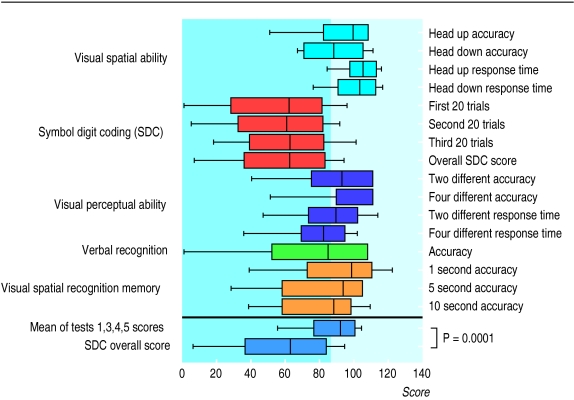
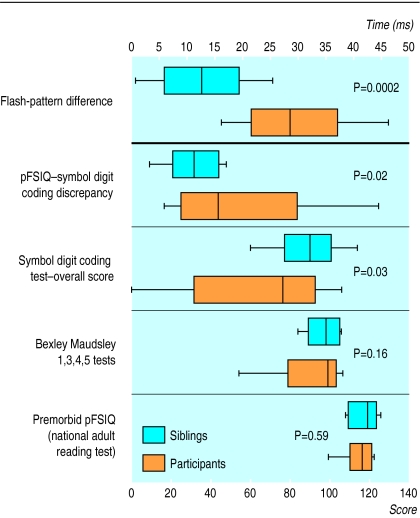
Results: The mean (SE) pFSIQ was above average at 114.4 (1.1). The most sensitive of the psychomotor tests for organic brain disease was the symbol digit coding (SDC) test (normal score 100, abnormal <85). PARTICIPANTS performed less well on this test (54.5 (6.0)) than expected from their pFSIQ (P<0.0001) and a little less poorly on the averaged less discriminating tests within the battery (86.1 (2.5), P<0.0001). In a comparison with the 15 sibling pairs (affected people's age 41.0 (3.3) years v sibling age of 42.7 (3.1) years (P=0.36) the exposed people had similar pFSIQ (114.7 (2.1)) to their siblings (116.3 (2.1), (P=0.59) but performed badly on the symbol digit coding test (51.8 (16.6)) v (87.5 (4.9) for siblings, P=0.03). The flash-pattern differences in exposed people were greater than in 42 unrelated control subjects of similar age (27.33 (1.64) ms v 18. 57 (1.47) ms, P=0.0002). The 15 unexposed siblings had significantly better flash-pattern differences than their affected siblings (13.4 (2.4) ms v 29.6 (2.9) ms, P=0.0002). No effect of anxiety could be shown on these measurements from the analysis of the anxiety scores of exposed people.
Conclusion: People who were exposed to the contaminated water at Camelford suffered considerable damage to cerebral function, which was not related to anxiety. Follow up studies would be required to determine the longer term prognosis for affected individuals.
Figures
Comment in
-
Camelford water incident.BMJ. 2000 Jun 3;320(7248):1536. BMJ. 2000. PMID: 10877574 Free PMC article. No abstract available.
-
Cerebral dysfunction after water pollution incident in Camelford. Results were biased by self selection of cases.BMJ. 2000 May 13;320(7245):1337. BMJ. 2000. PMID: 10885914 Free PMC article. No abstract available.
-
Cerebral dysfunction after water pollution incident in Camelford. Study has several methodological errors.BMJ. 2000 May 13;320(7245):1337-8. BMJ. 2000. PMID: 10885915 No abstract available.
-
Cerebral dysfunction after water pollution incident in Camelford. Inappropriate study, inappropriate conclusions.BMJ. 2000 May 13;320(7245):1338. BMJ. 2000. PMID: 10885916 No abstract available.
-
Cerebral dysfunction after water pollution incident in Camelford. Study may prolong the agony.BMJ. 2000 May 13;320(7245):1338. BMJ. 2000. PMID: 10885917 No abstract available.
References
-
- Clayton B.on behalf of Lowermoor Incident Health Advisory Group. Water pollution at Lowermoor, North Cornwall. 1989Truro: Cornwall and Isles of Scilly District Health Authority
-
- Owen PJ, Miles DP. A review of hospital discharge rates in a population around Camelford in North Cornwall up to the fifth anniversary of an episode of aluminium sulphate absorption. J Public Health Med. 1995;17:200–204. - PubMed
-
- Clayton B.on behalf of Lowermoor Incident Health Advisory Group, Department of Health. Water pollution at Lowermoor, North Cornwall (second report). 1991London: HMSO
-
- McMillan TM, Freemont AJ, Herxheimer A, Denton J, Taylor AP, Pazianas M, et al. Camelford water poisoning accident: serial neuropsychological assessments and further observations on bone aluminium. Hum Exp Toxicol. 1993;12:37–42. - PubMed
Publication types
MeSH terms
Substances
LinkOut - more resources
Full Text Sources
Medical