


Immune responses induced by gene gun or intramuscular injection of DNA vaccines that express immunogenic regions of the serine repeat antigen from Plasmodium falciparum
- PMID: 10496891
- PMCID: PMC96866
- DOI: 10.1128/IAI.67.10.5163-5169.1999
Immune responses induced by gene gun or intramuscular injection of DNA vaccines that express immunogenic regions of the serine repeat antigen from Plasmodium falciparum
Abstract
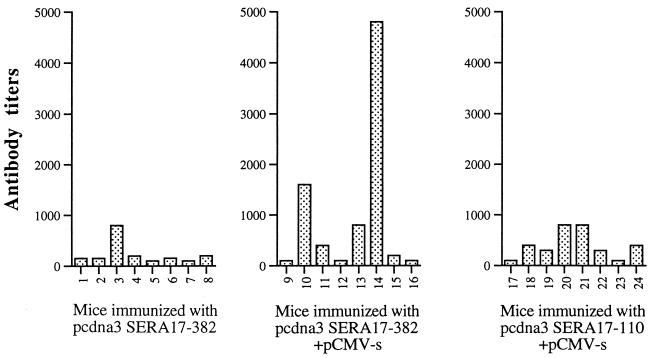
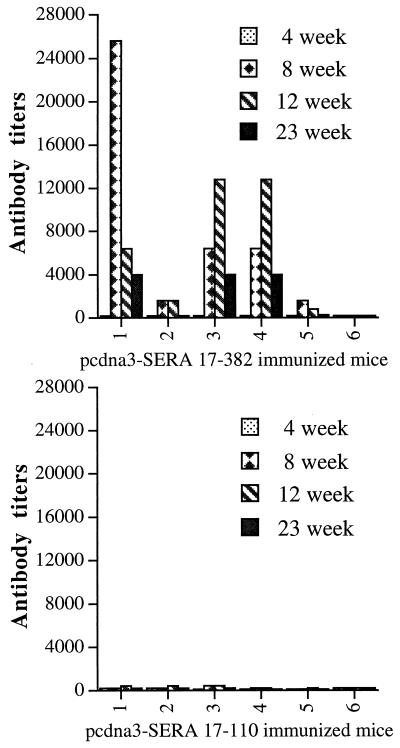
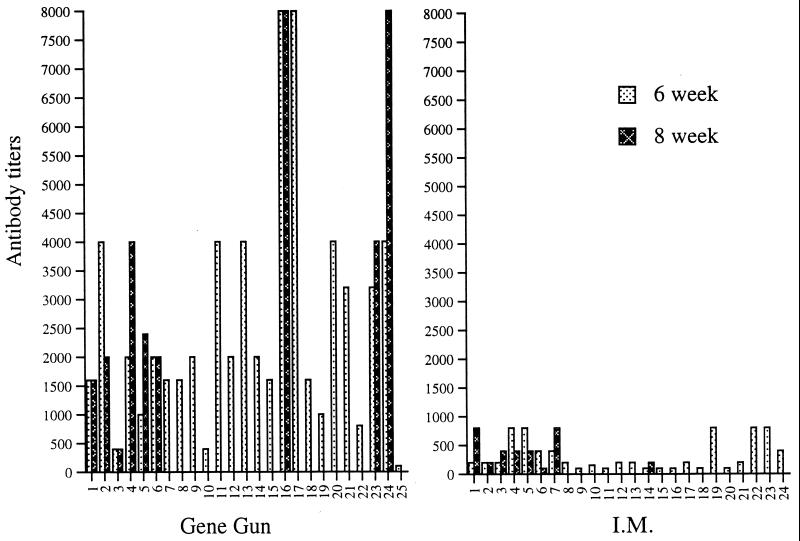
The liver- and blood-stage-expressed serine repeat antigen (SERA) of Plasmodium falciparum is a candidate protein for a human malaria vaccine. We compared the immune responses induced in mice immunized with SERA-expressing plasmid DNA vaccines delivered by intramuscular (i.m.) injection or delivered intradermally by Gene Gun immunization. Mice were immunized with a pcdna3 plasmid encoding the entire 47-kDa domain of SERA (amino acids 17 to 382) or the N-terminal domain (amino acids 17 to 110) of SERA. Minimal antibody responses were detected following DNA vaccination with the N-terminal domain of SERA, suggesting that the N-terminal domain alone is not highly immunogenic by this route of vaccine delivery. Immunization of mice by Gene Gun delivery of the 47-kDa domain of SERA elicited a significantly higher serum antibody titer to the antigen than immunization of mice by i.m. injection with the same plasmid did. The predominant isotype subclass of the antibodies elicited to the SERA protein following i.m. and Gene Gun immunizations with SERA plasmid DNA was immunoglobulin G1. Coimmunization of mice with SERA plasmid DNA and a plasmid expressing the hepatitis B surface antigen (pCMV-s) by the i.m. route resulted in higher anti-SERA titers than those generated in mice immunized with the SERA DNA plasmid alone. Vaccination with DNA may provide a viable alternative or may be used in conjunction with protein-based subunit vaccines to maximize the efficacy of a human malaria vaccine that includes immunogenic regions of the SERA protein.
Figures
References
-
- Banyal H S, Inselburg J. Isolation and characterization of parasite-inhibitory Plasmodium falciparum monoclonal antibodies. Am J Trop Med Hyg. 1985;34:1055–1064. - PubMed
-
- Barr P J, Inselburg J, Green L M, Kansopon J, Hahm B K, Gibson H L, Lee-Ng C T, Bzik D J, Li W-B, Bathurst I C. Immunogenicity of recombinant Plasmodium falciparum SERA proteins in rodents. Mol Biochem Parasitol. 1991;45:159–170. - PubMed
-
- Bhatia A, Delplace P, Fortier B, Dubremetz J F, Vernes A. Immunochemical analysis of a major antigen of Plasmodium falciparum (P126) among ten geographic isolates. Am J Trop Med Hyg. 1987;36:15–19. - PubMed
Publication types
MeSH terms
Substances
LinkOut - more resources
Full Text Sources
Other Literature Sources
