. 1999 Oct;43(10):2389-94.
doi: 10.1128/AAC.43.10.2389.

Effects of antibiotic therapy on Pseudomonas aeruginosa-induced lung injury in a rat model

Affiliations

Effects of antibiotic therapy on Pseudomonas aeruginosa-induced lung injury in a rat model

E J Ernst et al. Antimicrob Agents Chemother. 1999 Oct.

Abstract

The effect of antibiotics on the acute lung injury induced by virulent Pseudomonas aeruginosa PA103 was quantitatively analyzed in a rat model. Lung injury was induced by the instillation of PA103 directly into the right lower lobes of the lungs of anesthetized rats. The alveolar epithelial injury, extravascular lung water, and total plasma equivalents were measured as separate, independent parameters of acute lung injury. Four hours after the instillation of PA103, all the parameters were increased linearly depending on the dose of P. aeruginosa. Next, we examined the effects of intravenously administered antibiotics on the parameters of acute lung injury in D-galactosamine-sensitized rats. One hour after the rats received 10(7) CFU of PA103, an intravenous bolus injection of aztreonam (60 mg/kg) or imipenem-cilastatin (30 mg/kg) was administered. Despite an MIC indicating resistance, imipenem-cilastatin improved all the measurements of lung injury; in contrast, aztreonam, which had an MIC indicating sensitivity, did not improve any of the lung injury parameters. The antibiotics did not generate different quantities of plasma endotoxin; therefore, endotoxin did not appear to explain the differences in lung injury. This in vivo model is useful to quantitatively compare the efficacies of parenteral antibiotic administration on Pseudomonas airspace infections.


Figures
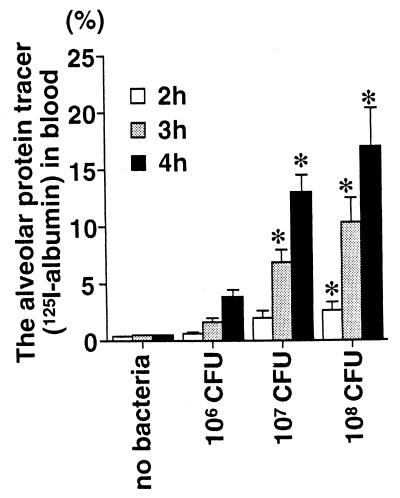
FIG. 1
FIG. 1
Alveolar epithelial injury in rats instilled with three different doses of P. aeruginosa. The rats received an instillate that included the alveolar protein tracer 125I-albumin without bacteria (control) or with P. aeruginosa PA103 (106, 107, or 108 CFU) in their lungs. The percentage of the alveolar protein tracer in the blood at 2, 3, or 4 h after the instillation was calculated. The data are means + standard errors. ∗, P < 0.05. P values are by comparison with the results for the control group that did not receive bacteria (analysis of variance followed by Dunnet’s test). The control (no-bacteria) and 106-, 107-, and 108-CFU groups had seven, six, nine, and five rats, respectively.
FIG. 2
FIG. 2
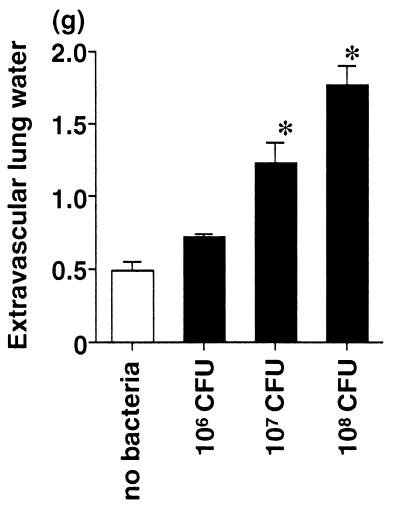
Extravascular lung water measurements in rats instilled with three different doses of P. aeruginosa. The rats received an instillate without bacteria (control) or with P. aeruginosa PA103 (106, 107, or 108 CFU) in their lungs. The amount of extravascular lung water was calculated 4 h after the instillation. The data are means + standard errors. ∗, P < 0.05. P values are by comparison with the results for the control group that did not receive bacteria. The control (no-bacteria) and 106-, 107-, and 108-CFU groups had seven, six, nine, and five rats, respectively.
FIG. 3
FIG. 3
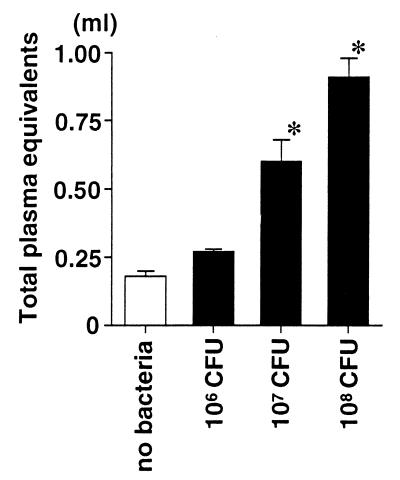
Total plasma equivalents in rats instilled with three different doses of P. aeruginosa. The rats received an instillate without bacteria (control) or with P. aeruginosa PA103 (106, 107, or 108 CFU) in their lungs. The total plasma equivalent was calculated 4 h after the instillation. The data are means + standard errors. ∗, P < 0.05. P values are by comparison with the results for the control group that did not receive bacteria. The control (no-bacteria) and 106-, 107-, and 108-CFU groups had seven, six, nine, and five rats, respectively.
FIG. 4
FIG. 4
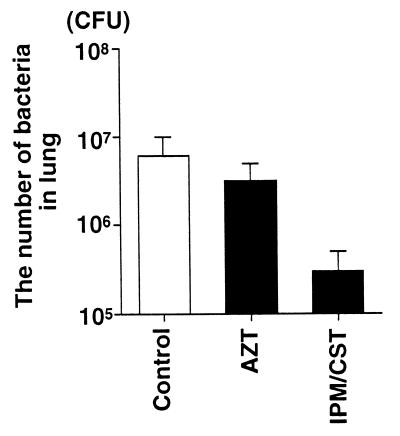
Effect of administration of aztreonam or imipenem-cilastatin on the number of bacteria in the right lung 6 h after the instillation of P. aeruginosa PA103. One hour after the airspace instillation of PA103 (107 CFU), an intravenous bolus dose of aztreonam (AZT; 60 mg/kg) or imipenem-cilastatin (IPM/CST; 30 mg/kg) was administered. Control rats (Control) received an equal volume of normal saline intravenously 1 h after the airspace instillation of PA103 (107 CFU). The data are means + standard errors (there were no statistically significant differences among groups by one-way analysis of variance). The control, AZT, and IPM/CST groups had seven, four, and four rats, respectively.
FIG. 5
FIG. 5
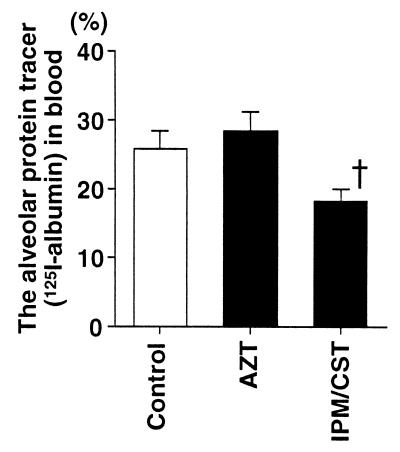
Alveolar epithelial injury in rats instilled with P. aeruginosa and then treated with aztreonam or imipenem-cilastatin. One hour after the airspace instillation of PA103 (107 CFU) with the alveolar protein tracer 125I-albumin, an intravenous bolus dose of aztreonam (AZT; 60 mg/kg) or imipenem-cilastatin (IPM/CST; 30 mg/kg) was administered. The percentage of the alveolar protein tracer in the blood 6 h after the instillation was calculated. The data are means + standard errors. †, P < 0.05. P values are by comparison with the results for the AZT group (one-way analysis of variance followed by Dunnet’s test). The control, AZT, and IPM/CST groups had seven, four, and four rats, respectively.
FIG. 6
FIG. 6
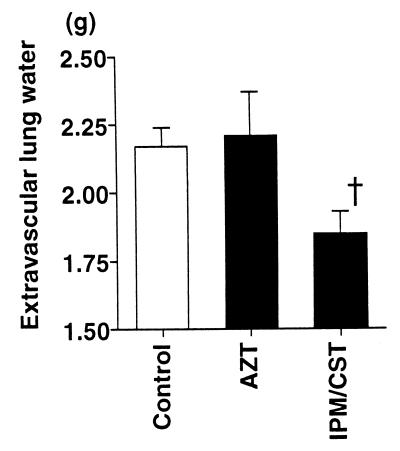
Extravascular lung water measurements in rats instilled with P. aeruginosa and then treated with aztreonam or imipenem-cilastatin. One hour after the airspace instillation of PA103 (107 CFU) with the alveolar protein tracer 125I-albumin, an intravenous bolus dose of aztreonam (AZT; 60 mg/kg) or imipenem-cilastatin (IPM/CST; 30 mg/kg) was administered. The extravascular lung water 6 h after the instillation was calculated. Data are means + standard errors. †, P < 0.05. P values are by comparison with the results for the AZT group (one-way analysis of variance followed by Dunnet’s test). The control, AZT, and IPM/CST groups had seven, four, and four rats, respectively.
FIG. 7
FIG. 7
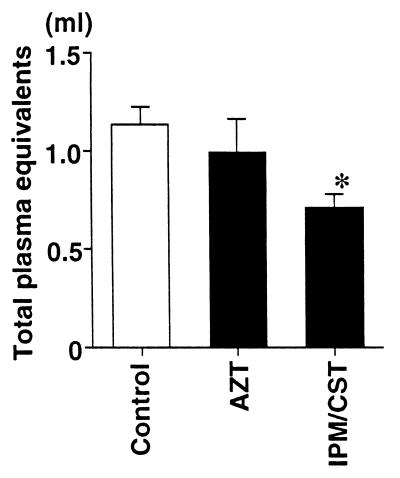
Total plasma equivalents in rats instilled with P. aeruginosa and then treated with aztreonam or imipenem-cilastatin. One hour after an airspace instillation of PA103 (107 CFU), an intravenous bolus dose of aztreonam (AZT; 60 mg/kg) or imipenem-cilastatin (IPM/CST; 30 mg/kg) was administered. The total plasma equivalents 6 h after the instillation of antibiotic were calculated. Data are means + standard errors. ∗, P < 0.05. P values are by comparison with the results for the control group (one-way analysis of variance followed by Dunnet’s test). The control, AZT, and IPM/CST groups had seven, four, and four rats, respectively.

References

    1. Allen K D, Green H T. Aztreonam in infections due to aerobic gram-negative bacteria. J Antimicrob Chemother. 1989;23:290–291. - PubMed
    1. Bahrami S, Redl H, Buurman W A, Schlag G. Influence of the xanthine derivative HWA 138 on endotoxin-related coagulation disturbances: effects in non-sensitized vs. D-galactosamine sensitized rats. Thromb Haemost. 1992;68:418–423. - PubMed
    1. Barza M. Imipenem: first of a new class of beta-lactam antibiotics. Ann Intern Med. 1985;103:552–560. - PubMed
    1. Birnbaum J F, Kahan M, Kropp H, MacDonald J S. Carbapenems, a new class of beta-lactam antibiotics. Discovery and development of imipenem/cilastatin. Am J Med. 1987;78:3–21. - PubMed
    1. Boccazzi A, Langer M, Mandeli M, Ranzi A M, Urso R. The pharmacokinetics of aztreonam and penetration into the bronchial secretions of critically ill patients. J Antimicrob Chemother. 1989;23:401–407. - PubMed

Publication types

MeSH terms