


Effect of milk proteins on adhesion of bacteria to stainless steel surfaces
- PMID: 10508087
- PMCID: PMC91605
- DOI: 10.1128/AEM.65.10.4543-4548.1999
Effect of milk proteins on adhesion of bacteria to stainless steel surfaces
Abstract
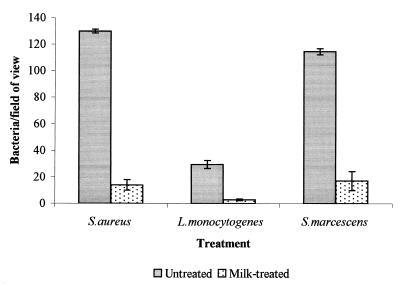
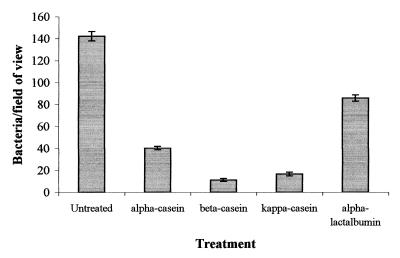
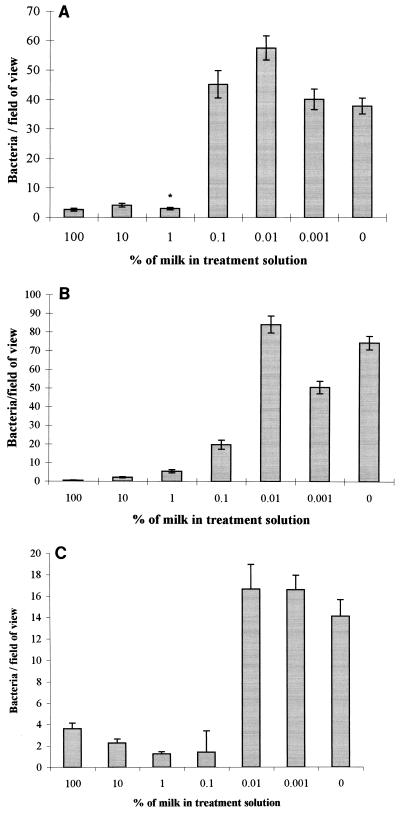
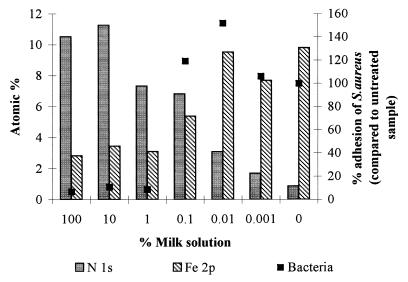
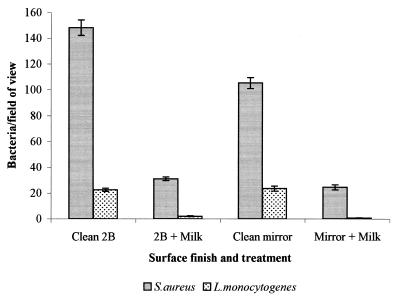
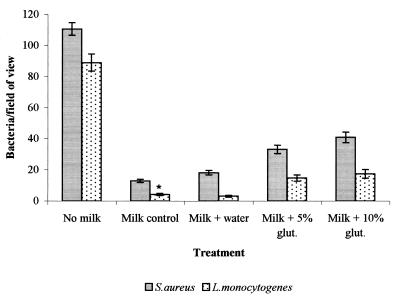
Stainless steel coupons were treated with skim milk and subsequently challenged with individual bacterial suspensions of Staphylococcus aureus, Pseudomonas fragi, Escherichia coli, Listeria monocytogenes, and Serratia marcescens. The numbers of attached bacteria were determined by direct epifluorescence microscopy and compared with the attachment levels on clean stainless steel with two different surface finishes. Skim milk was found to reduce adhesion of S. aureus, L. monocytogenes, and S. marcescens. P. fragi and E. coli attached in very small numbers to the clear surfaces, making the effect of any adsorbed protein layer difficult to assess. Individual milk proteins alpha-casein, beta-casein, kappa-casein, and alpha-lactalbumin were also found to reduce the adhesion of S. aureus and L. monocytogenes. The adhesion of bacteria to samples treated with milk dilutions up to 0.001% was investigated. X-ray photoelectron spectroscopy was used to determine the proportion of nitrogen in the adsorbed films. Attached bacterial numbers were inversely related to the relative atomic percentage of nitrogen on the surface. A comparison of two types of stainless steel surface, a 2B and a no. 8 mirror finish, indicated that the difference in these levels of surface roughness did not greatly affect bacterial attachment, and reduction in adhesion to a milk-treated surface was still observed. Cross-linking of adsorbed proteins partially reversed the inhibition of bacterial attachment, indicating that protein chain mobility and steric exclusion may be important in this phenomenon.
Figures
References
-
- Abbott A, Rutter P R, Berkeley R C W. The influence of ionic strength, pH and a protein layer on the interaction between Streptococcus mutans and glass surfaces. J Gen Microbiol. 1983;129:439–445. - PubMed
-
- Austin J W, Bergeron G. Development of bacterial biofilms in dairy processing lines. J Dairy Res. 1995;62:509–519. - PubMed
-
- Baker J H. Factors affecting the colonisation of various surfaces in a river. Can J Microbiol. 1984;30:511–515.
Publication types
MeSH terms
Substances
LinkOut - more resources
Full Text Sources
