


Production of chymotrypsin-resistant Bacillus thuringiensis Cry2Aa1 delta-endotoxin by protein engineering
- PMID: 10508095
- PMCID: PMC91613
- DOI: 10.1128/AEM.65.10.4601-4605.1999
Production of chymotrypsin-resistant Bacillus thuringiensis Cry2Aa1 delta-endotoxin by protein engineering
Abstract
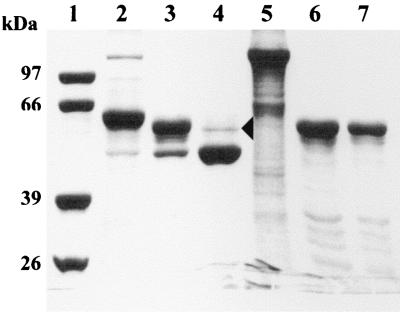
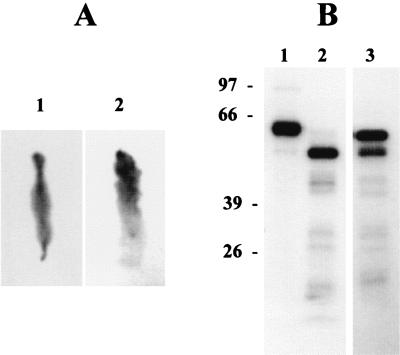
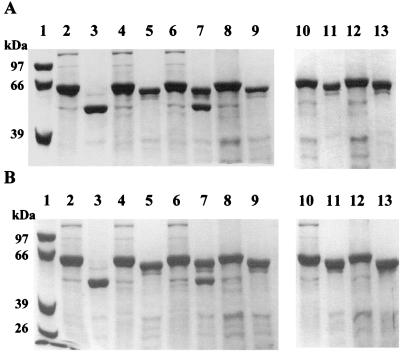
Cleavage of the Cry2Aa1 protoxin (molecular mass, 63 kDa) from Bacillus thuringiensis by midgut juice of gypsy moth (Lymantria dispar) larvae resulted in two major protein fragments: a 58-kDa fragment which was highly toxic to the insect and a 49-kDa fragment which was not toxic. In the midgut juice, the protoxin was processed into a 58-kDa toxin within 1 min, but after digestion for 1 h, the 58-kDa fragment was further cleaved within domain I, resulting in the protease-resistant 49-kDa fragment. Both the 58-kDa and nontoxic 49-kDa fragments were also found in vivo when (125)I-labeled toxin was fed to the insects. N-terminal sequencing revealed that the protease cleavage sites are at the C termini of Tyr49 and Leu144 for the active fragment and the smaller fragment, respectively. To prevent the production of the nontoxic fragment during midgut processing, five mutant proteins were constructed by replacing Leu144 of the toxin with Asp (L144D), Ala (L144A), Gly (L144G), His (L144H), or Val (L144V) by using a pair of complementary mutagenic oligonucleotides in PCR. All of the mutant proteins were highly resistant to the midgut proteases and chymotrypsin. Digestion of the mutant proteins by insect midgut extract and chymotrypsin produced only the active 58-kDa fragment, except that L144H was partially cleaved at residue 144.
Figures
References
-
- Bravo A, Hendrickx K, Jensens S, Peferoen M. Immunocytochemical analysis of specific binding of Bacillus thuringiensis insecticidal crystal proteins to lepidopteran and coleopteran midgut membranes. J Invertebr Pathol. 1992;60:247–253.
-
- Carroll J, Convents D, Van Damme J, Boets A, Van Rie J, Ellar D J. Intramolecular proteolytic cleavage of Bacillus thuringiensis Cry3A δ-endotoxin may facilitate its coleopteran toxicity. J Invertebr Pathol. 1997;70:41–49. - PubMed
-
- Choma C T, Kaplan H. Folding and unfolding of the protoxin from Bacillus thuringiensis: evidence that the toxic moiety is present in an active conformation. Biochemistry. 1990;29:10971–10977. - PubMed
Publication types
MeSH terms
Substances
Grants and funding
LinkOut - more resources
Full Text Sources
Other Literature Sources
