. 1999 Oct 4;190(7):935-42.
doi: 10.1084/jem.190.7.935.

Sulfation of a high endothelial venule-expressed ligand for L-selectin. Effects on tethering and rolling of lymphocytes

Affiliations

Sulfation of a high endothelial venule-expressed ligand for L-selectin. Effects on tethering and rolling of lymphocytes

K Tangemann et al. J Exp Med. .

Abstract

During lymphocyte homing, L-selectin mediates the tethering and rolling of lymphocytes on high endothelial venules (HEVs) in secondary lymphoid organs. The L-selectin ligands on HEV are a set of mucin-like glycoproteins, for which glycosylation-dependent cell adhesion molecule 1 (GlyCAM-1) is a candidate. Optimal binding in equilibrium measurements requires sulfation, sialylation, and fucosylation of ligands. Analysis of GlyCAM-1 has revealed two sulfation modifications (galactose [Gal]-6-sulfate and N-acetylglucosamine [GlcNAc]-6-sulfate) of sialyl Lewis x. Recently, three related sulfotransferases (keratan sulfate galactose-6-sulfotransferase [KSGal6ST], high endothelial cell N-acetylglucosamine-6-sulfotransferase [GlcNAc6ST], and human GlcNAc6ST) were cloned, which can generate Gal-6-sulfate and GlcNAc-6-sulfate in GlyCAM-1. Imparting these modifications to GlyCAM-1, together with appropriate fucosylation, yields enhanced rolling ligands for both peripheral blood lymphocytes and Jurkat cells in flow chamber assays as compared with those generated with exogenous fucosyltransferase. Either sulfation modification results in an increased number of tethered and rolling lymphocytes, a reduction in overall rolling velocity associated with more frequent pausing of the cells, and an enhanced resistance of rolling cells to detachment by shear. All of these effects are predicted to promote the overall efficiency of lymphocyte homing. In contrast, the rolling interactions of E-selectin transfectants with the same ligands are not affected by sulfation.


Figures
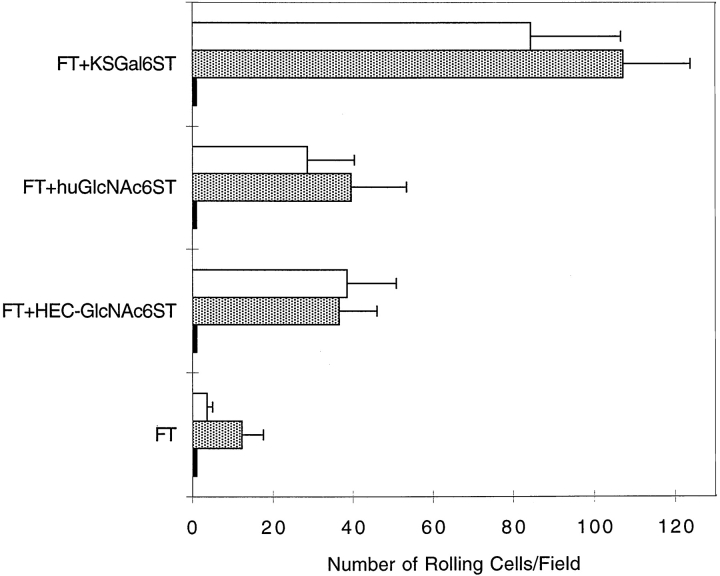
Figure 1
Figure 1
Rolling of PBLs and Jurkat cells on various GlyCAM-1/IgG chimeras under flow conditions. Purified recombinant GlyCAM-1/IgG chimeras were coated at equal site densities. PBLs (white bars) and Jurkat cells (gray bars) at 2 × 10⁶ cells/ml were perfused through the flow chamber at a wall shear stress of 1.25 or 1 dyn/cm2, respectively. At 2 min of flow, the number of rolling cells was determined. For inhibition studies (black bars), parallel samples of cells were preincubated with DREG56 mAb, fucoidin, or EDTA, or the immobilized GlyCAM-1/IgG was treated with sialidase. Stable tethering was completely absent (zero rolling cells) on nonfucosylated substrates that were sulfated by KSGal6ST, HEC-GlcNAc6ST. The values represent the mean ± SD of the number of rolling cells in at least two independent experiments, each performed in duplicate using two different fields of view. Statistical analysis using an unpaired two-tailed Student's t test showed that the enhanced binding of PBLs and Jurkat cells to sulfated GlyCAM-1/IgG was statistically significant in all cases (P < 0.0001).
Figure 2
Figure 2
Jurkat cell tethering onto various GlyCAM-1/IgG chimeras in shear flow. Jurkat cells (106 cells/ml) were perfused into the chamber, and the fraction of cells that came into close proximity with the substrate and tethered stably onto different GlyCAM-1/IgG chimeras was determined. Data points represent the mean ± SD of the frequency of stable tethers in three independent experiments, each performed in duplicate using two different fields of view. Statistical analysis using an unpaired two-tailed Student's t test showed that the enhanced tethering frequency of Jurkat cells to sulfated GlyCAM-1/IgG as compared with nonsulfated GlyCAM-1 was statistically significant (for KSGal6ST, P < 0.004 in the range of 0.4–1.5 dyn/cm2; for huGlcNAc6ST, P < 0.0002 in the range of 0.6–1 dyn/cm2; and for HEC-GlcNAc6ST, P < 0.002 in the range of 0.6–1.25 dyn/cm2).
Figure 4
Figure 4
Tethering and rolling of Jurkat cells on various GlyCAM-1/IgG chimeras over a range of site densities. Jurkat cells (2 × 10⁶ cells/ml) were perfused into the chamber at 1 dyn/cm2, and the frequency of stable tethers (A) and the velocity of cells (B) was determined after 2 min of flow. Data points represent the mean ± SD (A) and the mean ± SEM (B) in three independent experiments, each performed at least in duplicate. Statistical analysis using an unpaired two-tailed Student's t test showed that the enhanced tethering frequencies and slower velocities of Jurkat cells on sulfated GlyCAM-1/IgG as compared with nonsulfated GlyCAM-1/IgG were statistically significant (for KSGal6ST, P < 0.0001 [A and B] at all site densities; for HEC-GlcNAc6ST at 33.3 and 100%, P < 0.008 [A] and P < 0.005 [B]).
Figure 4
Figure 4
Tethering and rolling of Jurkat cells on various GlyCAM-1/IgG chimeras over a range of site densities. Jurkat cells (2 × 10⁶ cells/ml) were perfused into the chamber at 1 dyn/cm2, and the frequency of stable tethers (A) and the velocity of cells (B) was determined after 2 min of flow. Data points represent the mean ± SD (A) and the mean ± SEM (B) in three independent experiments, each performed at least in duplicate. Statistical analysis using an unpaired two-tailed Student's t test showed that the enhanced tethering frequencies and slower velocities of Jurkat cells on sulfated GlyCAM-1/IgG as compared with nonsulfated GlyCAM-1/IgG were statistically significant (for KSGal6ST, P < 0.0001 [A and B] at all site densities; for HEC-GlcNAc6ST at 33.3 and 100%, P < 0.008 [A] and P < 0.005 [B]).
Figure 3
Figure 3
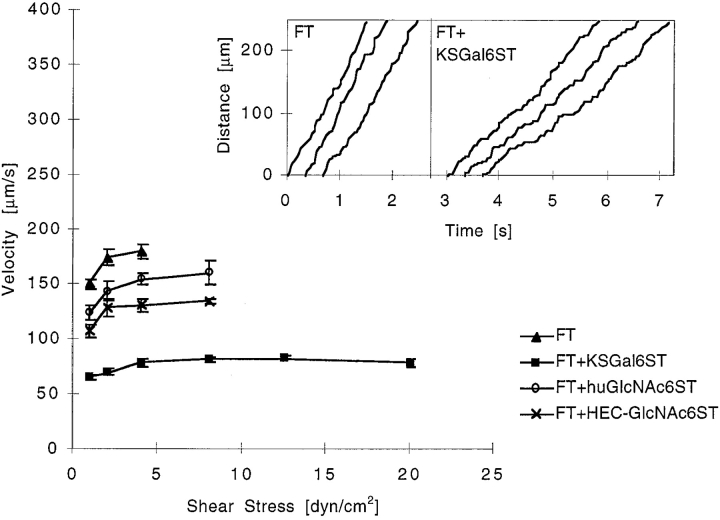
Comparison of Jurkat cell rolling velocities on various GlyCAM-1/IgG chimeras. Jurkat cells (2 × 10⁶ cells/ml) were tethered onto different GlyCAM-1/IgG chimeras at a wall shear stress of 1 dyn/cm2 for 2 min. Wall shear stress was then increased at intervals of 5 s to a maximum of 35 dyn/cm2, and rolling velocities over 1–3 s were measured. The data points represent the mean rolling velocity ± SE of the mean of three to four independent experiments, each performed in duplicate using two different fields of view. Statistical analysis using an unpaired two-tailed Student's t test showed that the reduced rolling velocity of Jurkat cells on sulfated GlyCAM-1/IgG as compared with nonsulfated GlyCAM-1 was statistically significant (for KSGal6ST, huGlcNAc6ST, and HEC-GlcNAc6ST, P < 0.0001 at ≥1 dyn/cm2). The inset shows the frame-by-frame (1/30 s) displacement of several randomly chosen cells as described in Materials and Methods.
Figure 5
Figure 5
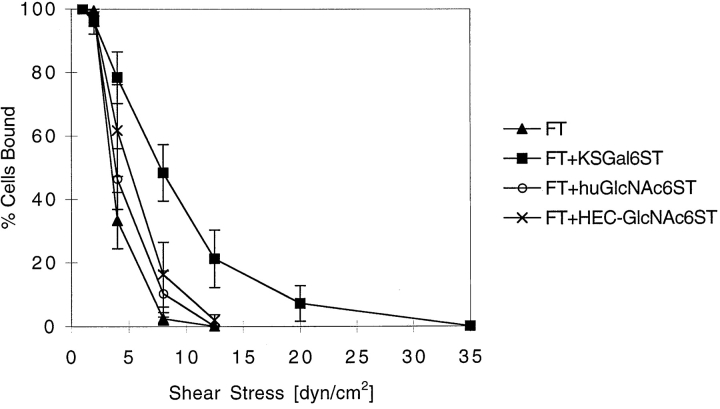
Resistance of rolling Jurkat cells to shear-induced detachment on various GlyCAM-1/IgG chimeras. Jurkat cells (2 × 10⁶ cells/ml) were allowed to tether onto different GlyCAM-1/IgG chimeras at a wall shear stress of 1 dyn/cm2 for 2 min. Wall shear stress was then increased at intervals of 5 s to a maximum of 35 dyn/cm2, and the number of rolling cells remaining bound at each shear stress was determined and expressed as the percentage of the maximum number of adherent cells. The data points represent the mean ± SD of three to four independent experiments, each performed in duplicate in two different fields of view. A statistical comparison of the detachment curves using a two-factor analysis of variance showed that the increased binding to sulfated GlyCAM-1/IgG as compared with nonsulfated GlyCAM-1 was statistically significant (for KSGal6ST, P < 0.0001; for huGlcNAc6ST, P < 0.02; and for HEC-GlcNAc6ST, P < 0.0003).

References

    1. Girard J.-P., Springer T.A. High endothelial venulesspecialized endothelium for lymphocyte migration. Immunol. Today. 1995;16:449–457. - PubMed
    1. Butcher E.C., Picker L.J. Lymphocyte homing and homeostasis. Science. 1996;272:60–66. - PubMed
    1. Rosen S.D. Selectins. In: Vale R., Kreis T., editors. Guide to the Extracellular Matrix and Adhesion Proteins. 2nd Edition. Oxford University Press; Oxford, UK: 1999. pp. 290–297.
    1. Imai Y., Lasky L.A., Rosen S.D. Sulphation requirement for GlyCAM-1, an endothelial ligand for L-selectin. Nature. 1993;361:555–557. - PubMed
    1. Hemmerich S., Butcher E.C., Rosen S.D. Sulfation-dependent recognition of HEV-ligands by L-selectin and MECA 79, an adhesion-blocking mAb. J. Exp. Med. 1994;180:2219–2226. - PMC - PubMed

Publication types

MeSH terms