. 1999 Oct;181(20):6238-46.
doi: 10.1128/JB.181.20.6238-6246.1999.

Genetic and biochemical characterization of a high-affinity betaine uptake system (BusA) in Lactococcus lactis reveals a new functional organization within bacterial ABC transporters

Affiliations

Genetic and biochemical characterization of a high-affinity betaine uptake system (BusA) in Lactococcus lactis reveals a new functional organization within bacterial ABC transporters

D Obis et al. J Bacteriol. 1999 Oct.

Abstract

The cytoplasmic accumulation of exogenous betaine stimulates the growth of Lactococcus lactis cultivated under hyperosmotic conditions. We report that L. lactis possesses a single betaine transport system that belongs to the ATP-binding cassette (ABC) superfamily of transporters. Through transposon mutagenesis, a mutant deficient in betaine transport was isolated. We identified two genes, busAA and busAB, grouped in an operon, busA (betaine uptake system). The transcription of busA is strongly regulated by the external osmolality of the medium. The busAA gene codes for the ATP-binding protein. busAB encodes a 573-residue polypeptide which presents two striking features: (i) a fusion between the regions encoding the transmembrane domain (TMD) and the substrate-binding domain (SBD) and (ii) a swapping of the SBD subdomains when compared to the Bacillus subtilis betaine-binding protein, OpuAC. BusA of L. lactis displays a high affinity towards betaine (K(m) = 1.7 microM) and is an osmosensor whose activity is tightly regulated by external osmolality, leading the betaine uptake capacity of L. lactis to be under dual control at the biochemical and genetic levels. A protein presenting the characteristics predicted for BusAB was detected in the membrane fraction of L. lactis. The fusion between the TMD and the SBD is the first example of a new organization within prokaryotic ABC transporters.


Figures
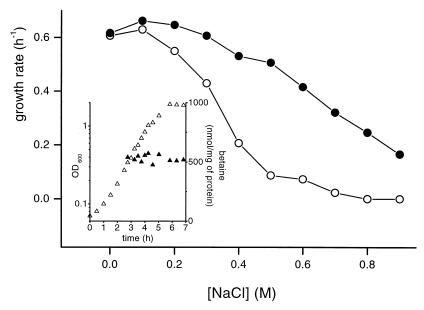
FIG. 1
FIG. 1
Effect of increased osmolality on the growth rates of L. lactis NCDO763. Cells were grown in CDM without (○) or with (●) 1 mM betaine. The osmolality was increased by the addition of NaCl. The inset shows a growth curve (▵) in CDM containing 0.3 M NaCl and 1 mM betaine, and the intracellular betaine content (▴) was measured by HPLC analysis at different times.
FIG. 2
FIG. 2
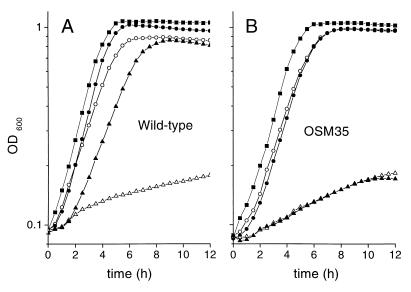
Comparison of the growth curves of L. lactis NCDO763 wild-type and OSM35 cells. Wild-type (A) and OSM35 (B) cells were grown at 30°C in CDM (■), CDM plus 0.3 M NaCl (○), CDM plus 0.3 M NaCl and 1 mM betaine (●), CDM plus 0.6 M NaCl (▵), or CDM plus 0.6 M NaCl and 1 mM betaine (▴).
FIG. 3
FIG. 3
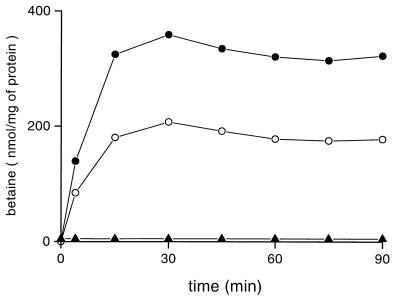
Betaine uptake activity in L. lactis NCDO763. Wild-type (circles) and OSM35 (triangles) cells were grown in CDM containing 0.3 M NaCl (solid) or 0.45 M sorbitol (open) supplemented with 1 mM betaine. Cells were washed and resuspended in 50 mM MES-NaOH (pH 6.5) containing 0.5% glucose and 50 μg of chloramphenicol per ml. After 5 min of preincubation at 30°C, uptake was initiated by the addition of [1-14C]betaine (final concentration, 0.5 mM) and 0.3 M NaCl (solid) or 0.45 M sorbitol (open) (final concentrations).
FIG. 4
FIG. 4
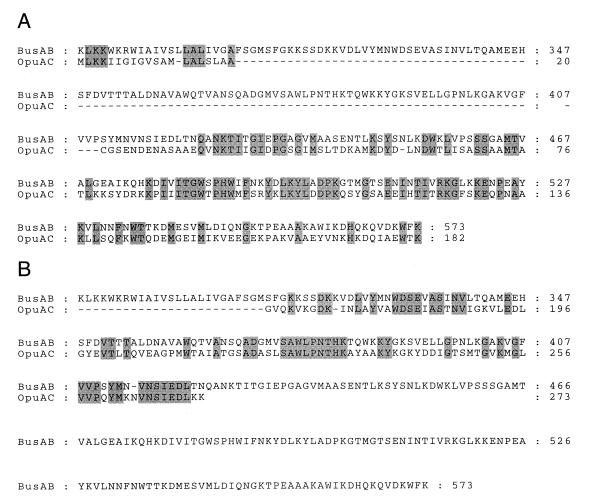
(A) Alignment of the substrate-binding domain of BusAB (residues 288 to 573) with the N-terminal part of pro-OpuAC (residues 1 to 182). (B) Alignment of the substrate-binding domain of BusAB (residues 288 to 573) with the C-terminal part of mature OpuAC (residues 163 to 273) of B. subtilis.
FIG. 5
FIG. 5
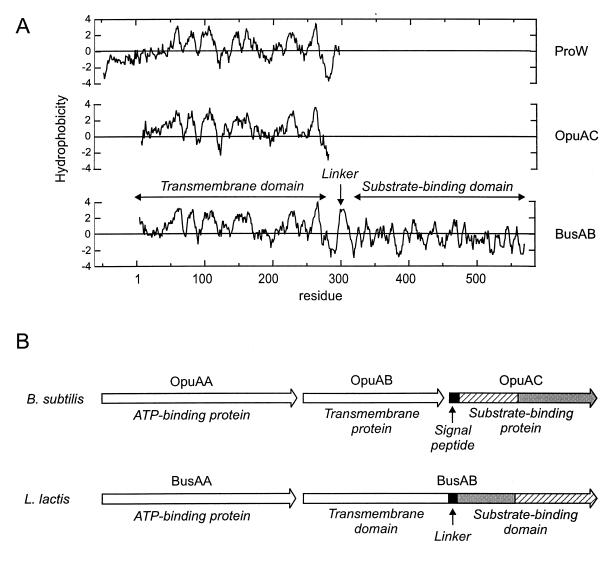
(A) Hydropathy plot of the transmembrane components of ProW of E. coli, OpuAB of B. subtilis, and BusAB of L. lactis NCDO763. The hydrophobicity scale is that of Kyte and Doolittle (20). The profile was obtained with a window of seven residues. The hydrophobicity profiles of ProW, OpuAB, and BusAB were superimposed on the basis of the aligned proteins. The numbering is that of BusAB. (B) Schematic organization of the polypeptides encoded by busA and comparison with those of opuA of B. subtilis. Regions presenting high similarity scores are filled identically (see the text).
FIG. 6
FIG. 6
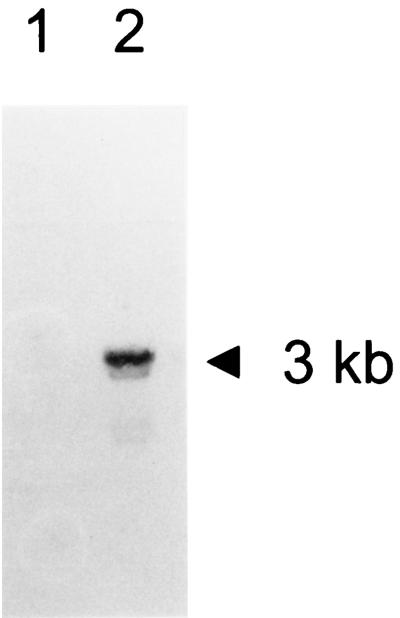
Induction of the expression of busA in response to osmotic upshock. RNA was isolated from wild-type cells grown on M17 glucose (lane 1) or M17 glucose containing 0.3 M NaCl (lane 2). After electrophoresis, the RNA was transferred to a membrane and probed with a busA-specific oligonucleotide probe. The size of the transcript is indicated.
FIG. 7
FIG. 7
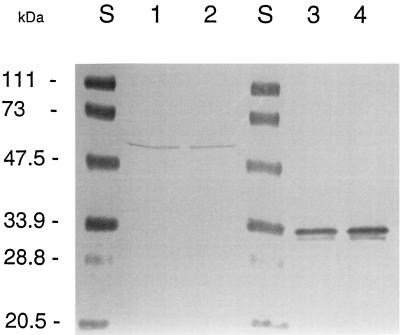
Western blotting of BusAB and OpuAC proteins. Proteins were separated by SDS-PAGE (12.5% polyacrylamide) and transferred to a nitrocellulose membrane. Shown are proteins of the membrane fractions of L. lactis cells grown in M17 (lanes 1) or in M17 containing 0.3 M NaCl (lane 2) and proteins from whole-cell extracts of B. subtilis JH642 obtained after growth on LB (lane 4) or LB containing 0.5 M NaCl (lane 5). BusAB and OpuAC were detected with an antiserum against the purified OpuAC protein of B. subtilis JH642. The molecular mass marker was from Bio-Rad (lanes S).
FIG. 8
FIG. 8
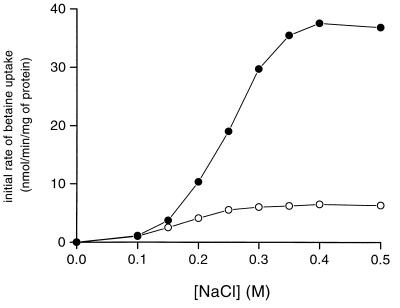
Activation of the betaine uptake system in L. lactis NCDO763 as a function of NaCl concentration. Wild-type cells were grown in CDM (○) or CDM–0.3 M NaCl (●) containing 1 mM betaine. Cells were harvested (OD600 = 1 to 1.5), washed twice, and resuspended in 50 mM MES-NaOH (pH 6.5) containing 0.5% glucose and 50 μg of chloramphenicol per ml. After 5 min of preincubation at 30°C, uptake was initiated by the addition of 20 μM [1-14C]betaine (specific activity, 2.5 mCi/mmol), and NaCl final concentrations and initial rates of betaine uptake were determined as indicated.

References

    1. Altschul S F, Gish W, Miller W, Myers E W, Lipman D J. Basic local alignment search tool. J Mol Biol. 1990;215:403–410. - PubMed
    1. Anba J, Bidnenko E, Hillier A, Ehrlich S D, Chopin M C. Characterization of the lactococcal abiD1 gene coding for phage abortive infection. J Bacteriol. 1995;177:3818–3823. - PMC - PubMed
    1. Arakawa T, Timasheff S N. The stabilization of proteins by osmolytes. Biophys J. 1985;47:411–414. - PMC - PubMed
    1. Bolotin A, Mauger S, Malarme K, Sorokin A, Ehrlich S D. Abstracts of the Conference on Streptococcal Genetics of the American Society for Microbiology, Vichy 1998. Washington, D.C.: American Society for Microbiology; 1998. Lactococcus lactis IL1403 diagnostic genomics, abstr. O3; pp. 10–11.
    1. Cairney J, Booth I R, Higgins C F. Osmoregulation of gene expression in Salmonella typhimurium: proU encodes an osmotically induced betaine transport system. J Bacteriol. 1985;164:1224–1232. - PMC - PubMed

Publication types

MeSH terms

Associated data

LinkOut - more resources