. 1999 Oct;181(20):6292-9.
doi: 10.1128/JB.181.20.6292-6299.1999.

Analysis of protein synthesis rates after initiation of chromosome replication in Escherichia coli

Affiliations

Analysis of protein synthesis rates after initiation of chromosome replication in Escherichia coli

D Bechtloff et al. J Bacteriol. 1999 Oct.

Abstract

The aim of this study was to investigate whether the synthesis rates of some proteins change after the initiation of replication in Escherichia coli. An intR1 strain, in which chromosome replication is under the control of an R1 replicon integrated into an inactivated oriC, was used to synchronize chromosome replication, and the rates of protein synthesis were analyzed by two-dimensional polyacrylamide gel electrophoresis of pulse-labeled proteins. Computerized image analysis was used to search for proteins whose expression levels changed at least threefold after initiation of a single round of chromosome replication, which revealed 7 out of about 1,000 detected proteins. The various synthesis rates of three of these proteins turned out to be caused by unbalanced growth and the synthesis of one protein was suppressed in the intR1 strain. The rates of synthesis of the remaining three could be correlated only to the synchronous initiation of replication. These three proteins were analyzed by peptide mass mapping and appeared to be the products of the dps, gapA, and pyrI genes. Thus, the expression of the vast majority of proteins is not influenced by the state of chromosome replication, and a possible role of the replication-associated expression changes of the three identified proteins in the cell cycle is not clear.


Figures
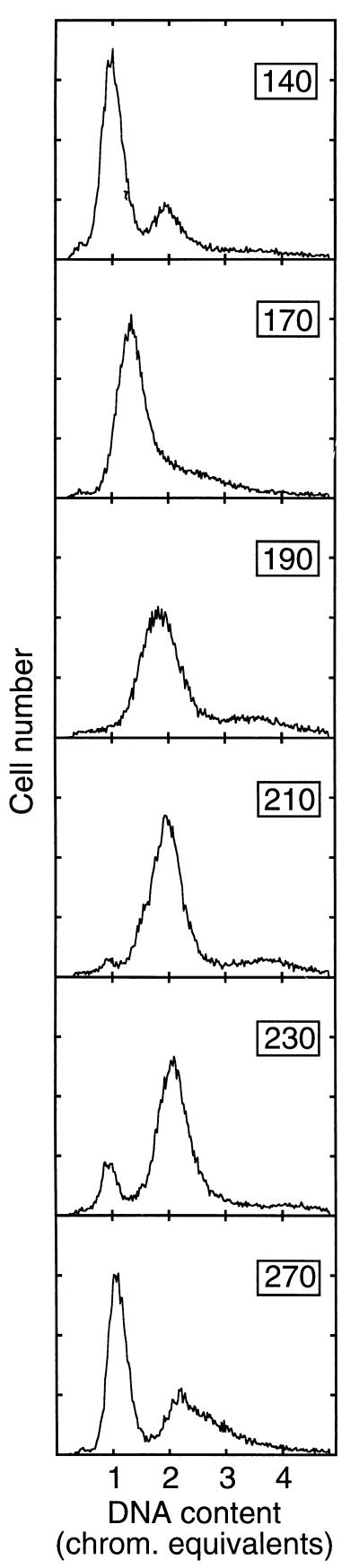
FIG. 1
FIG. 1
Flow cytometry data showing the DNA distribution of an MG::71CW(pOU420) culture with synchronized replication. A culture growing exponentially in M9 medium at 40°C was shifted to 36°C at time zero. After 150 min, the culture was shifted to 40°C for 8 min and then returned to 36°C. The samples were taken at the times (in minutes) indicated in the upper right corners of the panels. About 24,000 cells were counted in each sample. chrom., chromosome.
FIG. 2
FIG. 2
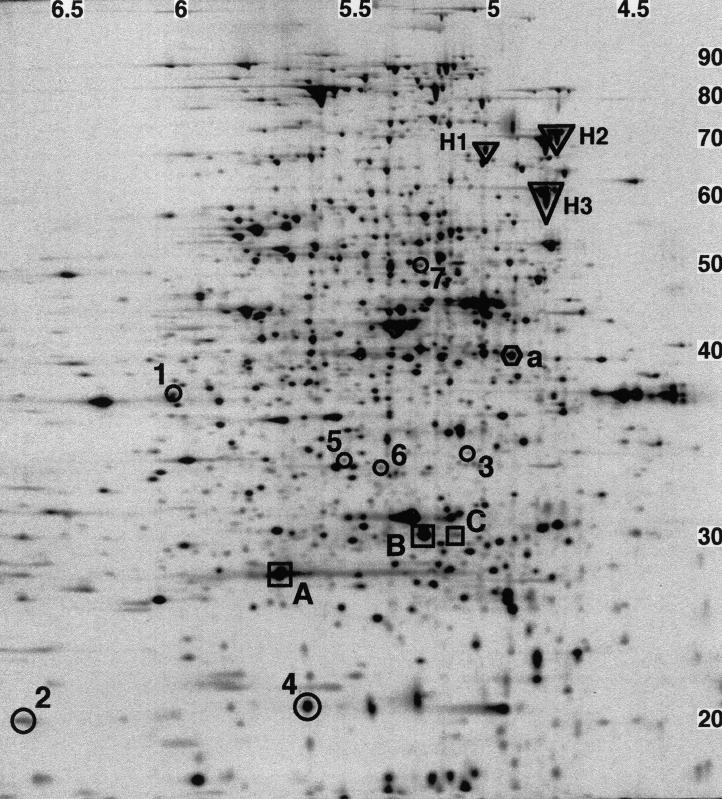
2-D PAGE autoradiogram of a 7-min pulse 50 min after initiation of a single round of replication in strain MG::71CW(pOU420). About 1,000 spots were detected on the gel. Spots 1 to 7 show significant changes in their intensities after synchronous initiation of replication in MG::71CW(pOU420). Proteins A, B, and C are intR1 specific. Protein a was chosen as an example of replication-independent protein synthesis. The heat shock proteins H1 (HtpG), H2 (DnaK), and H3 (GroEL) were identified by comparison with an E. coli 2-D PAGE database (30). The numbers at the top are pI, and the numbers on the right are MW, in thousands.
FIG. 3
FIG. 3
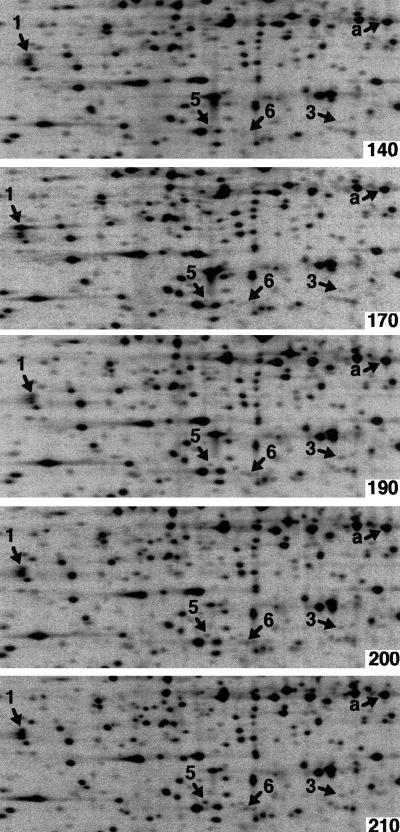
Identical sections of 2-D PAGE autoradiograms at each time point investigated after synchronous initiation of replication in MG::71CW(pOU420). Spots 1, 3, 5, and 6, whose intensities were found to change significantly after synchronous initiation of replication, and the example for continuous synthesis, protein a, are indicated. The time (in minutes) after the temperature downshift to 36°C is indicated in the upper right corner of each panel. At 150 min, replication was synchronously initiated by a transient (8-min) upshift to 40°C.
FIG. 4
FIG. 4
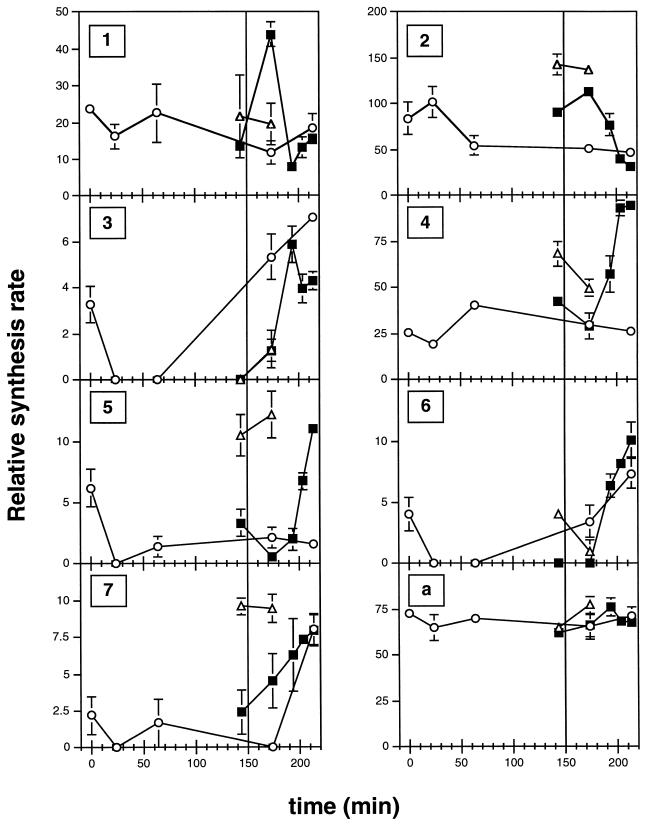
Quantification (spot intensity; the scale is relative) of spots 1 to 7 and a during temperature shift experiments with MG::71CW(pOU420) and MG1655. In order to synchronize replication, exponentially growing MG::71CW(pOU420) cells were shifted from 40 to 36°C at time zero to block the initiation of replication. After 150 min the cells were shifted to 40°C for 8 min to synchronously initiate replication (filled squares). As a control, new MG::71CW(pOU420) cultures were grown as explained above without a shift to 40°C after 150 min (open circles). MG1655 (open triangles) was grown like MG::71CW(pOU420), with the 8-min temperature upshift to 40°C after 150 min at 36°C. The values for the relative synthesis rates were placed in the middle of the 7-min window during which the proteins were pulse-labeled. Each value is the mean for four gels. Vertical bars show standard errors. The start of the 8-min shift to 40°C for initiation of replication is indicated by a vertical line at 150 min.
FIG. 5
FIG. 5
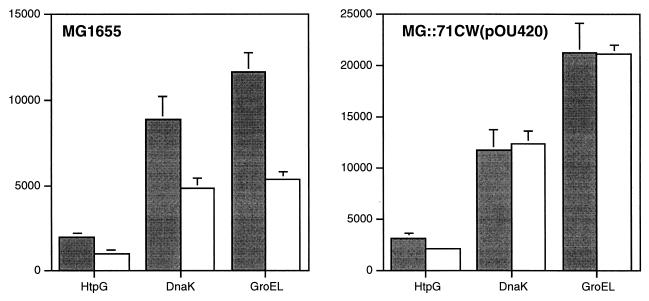
Quantification (spot intensity) of the heat shock proteins HtpG, DnaK, and GroEL 10 min before (140 min after the temperature shift to 36°C [grey bars]) and 20 min after (170 min [white bars]) the 8-min temperature upshift to 40°C in MG1655 and MG::71CW(pOU420). The heat shock proteins were identified by comparison with an E. coli 2-D PAGE database (30). Data are the means for four gels. Vertical bars show standard errors.

References

    1. Almirón M, Link A J, Furlong D, Kolter R. A novel DNA binding protein with regulatory and protective roles in starved Escherichia coli. Genes Dev. 1992;6:2646–2654. - PubMed
    1. Altuvia S, Almirón M, Huisman G, Kolter R, Storz G. The dps promoter is activated by OxyR during growth and by IHF and ςs in stationary phase. Mol Microbiol. 1994;13:265–272. - PubMed
    1. Andrews B J, Herskowitz I. Regulation of cell cycle-dependent gene expression in yeast. J Biol Chem. 1990;265:14057–14060. - PubMed
    1. Bachmann B J. Derivations and genotypes of some mutant derivatives of Escherichia coli K-12. In: Neidhardt F C, Curtiss III R, Ingraham J L, Lin E C C, Low K B, Magasanik B, Reznikoff W S, Riley M, Schaechter M, Umbarger H E, editors. Escherichia coli and Salmonella: cellular and molecular biology. 2nd ed. Washington, D.C.: ASM Press; 1996. pp. 2460–2488.
    1. Bernander R, Åkerlund T, Nordström K. Inhibition and restart of initiation of chromosome replication: effects on exponentially growing Escherichia coli cells. J Bacteriol. 1995;177:1670–1682. - PMC - PubMed

Publication types

Substances

LinkOut - more resources