. 1999 Oct;181(20):6339-46.
doi: 10.1128/JB.181.20.6339-6346.1999.

Ras signaling is required for serum-induced hyphal differentiation in Candida albicans

Affiliations

Ras signaling is required for serum-induced hyphal differentiation in Candida albicans

Q Feng et al. J Bacteriol. 1999 Oct.

Abstract

Serum induces Candida albicans to make a rapid morphological change from the yeast cell form to hyphae. Contrary to the previous reports, we found that serum albumin does not play a critical role in this morphological change. Instead, a filtrate (molecular mass, <1 kDa) devoid of serum albumin induces hyphae. To study genes controlling this response, we have isolated the RAS1 gene from C. albicans by complementation. The Candida Ras1 protein, like Ras1 and Ras2 of Saccharomyces cerevisiae, has a long C-terminal extension. Although RAS1 appears to be the only RAS gene present in the C. albicans genome, strains homozygous for a deletion of RAS1 (ras1-2/ras1-3) are viable. The Candida ras1-2/ras1-3 mutant fails to form germ tubes and hyphae in response to serum or to a serum filtrate but does form pseudohyphae. Moreover, strains expressing the dominant active RAS1(V13) allele manifest enhanced hyphal growth, whereas those expressing a dominant negative RAS1(A16) allele show reduced hyphal growth. These data show that low-molecular-weight molecules in serum induce hyphal differentiation in C. albicans through a Ras-mediated signal transduction pathway.


Figures

FIG. 1
FIG. 1
Serum albumin is not the component of serum that induces germ tubes and hyphae. (A) Germ tubes and hyphae are induced by different concentrations of bovine serum and bovine serum albumin (BSA). Serum contains 40 mg of albumin per ml. Therefore, 0.5% serum contains 0.2 mg of albumin and 0.2% serum contains 0.08 mg of albumin. The recombinant human serum albumin (rHSA) only induced pseudohyphae at a high concentration. (B1) NAR serum induces germ tubes (2 h) and hyphae (24 h) as effectively as the wild-type rat (SD8W) serum. (B2) Sodium dodecyl sulfate-polyacrylamide gel. Lanes: 1, molecular weight marker; 2, 14.5 μg of purified bovine serum albumin; 3, 0.5 μl of SD8W serum; 4, 0.5 μl of NAR serum.
FIG. 2
FIG. 2
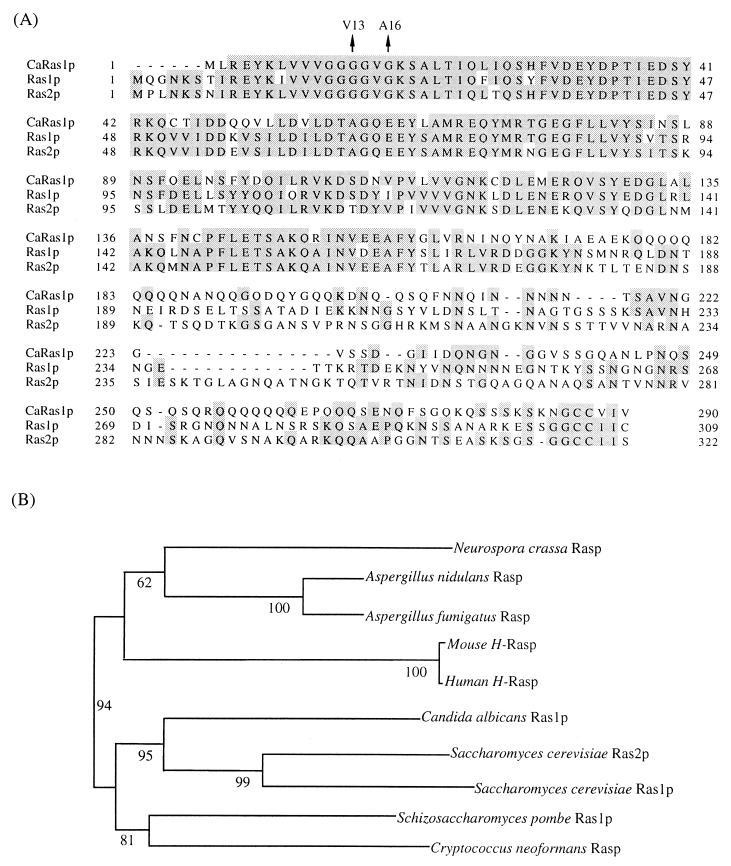
The C. albicans Ras protein. (A) Sequence alignment of C. albicans Ras1, S. cerevisiae Ras1 and Ras2 proteins. Identical residues are shaded. Amino acids changed in different Ras proteins are indicated by arrows. (B) Phylogenetic tree of Ras proteins from different organisms. The 3′-end sequences of S. cerevisiae Ras1 and Ras2 and C. albicans Ras1 proteins were truncated to create the tree by using the CLUSTALX program. The phylogenetic tree was made with 1,000 bootstrap resamplings. The numbers are bootstrap percentages for each branch point.
FIG. 3
FIG. 3
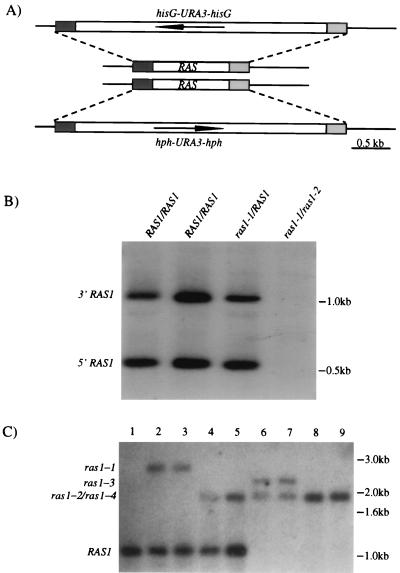
Deletion of the RAS1 gene in C. albicans. (A) The RAS1 ORF (0.9-kb), hisG-URA3-hisG (4.0-kb), and hph-URA3-hph (3.4-kb) cassettes are represented by open boxes. The arrows in the boxes indicate the direction of the transcription of URA3. 5′- and 3′-end sequences of RAS1 are represented by shaded boxes. (B) Low-stringency Southern blot analysis of RAS genes in C. albicans. Candida genomic DNAs from different strains were digested with SspI, run on 1% agarose gel, and transferred to the Hybond+ membrane. The membrane was hybridized at 65°C overnight and washed at 60°C in 0.5 × SSC (1× SSC is 0.15 M NaCl plus 0.015 M sodium citrate). The probe is RAS1 ORF. (C) Southern blot analysis of RAS1 deletion. Genomic DNAs were digested with SspI. The probe is the RAS1 3′ sequence. Lanes: 1, wild-type strain; 2 and 3, RAS1/ras1-1; 4 and 5, RAS1/ras1-2; 6 and 7, ras1-2/ras1-3; 8 and 9, ras1-2/ras1-4.
FIG. 4
FIG. 4
The homozygous ras1-2/ras1-3 deletion strain was defective for both germ tubes and hyphal formation. (A) Liquid medium assay. Log-phase cells (105/ml) were induced by 10% serum in 50 mM potassium phosphate (pH 6) at 37°C. (B) Solid medium assay. The agar plate contains 5% serum. Cells were streaked onto the plate and incubated at 37°C overnight.
FIG. 5
FIG. 5
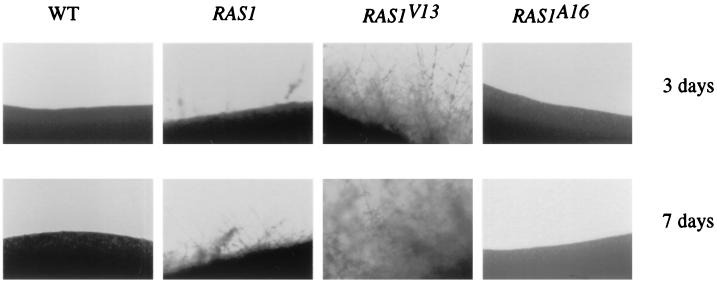
The dominant-active allele RAS1V13 enhances filamentous growth, and the dominant-negative allele RAS1A16 suppresses filamentous growth. Cells were streaked onto a SC-Ura–sucrose (2%) plate containing 50 mM succinate at pH 5. The strain carrying the RAS1/RAS1/M-RAS1V13 (the RAS1V13 allele under control of the maltose 2 promoter) formed hyphae at the edge of the colonies after incubation at 30°C for 3 days, whereas RAS1/RAS1/M-RAS1 (a strain containing wild-type RAS1 allele under the maltose promoter) started to form hyphae after 7 days. The wild-type strain formed shorter and fewer hyphae after 7 days than did RAS1/RAS1/M-RAS1. The strain carrying the RAS1A16 allele did not form hyphae even after 2 weeks.
FIG. 6
FIG. 6
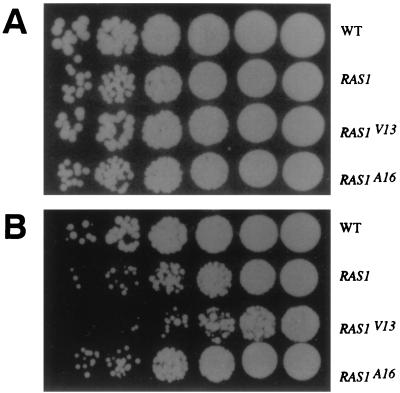
The strain carrying the dominant active allele RAS1V13 was more sensitive to heat shock. The same number of cells were either left untreated (A) or heat shocked at 50°C for 10 min (B). Each spot represents the culture diluted successively by fivefold (from right to left) on a YPD plate. The plates were incubated at 30°C for 2 days.

References

    1. Anderson M L, Odds F C. Adherence of Candida albicans to vaginal epithelia: significance of morphological form and effect of ketoconazole. Mykosen. 1985;28:531–540. - PubMed
    1. Barlow A J, Aldersley T, Chattaway F W. Factors present in serum and seminal plasma which promote germ-tube formation and mycelial growth of Candida albicans. J Gen Microbiol. 1974;82(Pt. 2):261–272. - PubMed
    1. Bell W M, Chaffin W L. Effect of yeast growth conditions on yeast-mycelial transition in Candida albicans. Mycopathologia. 1983;84:41–44. - PubMed
    1. Berardinelli S, Opheim D J. New germ tube induction medium for the identification of Candida albicans. J Clin Microbiol. 1985;22:861–862. - PMC - PubMed
    1. Buckley H R, Van uden N. The identification of Candida albicans within two hours by the use of an egg white slide preparation. Sabouraudia. 1963;2:205–208.

Publication types

Associated data