. 1999 Oct;181(20):6361-70.
doi: 10.1128/JB.181.20.6361-6370.1999.

Growth phase-dependent variation in protein composition of the Escherichia coli nucleoid

Affiliations

Growth phase-dependent variation in protein composition of the Escherichia coli nucleoid

T Ali Azam et al. J Bacteriol. 1999 Oct.

Abstract

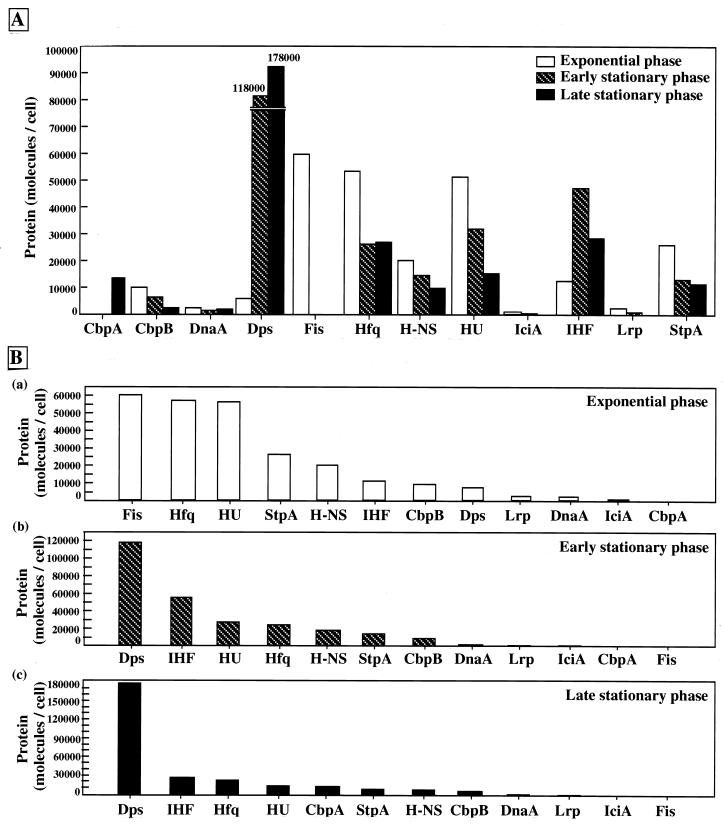
The genome DNA of Escherichia coli is associated with about 10 DNA-binding structural proteins, altogether forming the nucleoid. The nucleoid proteins play some functional roles, besides their structural roles, in the global regulation of such essential DNA functions as replication, recombination, and transcription. Using a quantitative Western blot method, we have performed for the first time a systematic determination of the intracellular concentrations of 12 species of the nucleoid protein in E. coli W3110, including CbpA (curved DNA-binding protein A), CbpB (curved DNA-binding protein B, also known as Rob [right origin binding protein]), DnaA (DNA-binding protein A), Dps (DNA-binding protein from starved cells), Fis (factor for inversion stimulation), Hfq (host factor for phage Q(beta)), H-NS (histone-like nucleoid structuring protein), HU (heat-unstable nucleoid protein), IciA (inhibitor of chromosome initiation A), IHF (integration host factor), Lrp (leucine-responsive regulatory protein), and StpA (suppressor of td mutant phenotype A). Intracellular protein levels reach a maximum at the growing phase for nine proteins, CbpB (Rob), DnaA, Fis, Hfq, H-NS, HU, IciA, Lrp, and StpA, which may play regulatory roles in DNA replication and/or transcription of the growth-related genes. In descending order, the level of accumulation, calculated in monomers, in growing E. coli cells is Fis, Hfq, HU, StpA, H-NS, IHF*, CbpB (Rob), Dps*, Lrp, DnaA, IciA, and CbpA* (stars represent the stationary-phase proteins). The order of abundance, in descending order, in the early stationary phase is Dps*, IHF*, HU, Hfq, H-NS, StpA, CbpB (Rob), DnaA, Lrp, IciA, CbpA, and Fis, while that in the late stationary phase is Dps*, IHF*, Hfq, HU, CbpA*, StpA, H-NS, CbpB (Rob), DnaA, Lrp, IciA, and Fis. Thus, the major protein components of the nucleoid change from Fis and HU in the growing phase to Dps in the stationary phase. The curved DNA-binding protein, CbpA, appears only in the late stationary phase. These changes in the composition of nucleoid-associated proteins in the stationary phase are accompanied by compaction of the genome DNA and silencing of the genome functions.


Figures
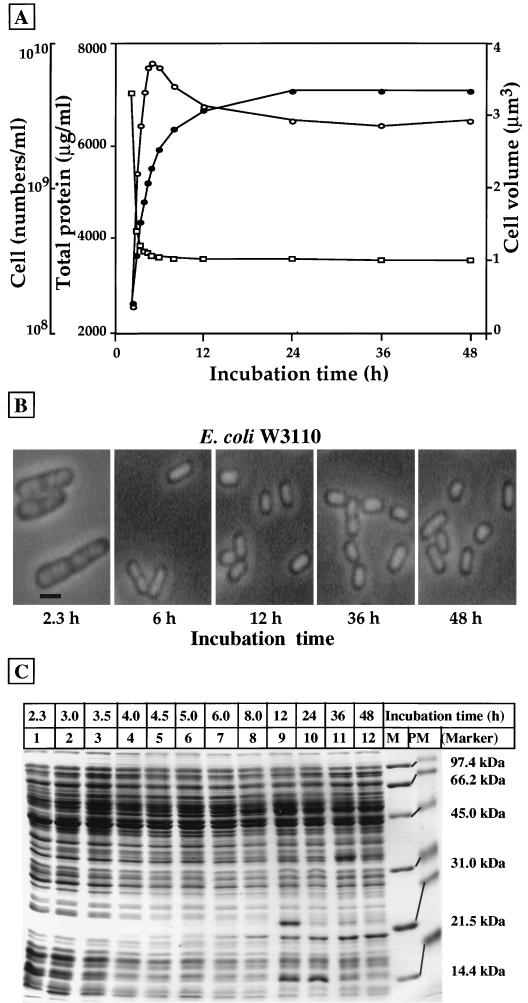
FIG. 1
FIG. 1
Expression patterns of E. coli W3110 proteins at various growth phases. (A) An early-stationary-phase culture of E. coli W3110 (A type) in LB medium at 37°C was diluted 170-fold with fresh LB medium, and the shaking culture was continued at 37°C. The total number of cells per milliliter (solid circles) and the average volume of cells (open squares) were measured with a Coulter Multisizer II. The protein concentration of cell lysates (open circles) was determined by staining with a Bio-Rad protein assay kit. (B) The same E. coli W3110 (A type) culture for the indicated times was stained with DAPI and observed for cell morphology. The bar in the 2.3-h sample represents 1 μm. (C) At the indicated time points (above the lane markers), aliquots of the culture were removed for the preparation of cell lysates. Portions of the cell lysates containing 15 μg of total proteins were subjected to SDS–15% PAGE. Gels were stained with Coomassie brilliant blue. The molecular mass markers (M, standard markers; PM, prestained markers) used were as follows: phosphorylase b, 97.4 kDa; bovine serum albumin, 66.2 kDa; ovalbumin, 45.0 kDa; carbonic anhydrase, 31.0 kDa; soybean trypsin inhibitor, 21.5 kDa; and lysozyme, 14.4 kDa.
FIG. 2
FIG. 2
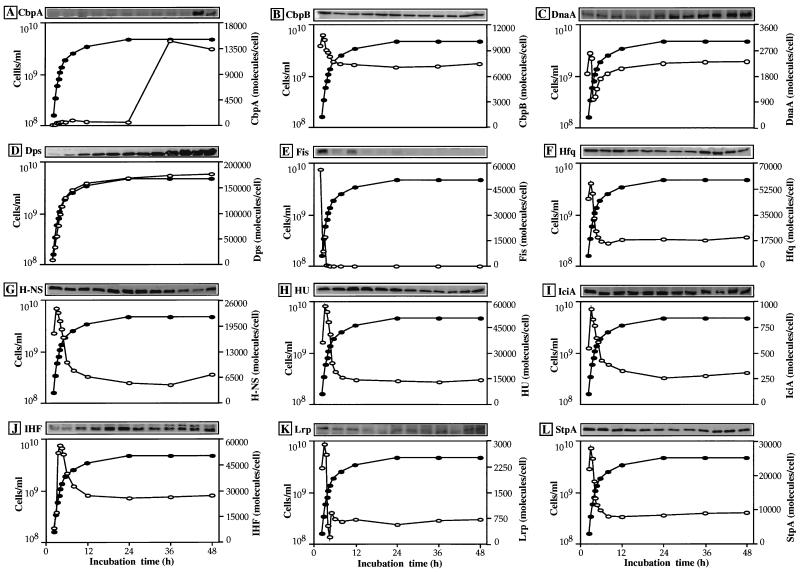
Growth phase-dependent variation in the intracellular levels of 12 DNA-binding proteins in E. coli W3110. For measurement of the concentrations of each DNA-binding protein, aliquots of cell lysates containing 15 μg of total proteins were subjected to SDS-PAGE (with a 10% gel for DnaA; a 12.5% gel for CbpA, CbpB, and IciA; and a 16.5% gel for Dps, Fis, Hfq, H-NS, HU, IFH, Lrp, and StpA) and proteins were electroblotted onto polyvinylidene difluoride membranes. The blots were probed with anti-CbpA (A), anti-CbpB or anti-Rob (B), anti-DnaA (C), anti-Dps (D), anti-Fis (E), anti-Hfq (F), anti-H-NS (G), anti-HU (H), anti-IciA (I), anti-IHF (J), anti-Lrp (K), or anti-StpA (L) antibodies. After immunostaining, the intensity of stained bands was measured by scanning the gels with an NIH Image analyzer system (version 1.61). To increase the accuracy of the calculation of protein molecules, the Western blot analysis was repeated at least three times for all samples. Solid circles represent the total number of cells measured with a Coulter Multisizer II, while open circles represent the total number of protein molecules per cell, calculated as averages of three independent measurements.
FIG. 3
FIG. 3
Growth phase-dependent variation in the intracellular levels of 12 DNA-binding proteins in E. coli W3110. The measurement of each DNA-binding protein was carried out as described in Materials and Methods. (A) Total numbers of each protein molecule at three distinct growth phases are shown. Exponential phase, 2.3 to 3.0 h; early stationary phase, 5.0 h; late stationary phase, 48 h (see Fig. 1 for the growth curve). (B) The order of the total number of molecules among the 12 DNA-binding proteins.

References

    1. Almirón M, Link A J, Furlong D, Kolter R. A novel DNA binding protein with regulatory and protective roles in starved Escherichia coli. Genes Dev. 1992;6:2646–2654. - PubMed
    1. Atlung T, Ingmer H. H-NS: a modulator of environmentally regulated gene expression. Mol Microbiol. 1997;24:7–17. - PubMed
    1. Ball C A, Osuna R, Ferguson K C, Johnson R C. Dramatic changes in Fis levels upon nutrient upshift in Escherichia coli. J Bacteriol. 1992;174:8043–8056. - PMC - PubMed
    1. Calvo J M, Matthews R G. Leucine-responsive regulatory protein: a global regulator of metabolism in Escherichia coli. Microbiol Rev. 1994;58:466–498. - PMC - PubMed
    1. Craig N L, Nash S E. E. coli integration host factor binds to specific sites in DNA. Cell. 1984;39:707–716. - PubMed

Publication types

MeSH terms

LinkOut - more resources