Comparative Study
. 1999 Oct;181(20):6469-77.
doi: 10.1128/JB.181.20.6469-6477.1999.

A developmentally regulated gene cluster involved in conidial pigment biosynthesis in Aspergillus fumigatus

Affiliations
Comparative Study

A developmentally regulated gene cluster involved in conidial pigment biosynthesis in Aspergillus fumigatus

H F Tsai et al. J Bacteriol. 1999 Oct.

Abstract

Aspergillus fumigatus, a filamentous fungus producing bluish-green conidia, is an important opportunistic pathogen that primarily affects immunocompromised patients. Conidial pigmentation of A. fumigatus significantly influences its virulence in a murine model. In the present study, six genes, forming a gene cluster spanning 19 kb, were identified as involved in conidial pigment biosynthesis in A. fumigatus. Northern blot analyses showed the six genes to be developmentally regulated and expressed during conidiation. The gene products of alb1 (for "albino 1"), arp1 (for "aspergillus reddish-pink 1"), and arp2 have high similarity to polyketide synthases, scytalone dehydratases, and hydroxynaphthalene reductases, respectively, found in the dihydroxynaphthalene (DHN)-melanin pathway of brown and black fungi. The abr1 gene (for "aspergillus brown 1") encodes a putative protein possessing two signatures of multicopper oxidases. The abr2 gene product has homology to the laccase encoded by the yA gene of Aspergillus nidulans. The function of ayg1 (for "aspergillus yellowish-green 1") remains unknown. Involvement of the six genes in conidial pigmentation was confirmed by the altered conidial color phenotypes that resulted from disruption of each gene in A. fumigatus. The presence of a DHN-melanin pathway in A. fumigatus was supported by the accumulation of scytalone and flaviolin in the arp1 deletant, whereas only flaviolin was accumulated in the arp2 deletants. Scytalone and flaviolin are well-known signature metabolites of the DHN-melanin pathway. Based on DNA sequence similarity, gene disruption results, and biochemical analyses, we conclude that the 19-kb DNA fragment contains a six-gene cluster which is required for conidial pigment biosynthesis in A. fumigatus. However, the presence of abr1, abr2, and ayg1 in addition to alb1, arp1, and arp2 suggests that conidial pigment biosynthesis in A. fumigatus is more complex than the known DHN-melanin pathway.


Figures
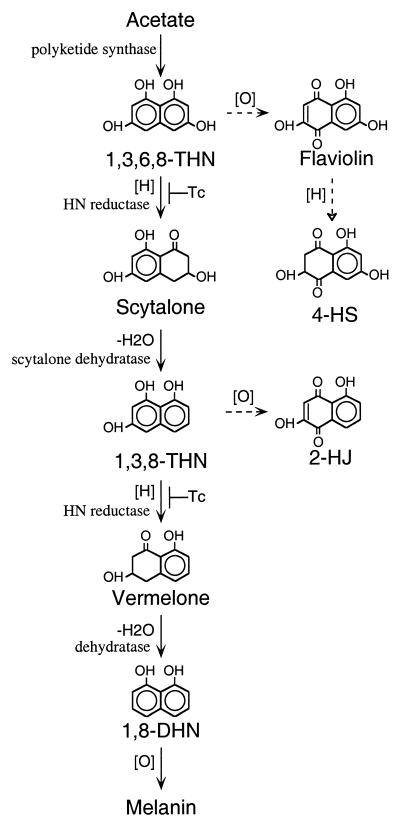
FIG. 1
FIG. 1
Biosynthetic pathway of melanin in brown and black fungi. The solid arrows indicate the main melanin pathway, and the dashed arrows indicate branching pathways from the melanin pathway. The hollow arrowhead indicates that the conversion requires more than one step. The reduction steps are indicated by [H] and the oxidation steps are indicated by [O]. Dehydration steps are labeled −H2O. A reduction step which can be inhibited by the fungicide tricyclazole is indicated with Tc.
FIG. 2
FIG. 2
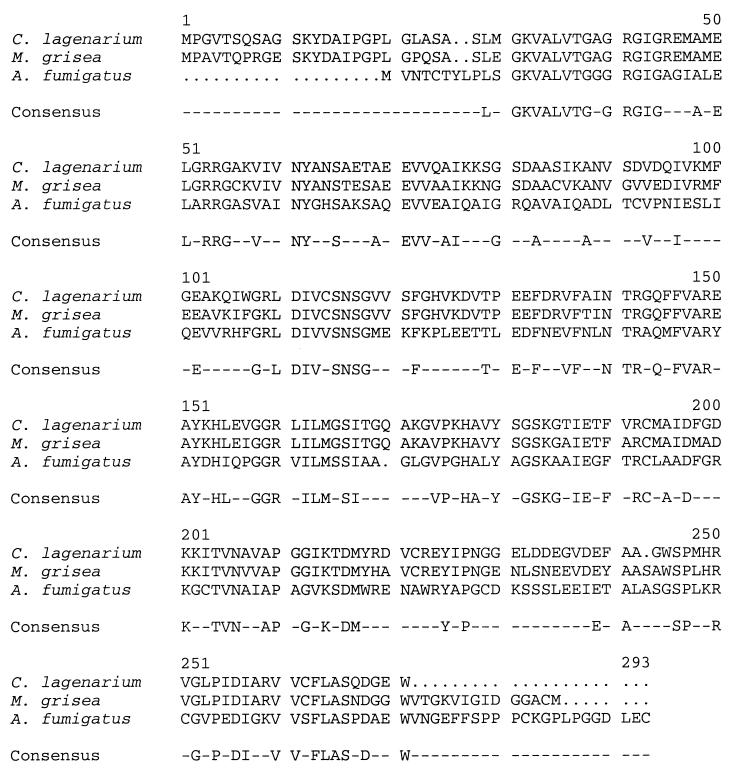
Amino acid alignment of HN reductases. The amino acid sequence comparison between Arp2p and HN reductases of Magnaporthe grisea (GenBank NCBI ID 1127197) and Colletotrichum lagenarium (GenBank accession no. D86079) is shown (18). The alignment was performed with the Genetics Computer Group program Pileup, using the default parameters (9). Dots represent gaps which were introduced during alignment. Dashes indicate the nonconsensus residues among three proteins.
FIG. 3
FIG. 3
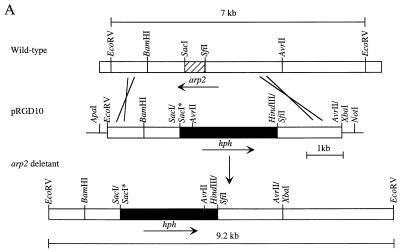
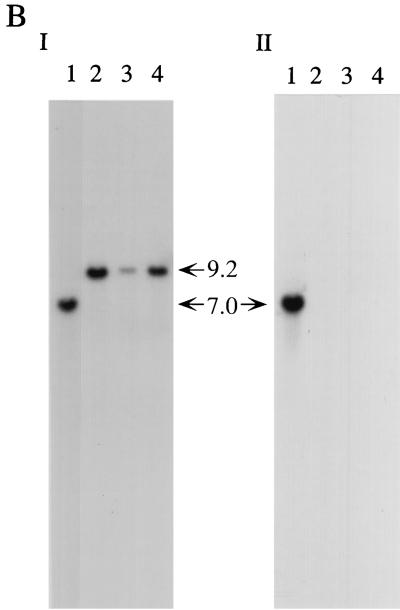
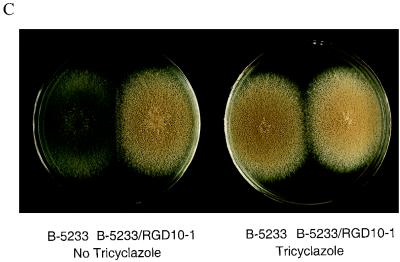
arp2 gene disruption in B-5233. (A) Diagram of a double-crossover event via homologous recombination. Open boxes represent DNA from A. fumigatus. Solid boxes represent the hph gene. Asterisks indicate SacI sites that were destroyed during vector construction. (B) Southern blot analysis of B-5233 and the arp2 deletants. Total DNA was digested with EcoRV. The blot was analyzed with pRGD10 (I) or a 0.6-kb SacI-SfiI DNA fragment (hatched box in Fig. 3A) as a probe (II). Lanes: 1, B-5233; 2, B-5233/RGD10-1; 3, 5233/RGD10-2; 4, 5233/RGD10-3. The sizes of hybridized DNA fragments are indicated by arrows. (C) Conidial color phenotype of B-5233 and B-5233/RGD10-1. Cultures were grown on Aspergillus minimal medium for 3 days with (right) or without (left) tricyclazole.
FIG. 3
FIG. 3
arp2 gene disruption in B-5233. (A) Diagram of a double-crossover event via homologous recombination. Open boxes represent DNA from A. fumigatus. Solid boxes represent the hph gene. Asterisks indicate SacI sites that were destroyed during vector construction. (B) Southern blot analysis of B-5233 and the arp2 deletants. Total DNA was digested with EcoRV. The blot was analyzed with pRGD10 (I) or a 0.6-kb SacI-SfiI DNA fragment (hatched box in Fig. 3A) as a probe (II). Lanes: 1, B-5233; 2, B-5233/RGD10-1; 3, 5233/RGD10-2; 4, 5233/RGD10-3. The sizes of hybridized DNA fragments are indicated by arrows. (C) Conidial color phenotype of B-5233 and B-5233/RGD10-1. Cultures were grown on Aspergillus minimal medium for 3 days with (right) or without (left) tricyclazole.
FIG. 3
FIG. 3
arp2 gene disruption in B-5233. (A) Diagram of a double-crossover event via homologous recombination. Open boxes represent DNA from A. fumigatus. Solid boxes represent the hph gene. Asterisks indicate SacI sites that were destroyed during vector construction. (B) Southern blot analysis of B-5233 and the arp2 deletants. Total DNA was digested with EcoRV. The blot was analyzed with pRGD10 (I) or a 0.6-kb SacI-SfiI DNA fragment (hatched box in Fig. 3A) as a probe (II). Lanes: 1, B-5233; 2, B-5233/RGD10-1; 3, 5233/RGD10-2; 4, 5233/RGD10-3. The sizes of hybridized DNA fragments are indicated by arrows. (C) Conidial color phenotype of B-5233 and B-5233/RGD10-1. Cultures were grown on Aspergillus minimal medium for 3 days with (right) or without (left) tricyclazole.
FIG. 4
FIG. 4
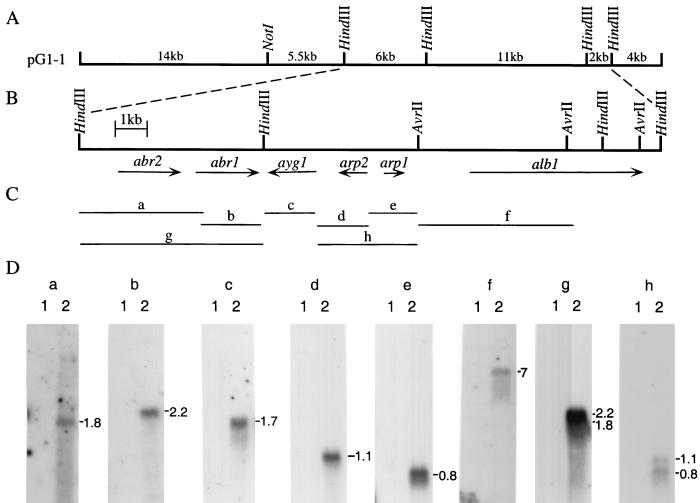
Gene cluster for conidial pigment biosynthesis in A. fumigatus. (A) Physical map of pG1-1. (B) Map of transcripts associated with conidiation. Arrows indicate the direction of transcripts. All of the six transcripts are found within a 19-kb DNA fragment. (C) Probes used for Northern analyses. The DNA fragments used as probes are labeled a, b, c, d, e, f, g, and h. (D) Northern blot analyses of gene expression at two different developmental stages. The sizes of the transcripts are labeled on the right of the blot in kilobases. Total RNA from B-5233 was isolated from mycelia 0 h (lane 1) or 14 h (lane 2) after induction of conidiation. A 12-μg portion of total RNA was fractionated on the 1% formaldehyde–agarose gel. The sizes of the hybridizing fragments are indicated at the side. rRNA stained with ethidium bromide was used as a control for the quantity and quality of the RNA preparation (data not shown).
FIG. 5
FIG. 5
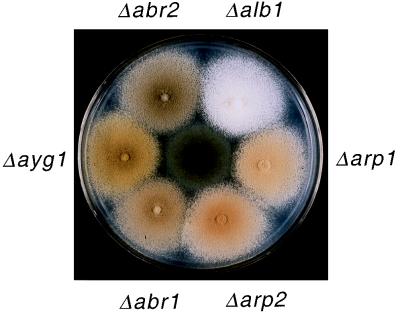
Sporulating cultures of the A. fumigatus wild-type strain and six single-gene deletants. The wild-type strain, producing bluish green conidia, is at the center of the plate. Each gene deletant is designated by the name of the deleted gene.
FIG. 6
FIG. 6
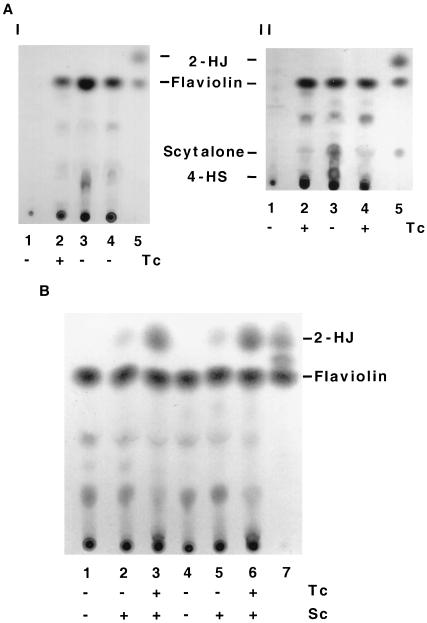
Biochemical analysis of accumulated intermediates and branch products of the DHN-melanin biosynthetic pathway of A. fumigatus. (A) (I) TLC analysis. Lanes: 1 and 2, wild-type strain B-5233; 3 and 4, arp2 deletants B-5233/RGD3-1 and B-5233/RGD10-1; 5, standards. (II) Lanes: 1 and 2, B-5233; 3 and 4, arp1 deletant B-5233/RGD4-2; 5, standards. (B) Scytalone feeding experiment. Lanes: 1 to 3, B-5233/RGD3-1; 4 to 6, B-5233/RGD10-1; 7, standards. The strains were grown on ASA medium for 6 days. Sc, 10−3 M scytalone in ASA medium; Tc, 30 μg of tricyclazole per ml in ASA medium.

References

    1. Amaar Y G, Moore M M. Mapping of the nitrate-assimilation gene cluster (crnA-niiA-niaD) and characterization of the nitrite reductase gene (niiA) in the opportunistic fungal pathogen Aspergillus fumigatus. Curr Genet. 1998;33:206–215. - PubMed
    1. Aramayo R, Timberlake W E. Sequence and molecular structure of the Aspergillus nidulans yA (laccase I) gene. Nucleic Acids Res. 1990;18:3415. - PMC - PubMed
    1. Bell A A, Stipanovic R D, Puhalla J E. Pentaketide metabolites of Verticillium dahliae: identification of (+)-scytalone as a natural precursor to melanin. Tetrahedron. 1976;32:1353–1356.
    1. Bell A A, Wheeler M H. Biosynthesis and functions of fungal melanins. Annu Rev Phytopathol. 1986;24:411–451.
    1. Bennett J W, Papa K E. The aflatoxigenic Aspergillus species. Adv Plant Pathol. 1988;6:263–280.

Publication types

LinkOut - more resources