Comparative Study
. 1999 Nov;58(11):691-7.
doi: 10.1136/ard.58.11.691.

Analysis of 16 different matrix metalloproteinases (MMP-1 to MMP-20) in the synovial membrane: different profiles in trauma and rheumatoid arthritis

Affiliations
Comparative Study

Analysis of 16 different matrix metalloproteinases (MMP-1 to MMP-20) in the synovial membrane: different profiles in trauma and rheumatoid arthritis

Y T Konttinen et al. Ann Rheum Dis. 1999 Nov.

Abstract

Objective: To define the pattern of mRNA expression of all human matrix metalloproteinases (MMPs) described to date in rheumatoid arthritis (RA) and traumatic synovial membrane, in order to differentiate between a physiological tissue remodelling pattern and that associated with inflammatory tissue destruction.

Methods: Analysis of SwissProt protein and EMBL/GenBank nucleotide sequence banks, protein sequence alignment, reverse transcriptase-polymerase chain reaction and nucleotide sequencing were used.

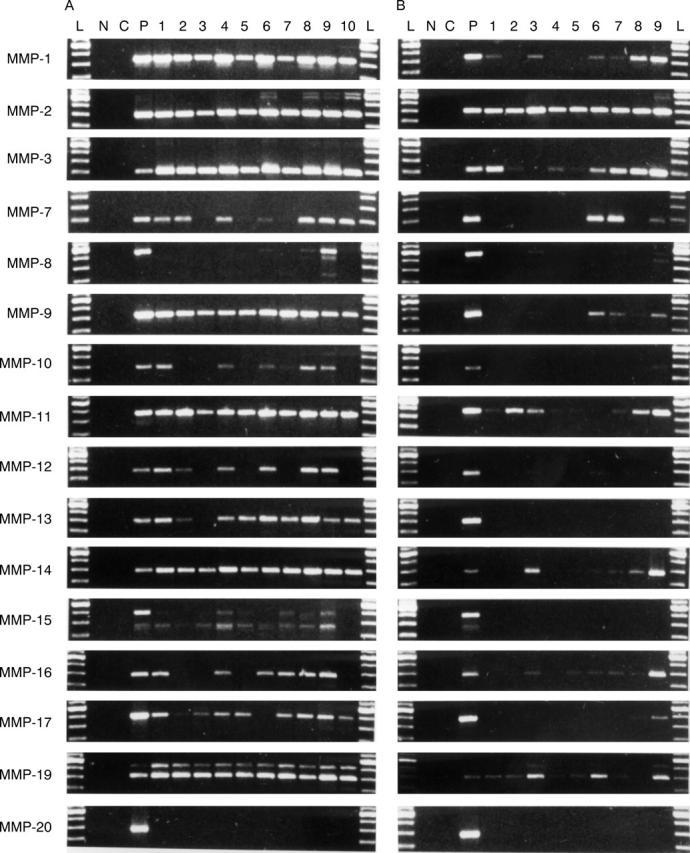
Results: MMP-2 (gelatinase A), MMP-3 (stromelysin-1), MMP-11 (stromelysin-3) and MMP-19 were constitutively expressed. MMP-1 (fibroblast type collagenase), MMP-9 (gelatinase B) and MMP-14 (MT1-MMP) were expressed in all RA, but only in 55-80% of trauma samples. MMP-13 (collagenase-3) and MMP-15 (MT2-MMP) were expressed exclusively in RA (80-90% of the samples). MMP-20 (enamelysin) was absent and MMP-8 (collagenase-2) was rarely found in RA or trauma. All other MMPs (-7, -10, -12, -16, -17) had an intermediate pattern of expression.

Conclusions: Some MMPs without interstitial collagenase activity seem to have a constitutive pattern of expression and probably participate in physiological synovial tissue remodelling. Some MMPs are exclusively associated to RA synovitis, for example, MMP-13, which preferentially degrades type II collagen and aggrecan, and MMP-15, which activates proMMP-2 and proMMP-13 and is involved in tumour necrosis factor alpha processing. This clear cut rheumatoid/inflammatory MMP profile, more complex than has been previously appreciated, may facilitate inflammatory tissue destruction in RA.


Figures
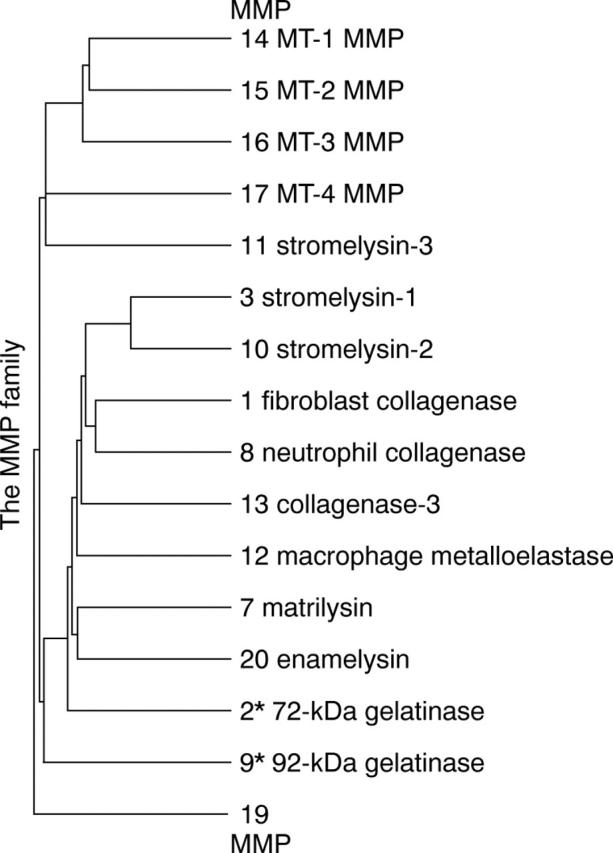
Figure 1
Figure 1
Family tree of the matrix metalloproteinases. Distance along the vertical axis in the family tree is proportional to the difference between sequences. The horizontal distance has no significance.
Figure 2
Figure 2
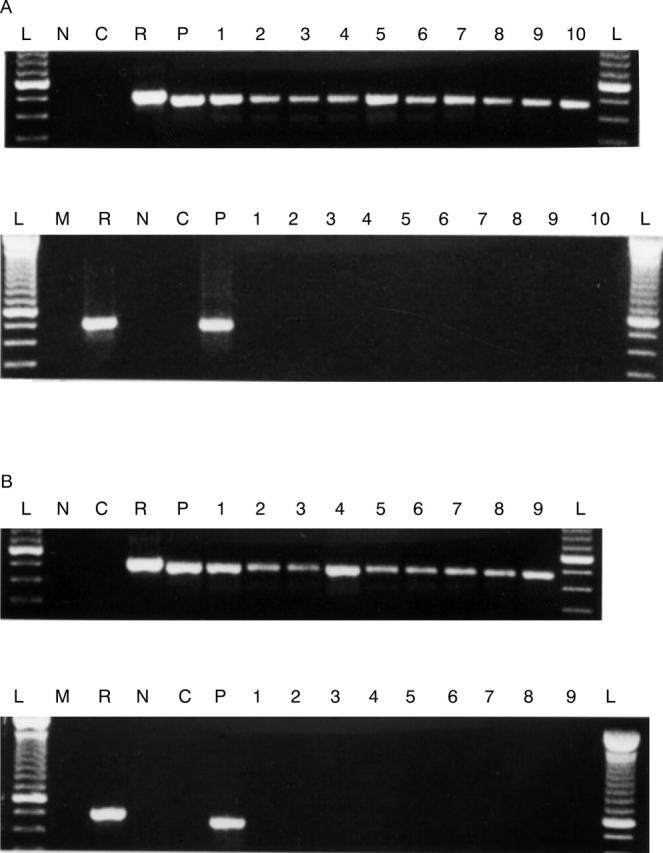
Reverse transcriptase polymerase chain reaction (RT-PCR) control analysis. (A) Ten synovitis tissue samples from RA patients (lanes 1-10). (B) Nine control non-arthritic knee injury samples (lanes 1-9). In both (A) and (B), the upper panel shows mRNA extraction control with β-actin PCR (466 bp) and the lower panel cDNA synthesis control with no RT enzyme (to exclude contamination with genomic DNA), but with regular PCR for β-actin. The expected size of the genomic β-actin would have been 907 bp. Samples are in same order. L indicates 100 bp DNA ladder, starting from 300 bp; N for negative PCR control without sample and C for negative PCR control without sample and primers were performed to exclude contamination of the reagents and found to be negative; P for positive PCR control of β-actin derived from breast cancer cDNA; M for negative cDNA synthesis control without RNA and R for positive cDNA synthesis control with control RNA representing in vitro transcribed RNA from the chloramphenicol acetyltransferase (CAT) gene provided with the kit (523 bp).
Figure 3
Figure 3
Reverse transcriptase polymerase chain reaction (RT-PCR) analysis of MMP-1 through MMP-20. (A) Ten synovitis tissue samples from RA patients (lanes 1-10). (B) Nine control non-arthritic knee injury samples (lanes 1-9). Samples are in the same order as in figure 2. It should be noted that the weakest bands are not visible in the photographic reproductions. Therefore, all data given in the results section and in table 3 are based on observations made from the original gels and photographs. L indicates 100 bp DNA ladder, starting from 300 bp; N for negative PCR control without sample; C for negative PCR control without sample and primers; and P for positive PCR control.

References

    1. Mol Biol Cell. 1996 Oct;7(10):1471-83 - PubMed
    1. J Biol Chem. 1996 May 3;271(18):11023-6 - PubMed
    1. J Biol Chem. 1997 Feb 14;272(7):4281-6 - PubMed
    1. Biochem J. 1997 Apr 1;323 ( Pt 1):13-6 - PubMed
    1. Genomics. 1997 Mar 1;40(2):222-33 - PubMed

Publication types