. 1999 Nov;67(11):5573-8.
doi: 10.1128/IAI.67.11.5573-5578.1999.

Differentiation of monocytes to macrophages primes cells for lipopolysaccharide stimulation via accumulation of cytoplasmic nuclear factor kappaB

Affiliations

Differentiation of monocytes to macrophages primes cells for lipopolysaccharide stimulation via accumulation of cytoplasmic nuclear factor kappaB

S Takashiba et al. Infect Immun. 1999 Nov.

Abstract

During infection, circulating blood monocytes migrate from the vasculature to the extravascular compartments where they mature into tissue macrophages. The maturation process prepares the cell to actively participate in the inflammatory and the immune responses, and many transcription factors have been found to be involved. Here we report on a novel role for nuclear factor kappaB (NF-kappaB) in this process. Its accumulation in the cytoplasm of differentiated macrophages is responsible for the enhanced ability of the cell to respond to lipopolysaccharide (LPS) stimulation, as determined by tumor necrosis factor alpha (TNF-alpha) secretion. Differentiation of the human monocytic cell line THP-1 into macrophage-like cells was induced by exposure of the cells to phorbol myristate acetate. DNA-bindable NF-kappaB was not detected in the cytoplasm of undifferentiated THP-1 cells but accumulated in the cytoplasm of the cells following differentiation. No TNF-alpha was detected in the media of resting differentiated and nondifferentiated THP-1 cells. Stimulation with LPS of differentiated cells induced the production of higher levels of TNF-alpha than stimulation of nondifferentiated cells. This hyperresponsiveness to LPS was found in the mRNA and secreted TNF-alpha levels. Furthermore, stimulation with LPS induced the translocation of NF-kappaB from the cytoplasm into the nucleus. This translocation process was more rapid in the differentiated cells than in the nondifferentiated cells, and the resultant accumulated levels of NF-kappaB in the nucleus were higher. The DNA-bindable NF-kappaB was identified as a heterodimer of p65 and p50. The results suggest that NF-kappaB accumulation in the cytoplasm during maturation of monocytes to macrophages primes the cells for enhanced responsiveness to LPS and results in the rapid secretion of inflammatory mediators, such as TNF-alpha, by mature macrophages following LPS challenge.


Figures
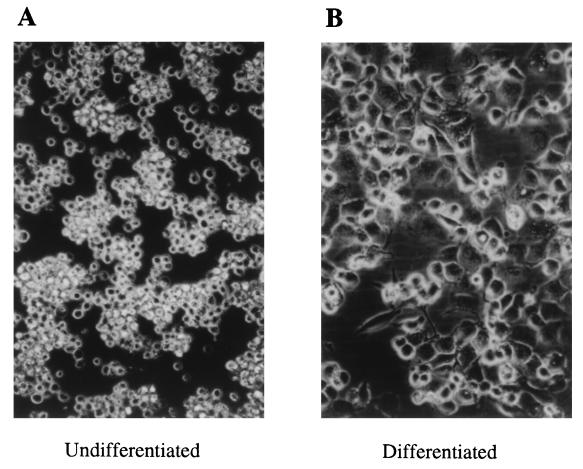
FIG. 1
FIG. 1
Induction of differentiation in THP-1 cells by PMA. THP-1 cells were incubated for 24 h without (A) or with (B) PMA (200 nM). The cells were photographed at ×200 magnification with a phase-contrast inverted microscope.
FIG. 2
FIG. 2
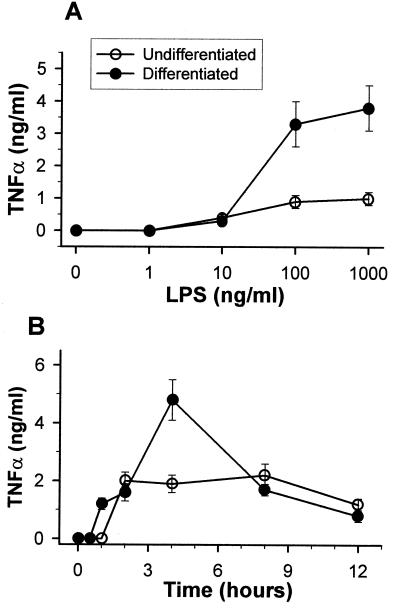
LPS-induced TNF-α secretion from differentiated and undifferentiated THP-1 cells. Differentiation to macrophages was induced by incubation of the cells with 200 nM PMA for 24 h. (A) Dose response of TNF-α secretion. Cells (106) were washed, and different doses of LPS as indicated in the graph were added to the culture medium. Medium was harvested for TNF-α analysis by ELISA after 6 h of incubation. (B) Kinetics of TNF-α secretion. Cells (106) were washed, and LPS (100 ng/ml) was added to the culture medium. Medium was harvested for TNF-α analysis by ELISA at the intervals indicated in the graph. This is one representative experiment of three. Results are presented as means ± standard errors.
FIG. 3
FIG. 3
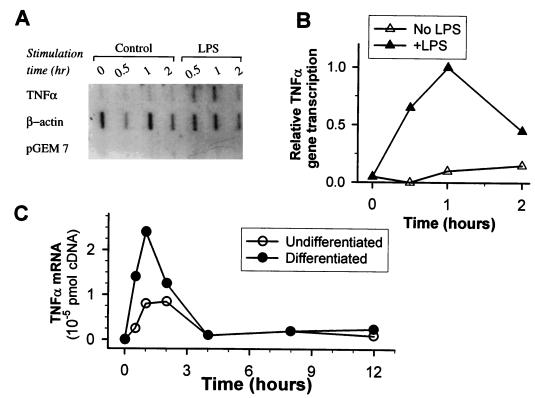
Analysis of TNF-α gene transcription and mRNA accumulation in THP-1 cells. (A) Nuclear run-on assay for newly transcribed TNF-α mRNA. Differentiation into macrophages was induced by incubation of the cells with 200 nM PMA for 24 h. Nuclei were harvested from LPS-stimulated and nonstimulated cells at different intervals, and in vitro transcription of the TNF-α gene was analyzed with specific probes for TNF-α. β-Actin was used as the internal control, and pGEM 7 vector was used as the negative control. (B) Densitometric analysis of the bands in panel A. (C) Kinetics of TNF-α mRNA accumulation in LPS-stimulated differentiated and undifferentiated THP-1 cells. Cells were stimulated with 100 ng of LPS per ml, and mRNA was extracted in the indicated time intervals. TNF-α mRNA was quantified by RT-PCR with [32P]dCTP in relation to a standard curve.
FIG. 4
FIG. 4
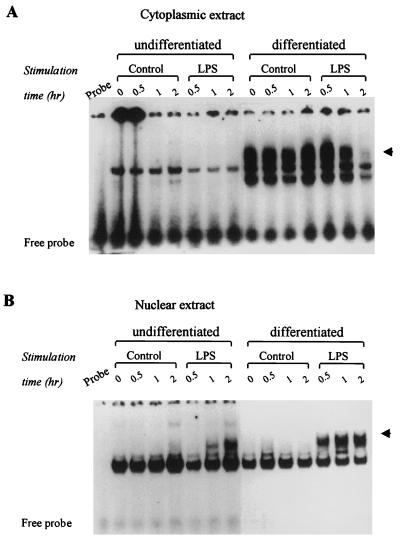
Effect of LPS on the accumulation of DNA-bindable NF-κB in the cytoplasm (A) and in the nuclei (B) of differentiated and undifferentiated THP-1 cells. Differentiation was induced by incubation of THP-1 cells (10 × 106 cells/100-mm-diameter plate) with 200 nM PMA for 24 h. After being washed, adherent cells were incubated with or without LPS (100 ng/ml) for the indicated time intervals. Cytoplasmic and nuclear extracts were obtained and then used for EMSA with NF-κB-specific 32P-labeled DNA probes. Specific bindings are shown by arrowheads. Data are representative of two independent experiments.
FIG. 5
FIG. 5
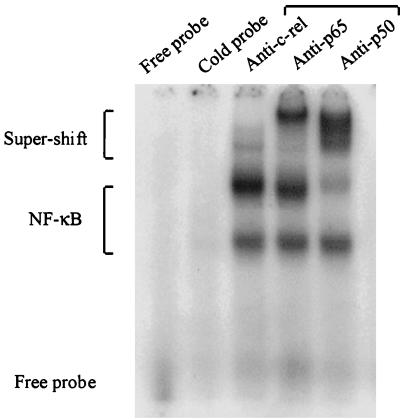
Identification of the NF-κB subunits. The NF-κB in the differentiated THP-1 cells was detected by supershift EMSA with specific antibodies to the different NF-κB subunits. Cytoplasmic extracts used in Fig. 4 were preincubated with the indicated antiserum before the binding reaction with the NF-κB-specific probe. Data are representative of two independent experiments.
FIG. 6
FIG. 6
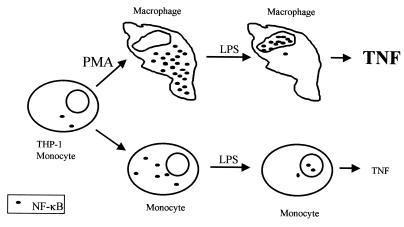
Schematic representation of the interrelationship between monocyte differentiation, NF-κB accumulation and translocation, and TNF-α secretion. When exposed to the phorbol ester PMA, THP-1 monocytes differentiate to mature macrophages. During the differentiation process, NF-κB accumulates in the cytoplasm. LPS stimulation induces the translocation of NF-κB into the nucleus, followed by the secretion of TNF-α. In the undifferentiated THP-1 cells, there are only low levels of NF-κB in the cytoplasm, which causes the cells to respond to LPS stimulation in a much slower way and by the secretion of lower levels of TNF-α, compared to the differentiated cells.

References

    1. Abmayer S M, Workman J L. Preparation of nuclear and cytoplasmic extracts from mammalian cells. In: Ausubel F M, Brent R, Kingston R E, Moore D D, Seidman J G, Smith J A, Struhl K, editors. Current protocols in molecular biology. New York, N.Y: Greene Publishing and Wiley Interscience; 1990. pp. 12.1.1–12.1.9.
    1. Auger M J, Ross J A. The biology of the macrophage. In: Lewis C E, McGee J O, editors. The macrophage. New York, N.Y: IRL Press; 1992. pp. 3–74.
    1. Baeuerle P A. The inducible transcription activator NF-κB: regulation by distinct protein subunits. Biochim Biophys Acta. 1991;1072:63–80. - PubMed
    1. Ballard D W, Dixon E P, Peffer N J, Bogerd H, Doerre S, Stein B, Greene W C. The 65-kDa subunit of human NF-kappa B functions as a potent transcriptional activator and a target for v-Rel-mediated repression. Proc Natl Acad Sci USA. 1992;89:1875–1879. - PMC - PubMed
    1. Bondeson J, Browne K A, Brennan F M, Foxwell B M J, Feldmann M. Selective regulation of cytokine induction by adenoviral gene transfer of IκB into human macrophages: lipopolysaccharide-induced, but not zymosan-induced, proinflammatory cytokines are inhibited, but IL-10 is nuclear factor-κB independent. J Immunol. 1999;162:2939–2945. - PubMed

Publication types

MeSH terms