. 1999 Nov 1;19(21):9298-305.
doi: 10.1523/JNEUROSCI.19-21-09298.1999.

Multiorgan autonomic dysfunction in mice lacking the beta2 and the beta4 subunits of neuronal nicotinic acetylcholine receptors

Affiliations

Multiorgan autonomic dysfunction in mice lacking the beta2 and the beta4 subunits of neuronal nicotinic acetylcholine receptors

W Xu et al. J Neurosci. .

Abstract

Transcripts for the beta2 and the beta4 nicotinic acetylcholine receptor (nAChR) subunits are found throughout the CNS and the peripheral nervous system. These two beta subunits can form heteromultimeric channels with any of the alpha2, alpha3, alpha4, or alpha5 subunits in heterologous expression systems. Nonetheless, the subunit composition of native nAChRs and the role of different nAChR subtypes in vivo remain unclear. We prepared null mutations for the beta2 and the beta4 genes and bred beta2-/-beta4-/- mice by mating mice of identical beta2-/-beta4+/- or beta2+/-beta4-/- genotype. The beta2-/- and the beta4-/- single-mutant mice grow to adulthood with no visible phenotypic abnormalities. The beta2-/-beta4-/- double mutants survive to birth but have impaired growth and increased perinatal mortality. They also present enlarged bladders with dribbling urination and develop urinary infection and bladder stones. The ocular pupils are widely dilated and do not constrict in response to light. Histological studies revealed no significant abnormalities of brain or peripheral tissues except for hyperplasia in the bladder mucosa of beta4-/- and beta2-/-beta4-/- mutants. Bladder strips from beta2-/-beta4-/- mice did not respond to nicotine but contracted when stimulated with a muscarinic agonist or electric field stimulation. Bladder strips from beta4 mutants did not respond to nicotine despite the absence of major bladder dysfunction in vivo. Acetylcholine-activated whole-cell currents were absent in superior cervical ganglion neurons from beta2-/-beta4-/- mice and reduced in neurons from beta4-/- mice. Although there is apparent redundancy and a superficially normal phenotype in beta2-/- and beta4-/- mice, physiological studies indicate major deficits in the beta4-/- mice. Our previous description of a similar phenotype in alpha3-/- mice and the current data suggest that the alpha3 and the beta4 subunits are major components in autonomic nAChRs. The phenotype of the beta2-/-beta4-/- and alpha3-/- mice resembles the autosomal recessive megacystis-microcolon-hypoperistalsis syndrome in humans.


Figures
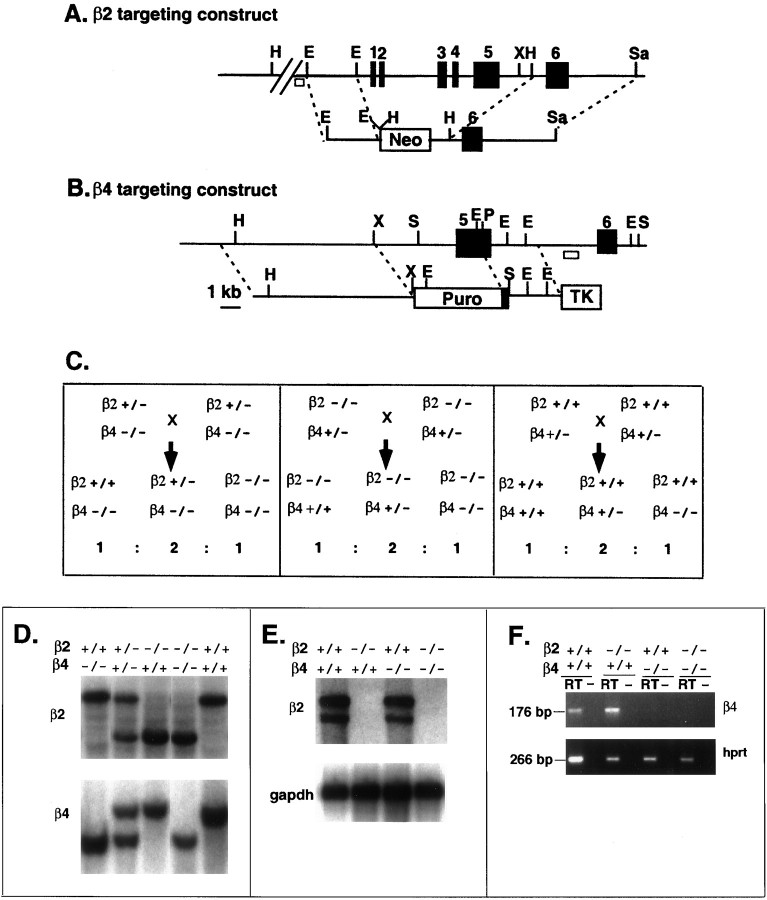
Fig. 1.
Fig. 1.
Gene targeting of the neuronal nAChR β2 and β4 subunits. A, Partial genomic structure of the murine β2 gene including the region from exons 1 to 6 (solidboxes) and the structure of the targeting vector are shown. The targeting vector contains Neo as a positive selectable marker. A homologous recombination event generated the deletion from exons 1 to 5. The diagnostic probe at the 5′-flanking region is shown as an openbox.B, Partial genomic structure of the murine β4 gene and β4-targeting vector are depicted with restriction enzyme sites and exons 5 and 6 (solidboxes). The targeting vector contains a puromycin resistance cassette (Puro) as a positive selectable marker and the Herpes simplex thymidine kinase gene (TK) as a negative selectable marker to obtain a replacement mutation. The diagnostic flanking probe is indicated as an openbox. In both A and B the restriction enzyme sites are as follows: E,EcoRI; H,HindIII;P,PstI; S,SacI; Sa,SalI; andX, XhoI. C, The three breeding schemes used to generate the mice studied are shown. Left, β2+/+β4−/− were compared with β2−/−β4−/− littermates.Center, Similarly, this breeding allowed comparison of β2−/−β4+/+ mice with β2−/−β4−/− littermates.Right, Finally, in this breeding, β2+/+β4−/− mice were compared with β2+/+β4+/+ (wild-type) littermates.D, Southern blot analysis identified the mice with the indicated genotypes using β2- and β4-flanking probes as indicated in A and B. E, Northern blot analysis of the expression of β2 mRNA in the brains of β2+/+β4+/+, β2−/−β4+/+, β2+/+β4−/−, and β2−/−β4−/− mice is shown. The probes are the rat cDNA of β2 and a cDNA for the control gene glyceraldehyde-3-phosphate dehydrogenase (gapdh). F, Reverse transcription-PCR analysis of β4 expression in the brains of β2+/+β4+/+, β2−/−β4+/+, β2+/+β4−/−, and β2−/−β4−/− mice is shown. Reverse transcription was performed with the addition of reverse transcriptase (RT) or absence of the enzyme (−) as the negative control, followed by PCR with primers of either the β4 gene or the hprt gene. The size of the PCR product is 176 bp for the β4 gene and 266 bp for the hprt gene.
Fig. 2.
Fig. 2.
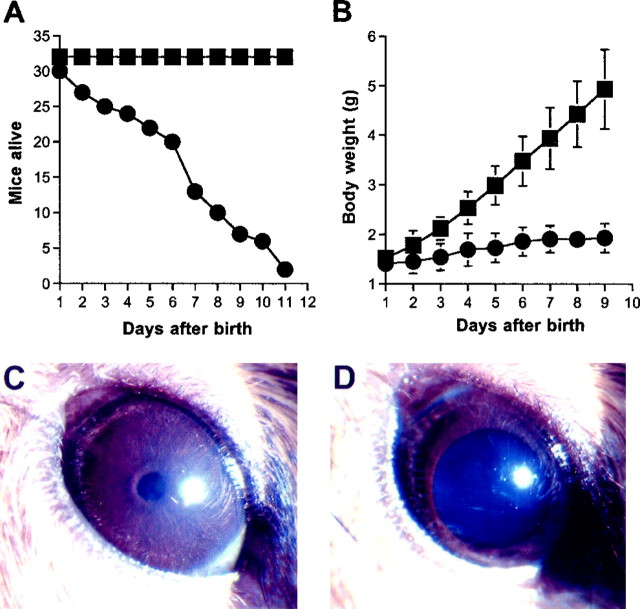
Phenotypic findings in mice lacking both β2 and β4 nAChR subunits. A, Survival curve of 30 β2−/−β4−/− mice (●) and 34 β2−/−β4+/+ mice (▪) in the first 11 d after birth. The survival curve of the β2−/−β4+/+ mice did not differ from that of age-matched wild-type animals (data not shown). B, Body weight growth of β2−/−β4−/− mice (●; n = 30 at day 1 andn = 6 at day 9) compared with that of β2−/−β4+/+ littermates (▪; n = 34). The body weight of the β2−/−β4+/+ mice did not differ from that of age-matched β2+/+β4−/− or wild-type animals (data not shown). Error bars represent the SD from the mean body weight for each group of animals. C, D, Comparison between the eye of a 16-d-old β2−/−β4+/+ mouse (C) and that of a β2−/−β4−/− littermate (D). The β2−/−β4−/− mouse had widely dilated pupils that did not constrict in response to light. The eyes of β2+/+β4−/− and β2−/−β4+/+ mice did not differ from those of wild-type animals.
Fig. 3.
Fig. 3.
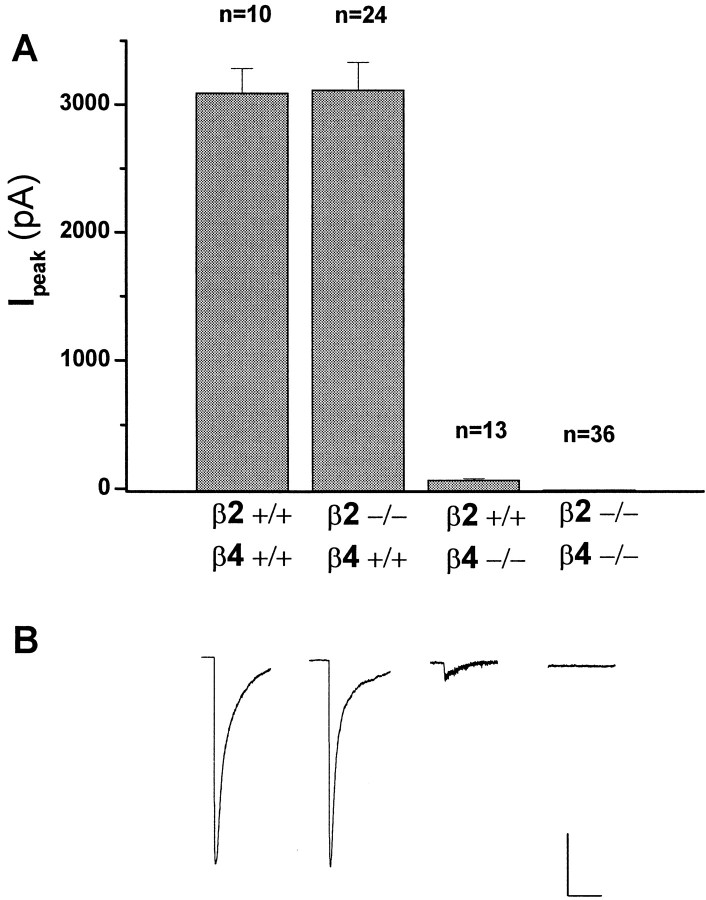
Comparison of nicotine-evoked currents from wild-type, β2−/−β4+/+, β2+/+β4−/−, and β2−/−β4−/− superior cervical ganglia neurons. A,Verticalbars represent average peak currents in response to a 5 sec pulse of nicotine (300 μm). Nicotine induced a large-amplitude desensitizing current in 100% of β2+/+β4+/+ (I = 3098 ± 188 pA; n = 10) and β2−/−β4+/+ (I = 3123 ± 212 pA; n = 24) neurons and a small-amplitude desensitizing current in 100% of β2+/+β4−/− neurons (I = 73 ± 7 pA;n = 13). In contrast, there was no response to applied nicotine in any of the β2−/−β4−/− neurons (n = 36). B,Tracesare representative whole-cell currents from superior cervical ganglia neurons of each genotype tested and shown in A. Calibration: β2+/+β4+/+, β2−/−β4+/+, 1000 nA, 5 sec; β2+/+β4−/−, β2−/−β4−/−, 250 pA, 5 sec.
Fig. 4.
Fig. 4.
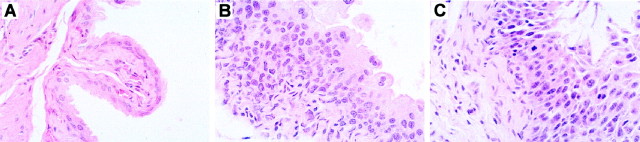
Altered bladder epithelium in β2−/−β4−/− mice. A, Microscopy of a β2+/+β4+/+ bladder wall with epithelium and underlying muscle. The epithelium is composed of several layers of regular cells. H&E staining, 400×. B,Bladder epithelium of a β2−/−β4−/− mouse that exhibits dysplasia. The number of epithelial cells is increased, and the cells are irregularly arranged. Some of the cells have decreased amounts of cytoplasm with an altered nuclear-to-cytoplasmic ratio. H&E staining, 400×. C, Bladder epithelium and underlying smooth muscle from an α3−/− mouse. The epithelium is dysplastic with an increased number of cells, which are irregularly arranged. Some cells show hyperchromatic nuclei and have decreased amounts of cytoplasm. Two cells exhibit mitotic figures. H&E staining, 400×.
Fig. 5.
Fig. 5.
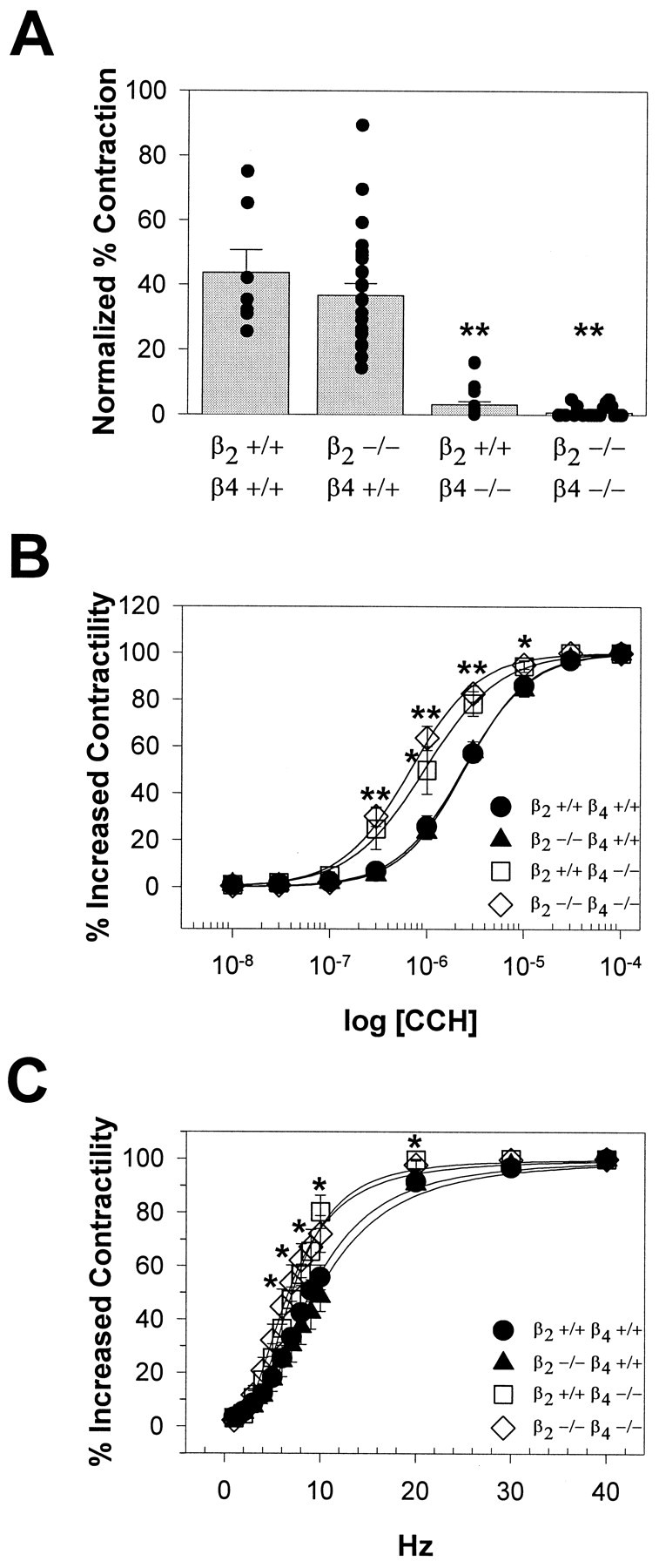
Reduced bladder contraction in response to nicotine in β2+/+β4−/− and β2−/−β4−/− mice.A, Responses to nicotine in β2+/+β4+/+ (n = 4), β2−/−β4+/+ (n = 18), β2+/+β4−/− (n = 17), and β2−/−β4−/− (n = 12) mice are shown. Data represent the contractile response to nicotine as a percentage of that to CCH (± SEM; **p < 0.01). B,Bladder contractions in response to CCH were superimposable in β2+/+β4+/+ (●) and β2−/−β4+/+ (▴) mice and were similar in β2+/+β4−/− (■) and β2−/−β4−/− (⋄) mice. The contractility responses of both β2+/+β4−/− and β2−/−β4−/− mice were significantly different from those of β2+/+β4+/+ and β2−/−β4+/+ mice (**p < 0.01; *p < 0.05). C. Bladder contractions in response to field stimulation were similar for β2+/+β4+/+ (●) and β2−/−β4+/+ (▴) mice and for β2+/+β4−/− (■) and β2−/−β4−/− (⋄) mice. The contractility responses of β2+/+β4−/− and β2−/−β4−/− mice were significantly different from those of β2+/+β4+/+ and β2−/−β4+/+ mice (*p < 0.05).

References

    1. Anand R, Conroy WG, Schoepfer R, Whiting P, Lindstrom J. Neuronal nicotinic acetylcholine receptors expressed in Xenopus oocytes have a pentameric quaternary structure. J Biol Chem. 1991;266:11192–11198. - PubMed
    1. Anneren G, Meurling S, Olsen L. Megacystis-microcolon-intestinal hypoperistalsis syndrome (MMIHS), an autosomal recessive disorder: clinical reports and review of the literature. Am J Med Genet. 1991;41:251–254. - PubMed
    1. Boulter J, O'Shea-Greenfield A, Duvoisin RM, Connolly JG, Wada E, Jensen A, Gardner PD, Ballivet M, Deneris ES, McKinnon D. Alpha 3, alpha 5, and beta 4: three members of the rat neuronal nicotinic acetylcholine receptor-related gene family form a gene cluster. J Biol Chem. 1990;265:4472–4482. - PubMed
    1. Bradley A. Teratocarcinomas and embryonic stem cells; a practical approach. IRL; Oxford: 1987.
    1. Colquhoun LM, Patrick JW. Alpha3, beta2, and beta4 form heterotrimeric neuronal nicotinic acetylcholine receptors in Xenopus oocytes. J Neurochem. 1997;69:2355–2362. - PubMed

Publication types

MeSH terms