


doi: 10.1073/pnas.96.22.12571.
Content mixing and membrane integrity during membrane fusion driven by pairing of isolated v-SNAREs and t-SNAREs
Affiliations
- PMID: 10535963
- PMCID: PMC22994
- DOI: 10.1073/pnas.96.22.12571
Item in Clipboard
Content mixing and membrane integrity during membrane fusion driven by pairing of isolated v-SNAREs and t-SNAREs
Proc Natl Acad Sci U S A.
.
Abstract
Membrane bilayer fusion has been shown to be mediated by v- and t-SNAREs initially present in separate populations of liposomes and to occur with high efficiency at a physiologically meaningful rate. Lipid mixing was demonstrated to involve both the inner and the outer leaflets of the membrane bilayer. Here, we use a fusion assay that relies on duplex formation of oligonucleotides introduced in separate liposome populations and report that SNARE proteins suffice to mediate complete membrane fusion accompanied by mixing of luminal content. We also find that SNARE-mediated membrane fusion does not compromise the integrity of liposomes.
Figures
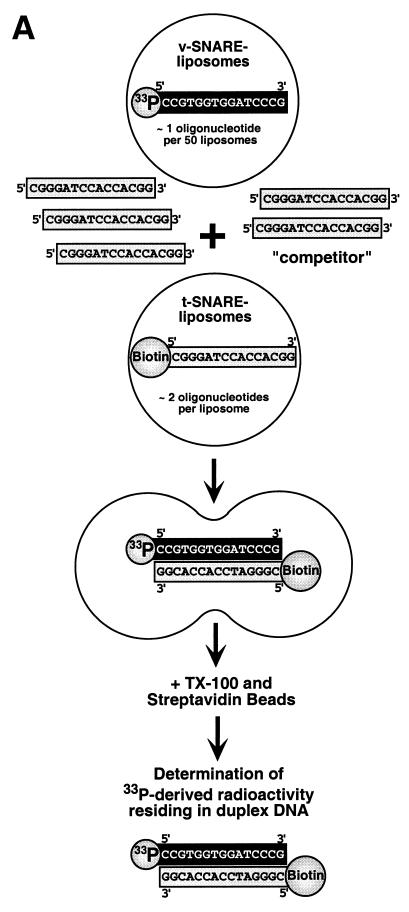
Content mixing assay and protein analysis of liposomes. (A) Schematic illustration of the oligonucleotide-based fusion assay. For a detailed description see text. (B) Analysis of the protein content of various proteoliposome preparations. Proteins were analyzed by using 10% NuPage Gels (NOVEX, San Diego) followed by Coomassie blue protein staining. Lanes: 1, 10 μl of VAMP-containing liposomes; 2, 10 μl of tc-syntaxin 1A/SNAP-25-containing liposomes; 3, 10 μl of H3-syntaxin 1A/SNAP25-containing liposomes obtained after thrombin treatment of tc-syntaxin 1A/SNAP25-containing liposomes (for details see Materials and Methods). The band highlighted with a star (lane 3) was previously identified as a degradation product of SNAP-25 (24).
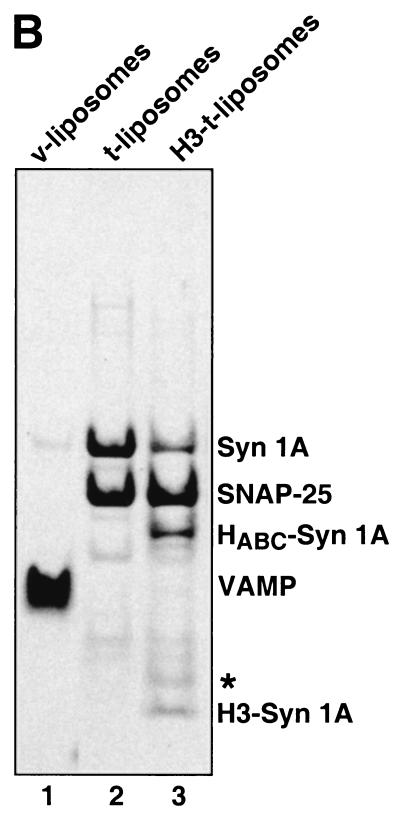
Content mixing assay and protein analysis of liposomes. (A) Schematic illustration of the oligonucleotide-based fusion assay. For a detailed description see text. (B) Analysis of the protein content of various proteoliposome preparations. Proteins were analyzed by using 10% NuPage Gels (NOVEX, San Diego) followed by Coomassie blue protein staining. Lanes: 1, 10 μl of VAMP-containing liposomes; 2, 10 μl of tc-syntaxin 1A/SNAP-25-containing liposomes; 3, 10 μl of H3-syntaxin 1A/SNAP25-containing liposomes obtained after thrombin treatment of tc-syntaxin 1A/SNAP25-containing liposomes (for details see Materials and Methods). The band highlighted with a star (lane 3) was previously identified as a degradation product of SNAP-25 (24).
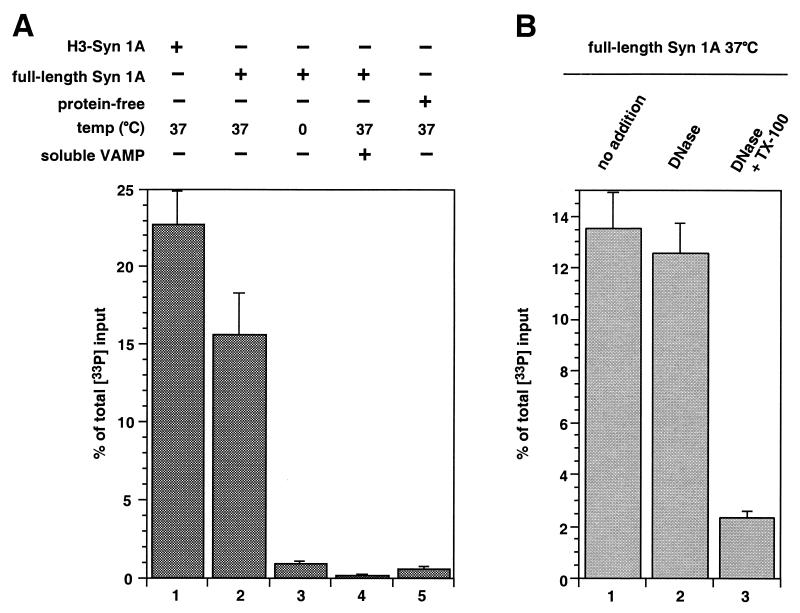
Characterization of SNARE-dependent membrane fusion based on content mixing. (A) SNARE-mediated liposome fusion results in content mixing. All samples contained v-liposomes loaded with 33P-labeled oligonucleotide 1 and were (without a preceding incubation at 0°C) incubated for 120 min under the conditions indicated. Where indicated, 5 μl of the cytoplasmic domain of VAMP (3.8 mg/ml) prepared as described in ref. were added to the incubation. After lysis of liposomes in the continued presence of competitor, biotinylated oligonucleotide 2 was affinity-purified (see Materials and Methods) and co-purification of oligonucleotide 1 was determined by measuring 33P-derived radioactivity. The data are expressed as percent of total 33P input. Standard deviations are shown [n = 5 (lane 1), n = 19 (lane 2), n = 13 (lane 3), n = 14 (lane 4), n = 9 (lane 5)]. (B) Oligonucleotides present in the incubation mixture are protected against DNase. All samples contained v-liposomes loaded with 33P-labeled oligonucleotide 1 and were incubated for 120 min at 37°C. Subsequent DNase I treatment (2 units per sample) was performed for 30 min on ice in the presence of 2 mM MgCl2 under the conditions indicated. After inhibition of DNase I by the addition of EDTA, liposomes were lysed and the mixture was subjected to affinity-purification of oligonucleotide 2. Recovery of 33P duplex DNA was determined as described above. Standard deviations are shown (n = 4).
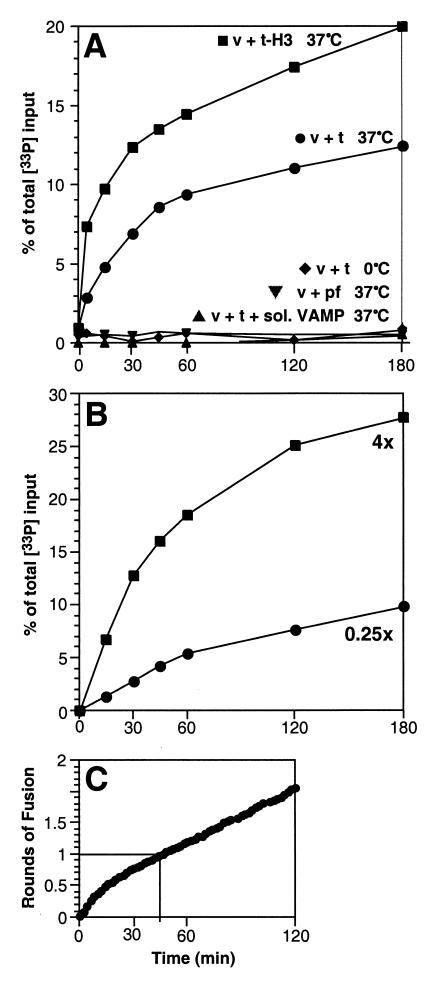
Kinetic analysis of content mixing. Incubations were carried out as described in the legend of Fig. 2 and in Materials and Methods. For kinetic analysis, incubations were scaled up to allow taking samples of 50 μl at the time points indicated. All experiments were performed without a preceding preincubation at 0°C. Affinity-purification of biotinylated oligonucleotide 2 was performed as described in Materials and Methods. (A) Comparison of full-length tc-Syntaxin-containing liposomes with H3-Syntaxin-containing liposomes. Purification of biotinylated oligonucleotide 2 and determination of co-purification of 33P-labeled oligonucleotide 1 was performed as described in the legend of Fig. 2 and in Materials and Methods. Pf, protein-free. (B) Influence of the amount of oligonucleotide 2 present in t-SNARE-containing liposomes on the kinetics of content mixing. Liposomes were prepared as described in Materials and Methods in the presence of various amounts of oligonucleotide 2. The standard concentration of oligonucleotide 2 (50 μM during liposome reconstitution) as used for experiments shown in Figs. 2 and 3A was elevated to 200 μM (4x) or was lowered to 12.5 μM (0.25x), respectively. Under both conditions, t-SNARE-liposomes contained full-length tc-syntaxin. (C) Analysis of membrane fusion based on lipid mixing. These experiments were performed as described earlier (17), using the same liposome preparations (containing full-length tc-syntaxin in t-SNARE liposomes) used for content mixing assays. The fusion signal is expressed as rounds of fusion applying the calibration curve described in the accompanying paper (24). One round of fusion is reached when every individual VAMP-containing liposome on average fused with a t-SNARE-containing liposome.
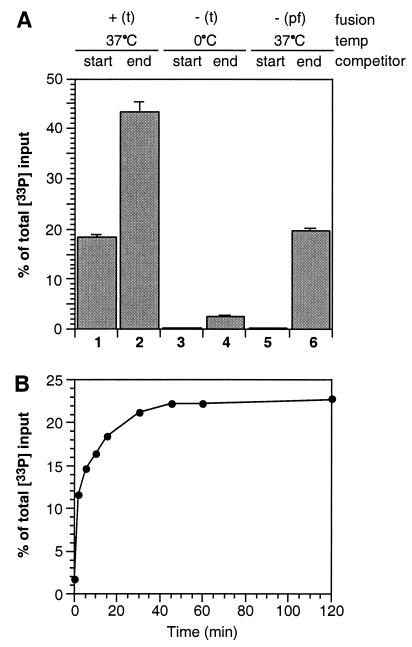
The integrity of liposomes is maintained during SNARE-dependent membrane fusion. (A) Analysis of leakage under fusion and nonfusion conditions. Incubations were performed as described in the legend of Fig. 2 and in Materials and Methods under the conditions indicated. All incubations contained VAMP-liposomes loaded with 33P-labeled oligonucleotide 1. Where indicated, t-SNARE (SNAP25/full-length syntaxin)-containing liposomes (t) loaded with biotinylated oligonucleotide 2 were replaced by protein-free (pf) liposomes containing biotinylated oligonucleotide 2. The competitor was either added at the beginning of the incubation (start) or after 2 hours of incubation (end) under the condition indicated. In the former case, the signal represents luminal duplex formation (i.e., content mixing as a result of membrane fusion) whereas, in the latter case, the signal represents luminal duplex formation plus leakage. Affinity-purification of biotinylated oligonucleotide 2 was performed as described in Materials and Methods. Standard deviations are shown (n = 4). (B) Kinetic analysis of leakage. Leakage was analyzed as described in A under nonfusion conditions. In this experiment, fusion was inhibited by preincubation of t-SNARE (SNAP25/full-length syntaxin) liposomes with the soluble domain of VAMP (final concentration 0.4 mg/ml). For kinetic analysis, incubations were scaled up to allow taking samples of 50 μl at the time points indicated followed by addition of competitor. Affinity-purification of biotinylated oligonucleotide 2 was performed as described in Materials and Methods.
Comment in
-
SNARE proteins mediate lipid bilayer fusion.Proc Natl Acad Sci U S A. 1999 Oct 26;96(22):12227-9. doi: 10.1073/pnas.96.22.12227. Proc Natl Acad Sci U S A. 1999. PMID: 10535902 Free PMC article. No abstract available.
References
-
- Söllner T, Whiteheart S W, Brunner M, Erdjument-Bromage H, Geromanos S, Tempst P, Rothman J E. Nature (London) 1993;362:318–324. - PubMed
-
- Rothman J E. Nature (London) 1994;372:55–63. - PubMed
-
- Sogaard M, Tani K, Ye R R, Geromanos S, Tempst P, Kirchhausen T, Rothman J E, Söllner T. Cell. 1994;78:937–948. - PubMed
-
- Brennwald P, Kearns B, Champion K, Keranen S, Bankaitis V, Novick P. Cell. 1994;79:245–258. - PubMed
-
- Nichols B J, Pelham H R. Biochim Biophys Acta. 1998;1404:9–31. - PubMed
Publication types
MeSH terms
Substances
LinkOut - more resources
Full Text Sources
