. 1999 Oct 26;96(22):12708-12.
doi: 10.1073/pnas.96.22.12708.

Humoral response to herpes simplex virus is complement-dependent

Affiliations

Humoral response to herpes simplex virus is complement-dependent

X J Da Costa et al. Proc Natl Acad Sci U S A. .

Abstract

The complement system represents a cascade of serum proteins, which provide a major effector function in innate immunity. Recent studies have revealed that complement links innate and adaptive immunity via complement receptors CD21/CD35 in that it enhances the B cell memory response to noninfectious protein antigens introduced i.v. To examine the importance of complement for immune responses to virus infection in a peripheral tissue, we compared the B cell memory response of mice deficient in complement C3, C4, or CD21/CD35 with wild-type controls. We found that the deficient mice failed to generate a normal memory response, which is characterized by a reduction in IgG antibody and germinal centers. Thus, complement is important not only in the effector function of innate immunity but also in the stimulation of memory B cell responses to viral-infected cell antigens in both blood and peripheral tissues.


Figures
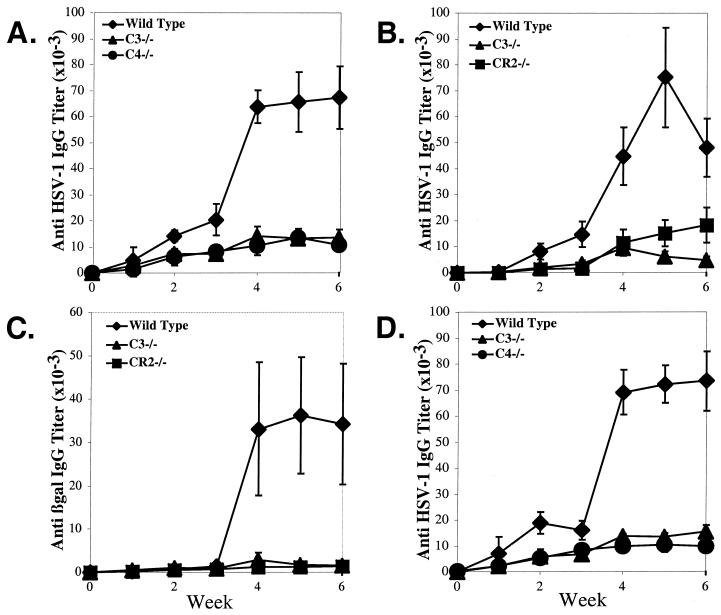
Figure 1
Figure 1
Classical pathway complement and complement receptors CD21/CD35 are required for the humoral response to replication-defective HD-2 virus or replication-competent KOS1.1 wt virus. Mice were injected at days 0 and 21 with 2 × 10⁶ pfu of replication-defective (AC) or replication-sufficient (D) virus, HD-2 and KOS1.1, respectively. Antibody titers were determined by ELISA assay. Mean titer ± SD represents at least five mice analyzed in two separate experiments. (A) Deficiency in either C3 or C4 results in an impaired secondary humoral response to infectious HSV-1. (B) Cr2−/− mice have an impaired secondary response similar to mice deficient in C3. (C) Humoral response to recombinant virus-expressed heterologous protein (β-galactosidase) is also impaired in mice deficient in C3 or CD21/CD35. (D) Secondary humoral response to replication-sufficient HSV-1 (strain KOS1.1) depends on complements C3 and C4.
Figure 2
Figure 2
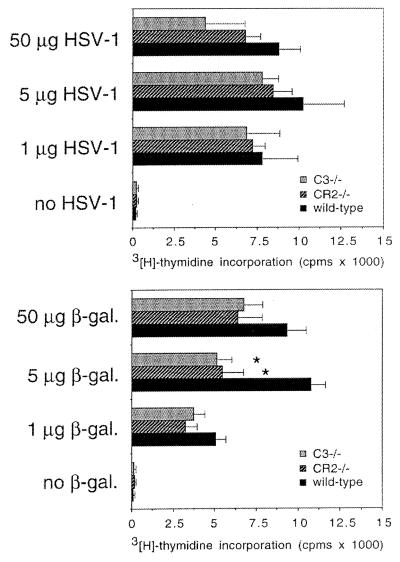
T cells are primed in C3−/− and Cr2−/− mice infected with HSV-1 strain HD-2. CD3+ T cells were purified by negative selection from LNs of complement-deficient or wt mice 7 days after a third challenge with virus and cultured with peritoneal macrophages along with varying concentrations of either viral lysate (Upper) or β-galactosidase (Lower). Columns represent mean ± SD of thymidine incorporation in cell lysate after harvest at day 3. Asterisk indicates statistical significance at P < 0.05.
Figure 3
Figure 3
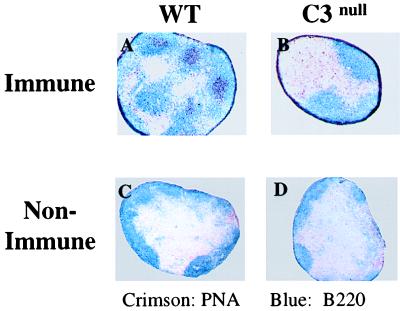
Germinal center response is impaired in C3−/− mice after infection with 2 × 10⁶ pfu of HSV-1 (HD-2 strain). LN (inguinal and popliteal) were harvested from either wt or C3−/− mice 7 days after a third viral challenge (A and B) or from those that were unimmunized (C and D). Cryosections were prepared and treated with antibody specific for B220 (B cell-specific) (in blue) and peanut agglutinin (crimson) as described in Materials and Methods. Representative sections identify PNA + GC in LN follicles of wt (A) but not C3−/− (B) mice infected with HSV or noninfected mice (C and D). [×100 (A and B) and ×50 (C and D).]
Figure 4
Figure 4
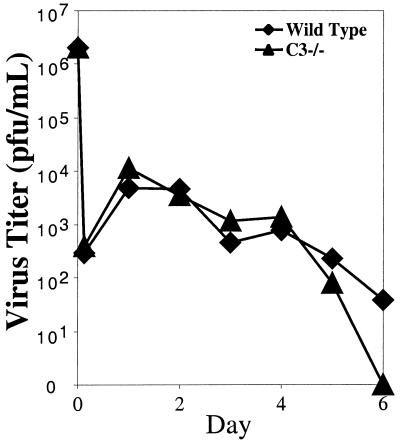
Replication of HSV is unimpaired in C3 knockout mice. Wt or C3−/− mice were infected with 2 × 10⁶ pfu of KOS1.1 by corneal infection. Virus replication was determined by titering eye swabs collected at the indicated times postinfection.

References

    1. Ezekowitz R, Sim R, Hill R, Gordon S. J Exp Med. 1983;159:244–260. - PMC - PubMed
    1. Cooper N R, Nemerow G R. J Invest Dermatol. 1985;85:39–46. - PubMed
    1. Muller-Eberhard H J. Annu Rev Biochem. 1988;57:321–347. - PubMed
    1. Reid K B M, Porter R R. Annu Rev Biochem. 1981;50:433–464. - PubMed
    1. Cooper N R. Immunol Today. 1991;12:327–331. - PubMed

Publication types

LinkOut - more resources