


Low-status monkeys "play dumb" when learning in mixed social groups
- PMID: 10536031
- PMCID: PMC23184
- DOI: 10.1073/pnas.96.22.12965
Low-status monkeys "play dumb" when learning in mixed social groups
Abstract
Many primates, including humans, live in complex hierarchical societies where social context and status affect daily life. Nevertheless, primate learning studies typically test single animals in limited laboratory settings where the important effects of social interactions and relationships cannot be studied. To investigate the impact of sociality on associative learning, we compared the individual performances of group-tested rhesus monkeys (Macaca mulatta) across various social contexts. We used a traditional discrimination paradigm that measures an animal's ability to form associations between cues and the obtaining of food in choice situations; but we adapted the task for group testing. After training a 55-member colony to separate on command into two subgroups, composed of either high- or low-status families, we exposed animals to two color discrimination problems, one with all monkeys present (combined condition), the other in their "dominant" and "subordinate" cohorts (split condition). Next, we manipulated learning history by testing animals on the same problems, but with the social contexts reversed. Monkeys from dominant families excelled in all conditions, but subordinates performed well in the split condition only, regardless of learning history. Subordinate animals had learned the associations, but expressed their knowledge only when segregated from higher-ranking animals. Because aggressive behavior was rare, performance deficits probably reflected voluntary inhibition. This experimental evidence of rank-related, social modulation of performance calls for greater consideration of social factors when assessing learning and may also have relevance for the evaluation of human scholastic achievement.
Figures
 )
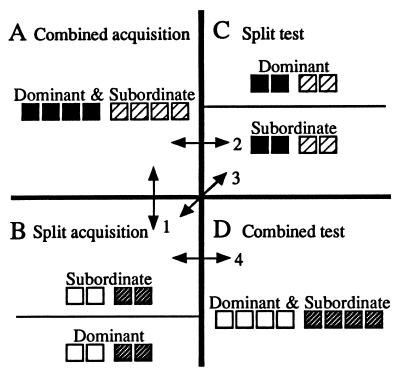
boxes. In split testing (C) and combined testing
(D), the discrimination problems remained the same, but
the social contexts were reversed. Arrows 1–4 show the specific
comparisons made to test the predictions regarding performance by
subordinates.
)
boxes. In split testing (C) and combined testing
(D), the discrimination problems remained the same, but
the social contexts were reversed. Arrows 1–4 show the specific
comparisons made to test the predictions regarding performance by
subordinates.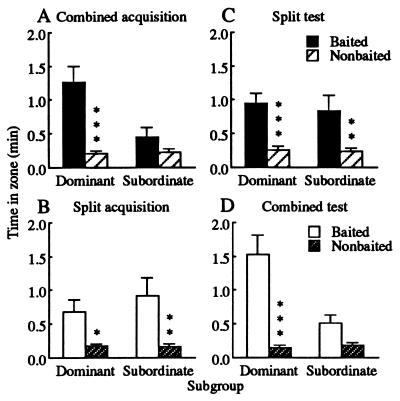
References
-
- Blodgett H C. Univ Calif Publ Psychol. 1929;4:113–134.
-
- Tolman E C, Honzik C H. Univ Calif Publ Psychol. 1930;4:257–275.
-
- Gove W R, Hughes M, Geerken M R. Soc Psychol Q. 1980;43:89–102. - PubMed
-
- Soltz D F. Psychol Rep. 1978;43:111–114.
-
- Whyte W F. Street Corner Society. Chicago: Univ. Chicago Press; 1943.
Publication types
MeSH terms
Grants and funding
LinkOut - more resources
Full Text Sources
