


The modulation of B7.2 and B7.1 on B cells by immunosuppressive agents
- PMID: 10540152
- PMCID: PMC1905388
- DOI: 10.1046/j.1365-2249.1999.01028.x
The modulation of B7.2 and B7.1 on B cells by immunosuppressive agents
Abstract
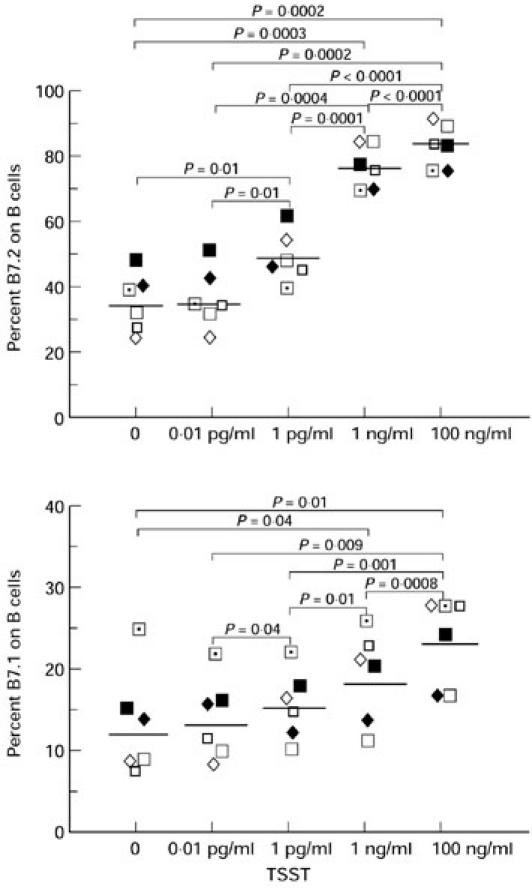
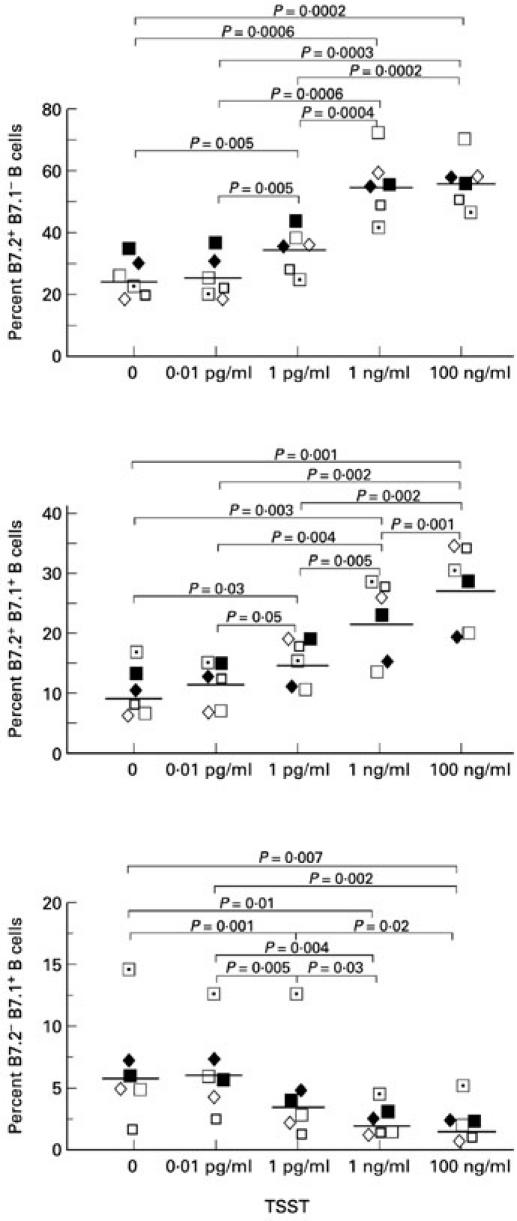
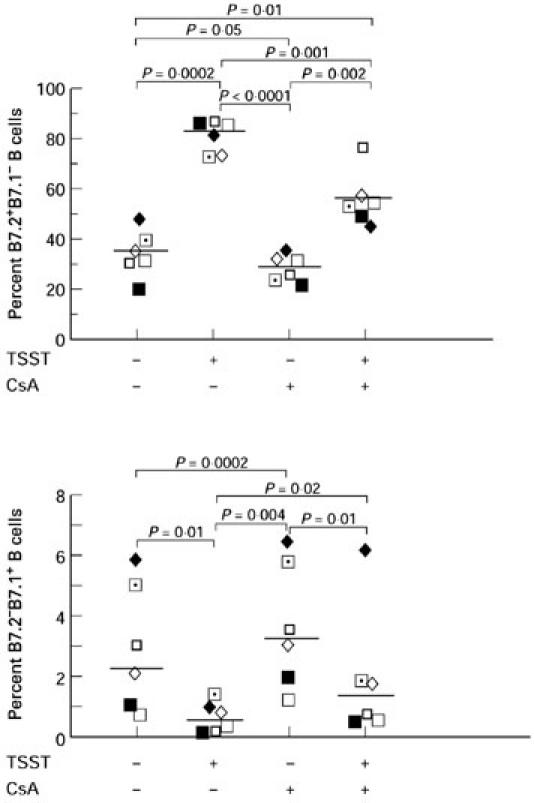
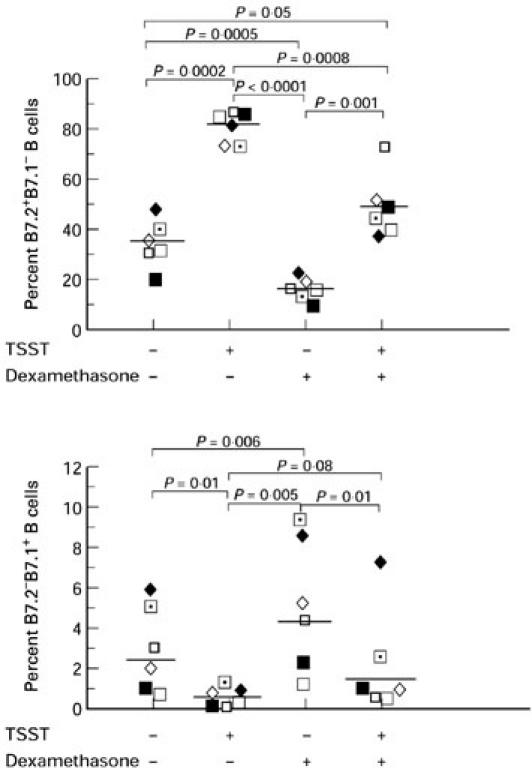
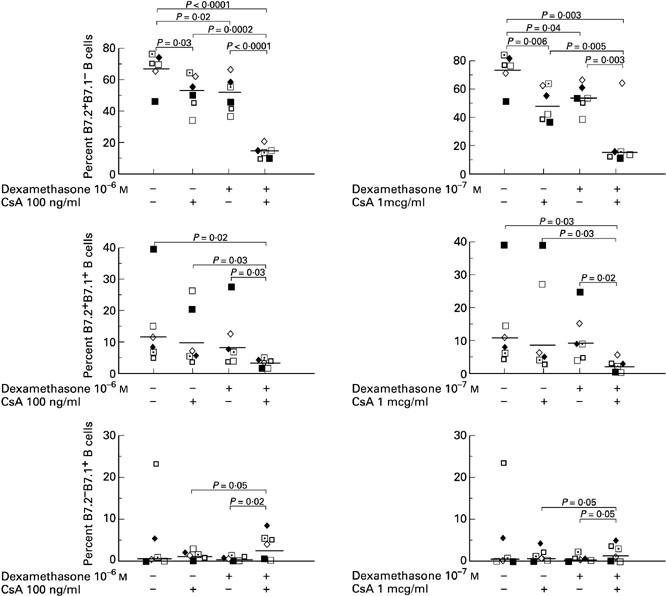
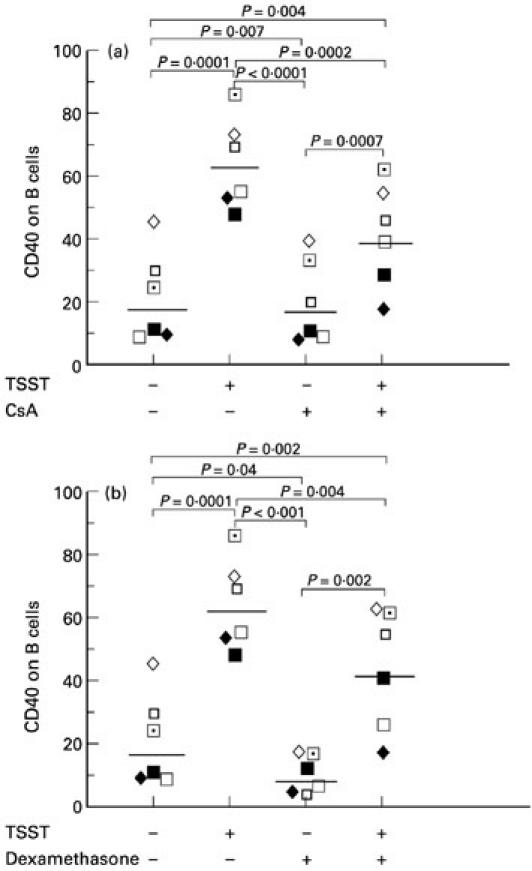
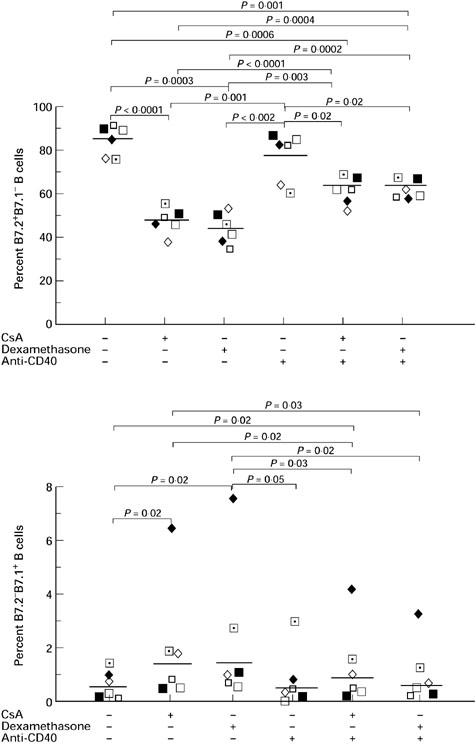
Several recent studies demonstrate that B7.2, but not B7.1, play an important role in allergic inflammation and IgE production. Agents that down-regulate B7.2 may therefore be of benefit for the treatment of Th2-driven allergic diseases. Our current study was carried out to investigate the effect of immunosuppressive agents, cyclosporin A (CsA) and dexamethasone, on B7.2 and B7.1 expression on B cells stimulated with the superantigen, toxic shock syndrome toxin-1 (TSST-1). The analysis of B7.2 and B7.1 on the same cells by flow cytometry demonstrated that TSST-1 up-regulated B7.2+B7.1- but not B7.1+B7.2- on B cells in a dose-dependent fashion. CsA and dexamethasone significantly down-regulated B7.2+B7.1- but up-regulated B7.2-B7.1+ B cells in the presence or absence of TSST-1 (100 ng/ml). Interestingly, the combination of CsA and dexamethasone was much more potent in the inhibition of B7.2 expression than either of these agents alone. As CD40 is known to up-regulate B7.2 expression on B cells, the mechanism of B7.2 down-regulation by CsA and dexamethasone was further studied by investigating the effect of these agents on CD40 expression on B cells. TSST-1 significantly increased CD40 expression on B cells. However, the addition of CsA or dexamethasone significantly down-regulated CD40 expression. Anti-CD40 MoAb significantly reversed the effects of CsA or dexamethasone on B7.2 and B7.1 expression, suggesting that T cell engagement of CD40 plays a role in the mechanisms by which CsA and dexamethasone acts on B cells. These data demonstrate the modulatory effect of CsA and dexamethasone on B7.2 and B7.1 expression on B cells and the potential role of CD40 in mediating this effect.
Figures
References
-
- Lenschow DJ, Walunas TL, Bluestone JA. CD28/B7 system of T cell costimulation. Annu Rev Immunol. 1996;14:233–58. - PubMed
-
- Bluestone JA. New perspectives of CD28-B7-mediated T cell costimulation. Immunity. 1995;2:555–9. - PubMed
-
- Linsley PS, Greene JL, Brady W, Bajorath J, Ledbetter JA, Peach R. Human B7-1 (CD80) B 7-2 (CD86) bind with similar avidities but distinct kinetics to CD28 and CTLA-4 receptors. Immunity. 1994;1:793–801. - PubMed
-
- Ellis JH, Burden MN, Vinogradov DV, Linge C, Crowe JS. Interactions of CD80 and CD86 with CD28 and CTLA4. J Immunol. 1996;156:2700–9. - PubMed
-
- Morton PA, Fu XT, Stewart JA, et al. Differential effects of CTLA-4 substitutions on the binding of human CD80 (B7-1) and CD86 (B7-2) J Immunol. 1996;156:1047–54. - PubMed
Publication types
MeSH terms
Substances
Grants and funding
LinkOut - more resources
Full Text Sources
Research Materials
