Helicobacter pylori infection and early onset myocardial infarction: case-control and sibling pairs study
- PMID: 10541503
- PMCID: PMC28263
- DOI: 10.1136/bmj.319.7218.1157
Helicobacter pylori infection and early onset myocardial infarction: case-control and sibling pairs study
Abstract
Objectives: To examine the association between coronary heart disease and chronic Helicobacter pylori infection.
Design: Case-control study of myocardial infarction at young ages and study of sibling pairs with one member affected and the other not.
Setting: United Kingdom.
Participants: 1122 survivors of suspected acute myocardial infarction at ages 30-49 (mean age 44 years) and 1122 age and sex matched controls with no history of coronary heart disease; 510 age and sex matched pairs of siblings (mean age 59 years) in which one sibling had survived myocardial infarction and one had no history of coronary heart disease.
Main outcome measures: Serological evidence of chronic infection with H pylori.
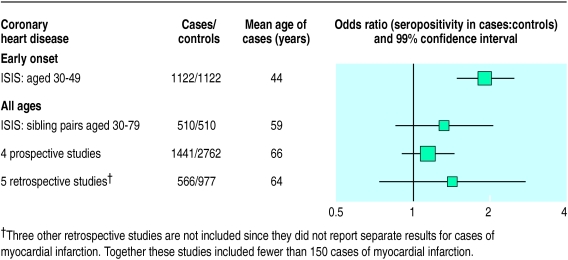
Results: 472 (42%) of the 1122 cases with early onset myocardial infarction were seropositive for H pylori antibodies compared with 272 (24%) of the 1122 age and sex matched controls, giving an odds ratio of 2.28 (99% confidence interval 1.80 to 2.90). This odds ratio fell to 1.87 (1.42 to 2.47; P<0.0001) after smoking and indicators of socioeconomic status were adjusted for and to 1.75 (1.29 to 2.36) after additional adjustment for blood lipid concentrations and obesity. Only 158 of the 510 pairs of siblings were discordant for H pylori status; among these, 91 cases and 67 controls were seropositive (odds ratio 1.33 (0.86 to 2.05)). No strong correlations were observed between H pylori seropositivity and measurements of other risk factors for coronary heart disease (plasma lipids, fibrinogen, C reactive protein, albumin, etc).
Conclusion: In the context of results from other relevant studies, these two studies suggest a moderate association between coronary heart disease and H pylori seropositivity that cannot be fully accounted for by other risk factors. But even if this association is causal and largely reversible by eradication of chronic infection, very large randomised trials would be needed to show this.
Figures
Comment in
-
Helicobacter pylori and myocardial infection. Excluding group with potentially higher rates of infection with H pylori could bias estimated odds ratio.BMJ. 2000 Mar 18;320(7237):799; author reply 800. BMJ. 2000. PMID: 10720376 Free PMC article. No abstract available.
-
Helicobacter pylori and myocardial infection. Exclusion criteria were inappropriate.BMJ. 2000 Mar 18;320(7237):799-800. BMJ. 2000. PMID: 10777305 No abstract available.
References
-
- Danesh J, Collins R, Peto R. Chronic infections and coronary heart disease: is there a link? Lancet. 1997;350:430–436. - PubMed
-
- Danesh J, Appleby P. Persistent infection and vascular disease: a systematic review. Expert Opin Invest Drugs. 1998;7:691–713. - PubMed
-
- Prospective Studies Collaboration. Cholesterol, diastolic blood pressure, and stroke: 13 000 strokes in 450 000 people in 45 prospective cohorts. Lancet. 1995;346:1647–1653. - PubMed
-
- ISIS-3 (Third International Study of Infarct Survival) Collaborative Group. ISIS-3: a randomised comparison of streptokinase vs tissue plasminogen activator vs anistreplase and of aspirin plus heparin vs aspirin alone among 41 229 cases of suspected acute myocardial infarction. Lancet. 1992;339:753–770. - PubMed
Publication types
MeSH terms
Substances
LinkOut - more resources
Full Text Sources
Medical
Research Materials