


Antimicrobial susceptibilities and serogroups of clinical strains of Clostridium difficile isolated in France in 1991 and 1997
- PMID: 10543736
- PMCID: PMC89532
- DOI: 10.1128/AAC.43.11.2607
Antimicrobial susceptibilities and serogroups of clinical strains of Clostridium difficile isolated in France in 1991 and 1997
Abstract
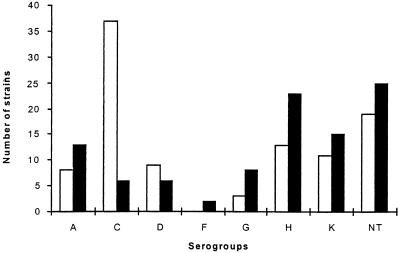
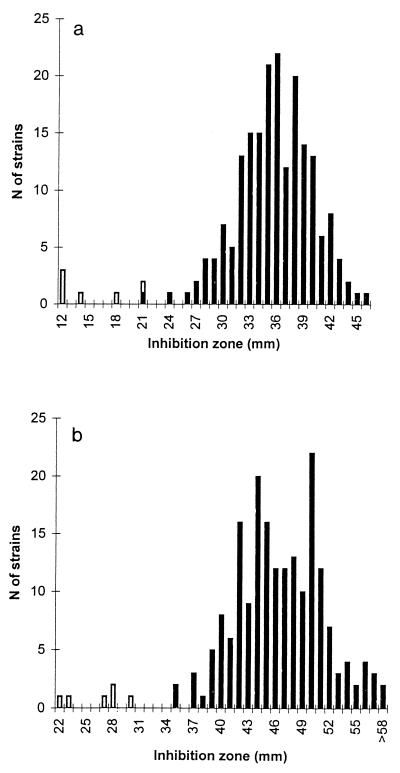
Glycopeptides (vancomycin and teicoplanin) and metronidazole are the drugs of choice for the treatment of Clostridium difficile infections, but trends in susceptibility patterns have not been assessed in the past few years. The objective was to study the MICs of glycopeptides and metronidazole for unrelated C. difficile strains isolated in 1991 (n = 100) and in 1997 (n = 98) by the agar macrodilution, the E-test, and the disk diffusion methods. Strain susceptibilities to erythromycin, clindamycin, tetracycline, rifampin, and chloramphenicol were also determined by the ATB ANA gallery (bioMérieux, La Balme-les-Grottes, France). The MICs at which 50% of isolates are inhibited (MIC(50)s) and MIC(90)s of glycopeptides and metronidazole remained stable between 1991 and 1997. All the strains were inhibited by concentrations that did not exceed 2 microgram/ml for vancomycin and 1 microg/ml for teicoplanin. Comparison of MICs determined by the agar dilution method recommended by the National Committee for Clinical Laboratory Standards and the E test showed correlations (+/-2 dilutions) of 86. 6, 95.9, and 99% for metronidazole, vancomycin, and teicoplanin, respectively. The E test always underestimated the MICs. Strains with decreased susceptibility to metronidazole (MICs, >/=8 microgram/ml) were isolated from six patients (n = 4 in 1991 and n = 2 in 1997). These strains were also detected by the disk diffusion method (zone inhibition diameter, </=21 mm); they belonged to nontoxigenic serogroup D (n = 5) and toxigenic serogroup H (n = 1). Decreased susceptibility to erythromycin (MICs, >/=1 microgram/ml), clindamycin (MICs, >/=2 microgram/ml), tetracycline (MICs, >/=8 microgram/ml), rifampin (MICs, >/=4 microgram/ml), and chloramphenicol (MICs, >/=16 microgram/ml) was observed in 64.2, 80.3, 23.7, 22.7, and 14.6% of strains, respectively. Strains isolated in 1997 were more susceptible than those isolated in 1991, and this trend was correlated to a major change in serogroup distribution. Periodic studies are needed in order to detect changes in serogroups and the emergence of strains with decreased susceptibility to therapeutic drugs.
Figures
References
-
- Barbut F, Corthier G, Charpack Y, Cerf M, Monteil H, Fosse T, Trévoux A, De Barbeyrac B, Boussougant Y, Tigaud S, Tytgat F, Sédallian A, Duborgel S, Collignon A, LeGuern M E, Bernasconi P, Petit J C. Prevalence and pathogenicity of Clostridium difficile in hospitalized patients. A French multicenter study. Arch Intern Med. 1996;156:1449–1454. - PubMed
-
- Barbut F, Mario N, Meyohas M C, Binet D, Frottier J, Petit J C. Investigation of a nosocomial outbreak of Clostridium difficile-associated diarrhoea among AIDS patients with random amplified polymorphic DNA. J Hosp Infect. 1994;26:181–189. - PubMed
-
- Barbut F, Meynard J L, Guiguet M, Avesani V, Bochet M V, Meyohas M C, Delmée M, Tilleul P, Frottier J, Petit J C. Clostridium difficile-associated diarrhea in HIV-infected patients: epidemiology and risk factors. J Acquir Immune Defic Syndr Hum Retrovirol. 1997;16:176–181. - PubMed
-
- Bartlett J G, Chang T W, Gurwith M, Gorbach S L, Onderdonk A B. Antibiotic-associated pseudomembranous colitis due to toxin-producing clostridia. N Engl J Med. 1978;298:531–534. - PubMed
-
- Bartolini A, Colao M G, Orsi A, Dei R, Giganti E, Parenti F. In vitro activity of vancomycin, teicoplanin, daptomycin, ramoplanin, MLD62873 and other agents against staphylococci, enterococci and Clostridium difficile. J Antimicrob Chemother. 1990;26:627–633. - PubMed
Publication types
MeSH terms
Substances
LinkOut - more resources
Full Text Sources
Other Literature Sources
Medical
Molecular Biology Databases
Miscellaneous
