


AMP deamination and purine exchange in human skeletal muscle during and after intense exercise
- PMID: 10545153
- PMCID: PMC2269626
- DOI: 10.1111/j.1469-7793.1999.00909.x
AMP deamination and purine exchange in human skeletal muscle during and after intense exercise
Abstract
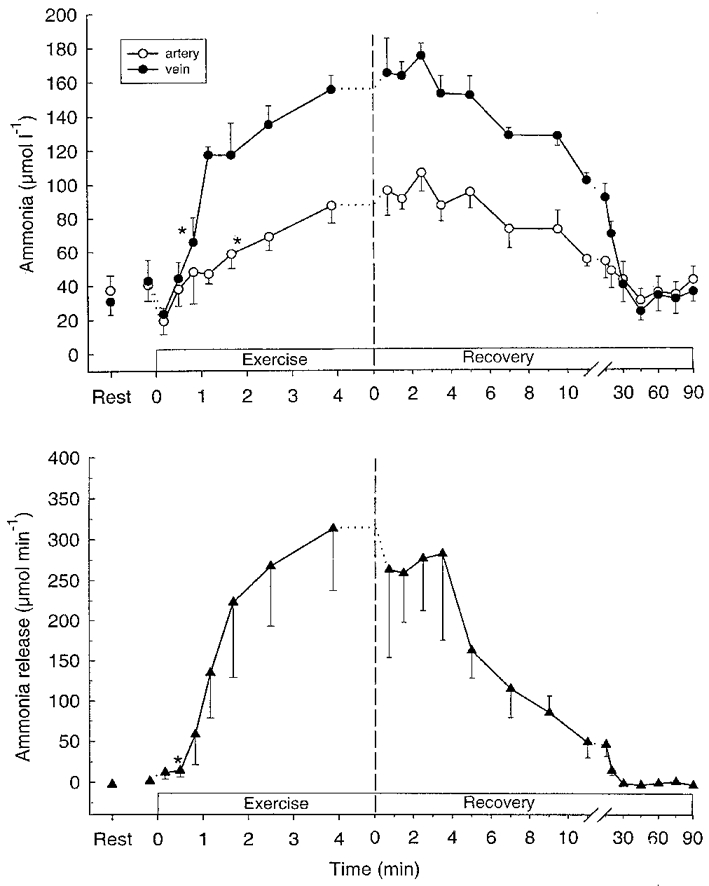
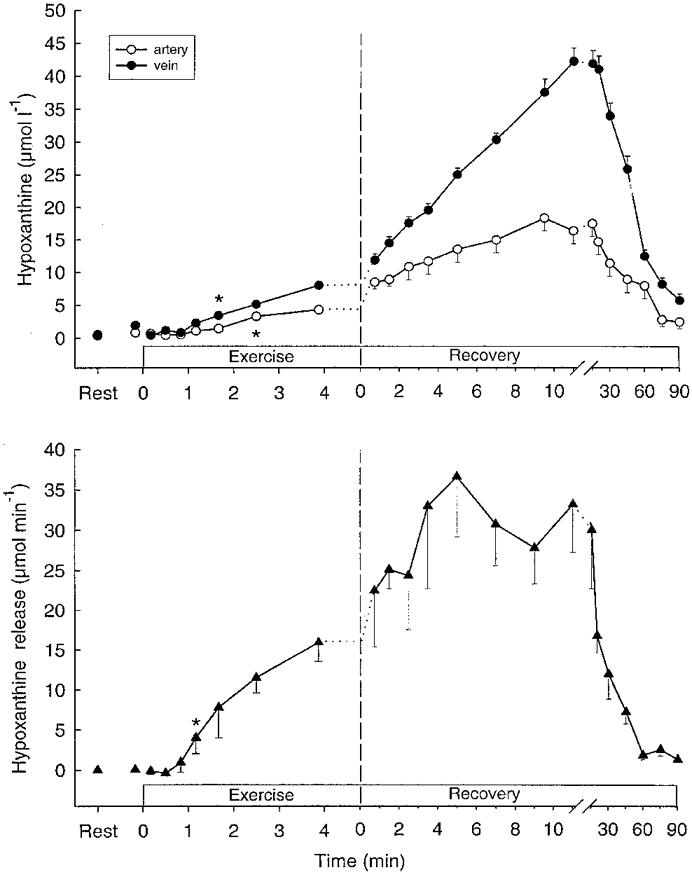
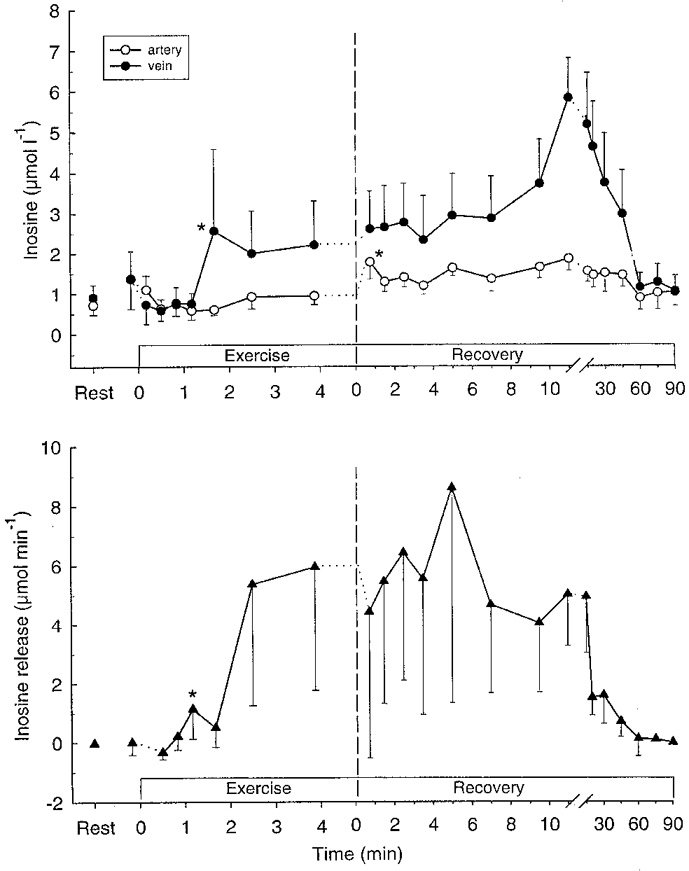
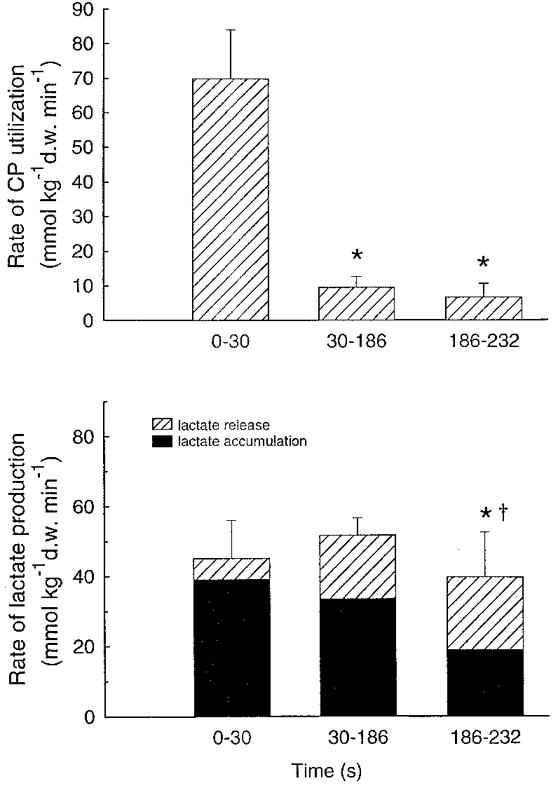
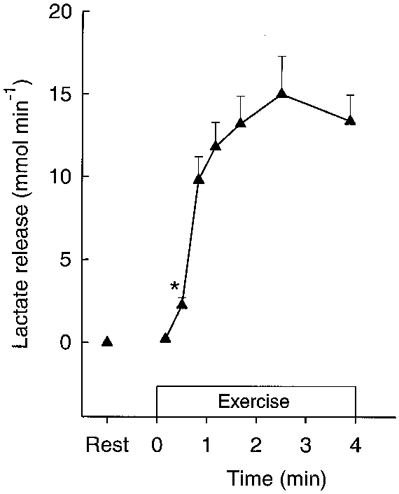
1. The present study examined the regulation of human skeletal muscle AMP deamination during intense exercise and quantified muscle accumulation and release of purines during and after intense exercise. 2. Seven healthy males performed knee extensor exercise at 64.3 W (range: 50-70 W) to exhaustion (234 s; 191-259 s). In addition, on two separate days the subjects performed exercise at the same intensity for 30 s and 80 % of exhaustion time (mean, 186 s; range, 153-207 s), respectively. Muscle biopsies were obtained from m.v. lateralis before and after each of the exercise bouts. For the exhaustive bout femoral arterio-venous concentration differences and blood flow were also determined. 3. During the first 30 s of exercise there was no change in muscle adenosine triphosphate (ATP), inosine monophosphate (IMP) and ammonia (NH3), although estimated free ADP and AMP increased 5- and 45-fold, respectively, during this period. After 186 s and at exhaustion muscle ATP had decreased (P < 0.05) by 15 and 19 %, respectively, muscle IMP was elevated (P < 0. 05) from 0.20 to 3.65 and 5.67 mmol (kg dry weight)-1, respectively, and muscle NH3 had increased (P < 0.05) from 0.47 to 2.55 and 2.33 mmol (kg d.w.)-1, respectively. The concentration of H+ did not change during the first 30 s of exercise, but increased (P < 0.05) to 245.9 nmol l-1 (pH 6.61) after 186 s and to 374.5 nmol l-1 (pH 6. 43) at exhaustion. 4. Muscle inosine and hypoxanthine did not change during exercise. In the first 10 min after exercise the muscle IMP concentration decreased (P < 0.05) by 2.96 mmol (kg d.w.)-1 of which inosine and hypoxanthine formation could account for 30 %. The total release of inosine and hypoxanthine during exercise and 90 min of recovery amounted to 1.07 mmol corresponding to 46 % of the net ATP decrease during exercise or 9 % of ATP at rest. 5. The present data suggest that AMP deamination is inhibited during the initial phase of intense exercise, probably due to accumulation of orthophosphate, and that lowered pH is an important positive modulator of AMP deaminase in contracting human skeletal muscle in vivo. Furthermore, formation and release of purines occurs mainly after intense exercise and leads to a considerable loss of nucleotides.
Figures
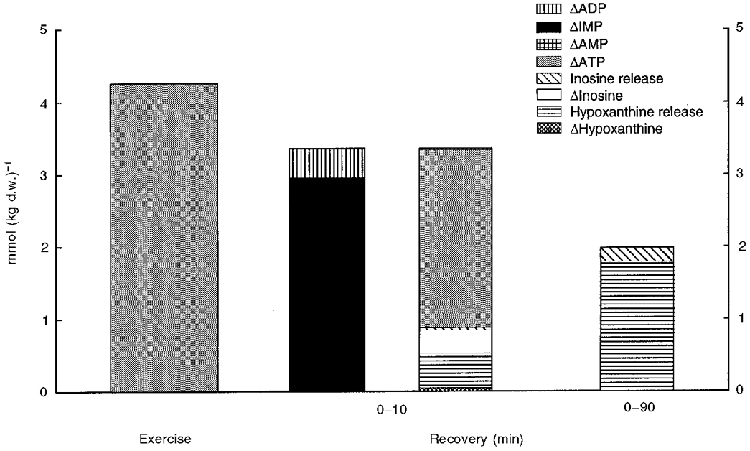
 ) is compared to AMP (
 ) and ATP (
 ) accumulation; accumulation (□) and release (
 ) of inosine as well as accumulation (
 ) and release (
 ) of hypoxanthine during the first 10 min of recovery (middle). In addition, total release of purines during 90 min of recovery is shown (right).
References
-
- Andersen P, Adams RP, Sjøgaard G, Thorboe A, Saltin B. Dynamic knee extension as a model for the study of an isolated exercising muscle in man. Journal of Applied Physiology. 1985;59:1647–1653. - PubMed
-
- Bangsbo J. Regulation of muscle glycogenolysis and glycolysis during intense exercise: in vivo studies using repeated intense exercise. In: Maughan RJ, Shirreffs SM, editors. Biochemistry of Exercise IX. Champaign, IL, USA: Human Kinetics Publishers, Inc.; 1996. pp. 261–276.
Publication types
MeSH terms
Substances
LinkOut - more resources
Full Text Sources
Other Literature Sources
Medical
