


Origin and evolutionary relationships of giant Galápagos tortoises
- PMID: 10557302
- PMCID: PMC23929
- DOI: 10.1073/pnas.96.23.13223
Origin and evolutionary relationships of giant Galápagos tortoises
Abstract
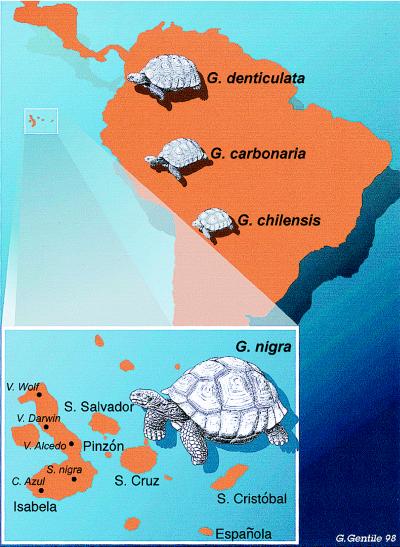
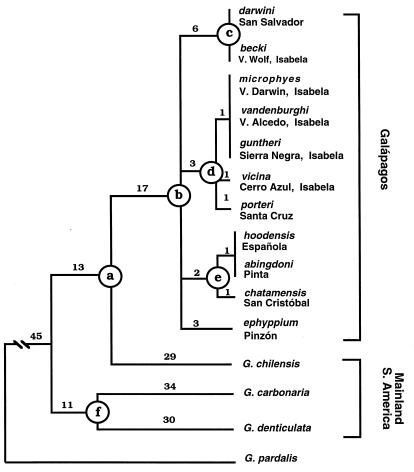
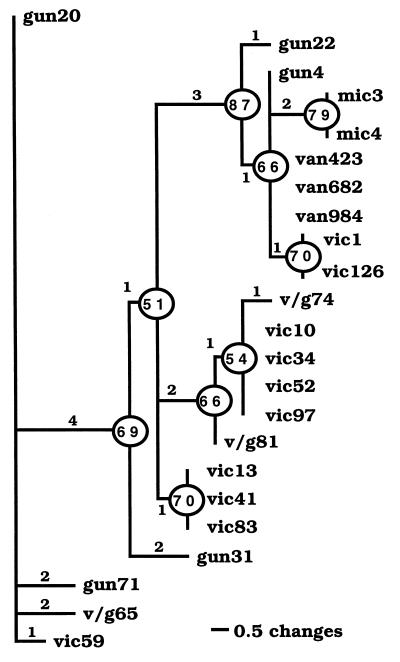
Perhaps the most enduring debate in reptile systematics has involved the giant Galápagos tortoises (Geochelone nigra), whose origins and systematic relationships captivated Charles Darwin and remain unresolved to this day. Here we report a phylogenetic reconstruction based on mitochondrial DNA sequences from Galápagos tortoises and Geochelone from mainland South America and Africa. The closest living relative to the Galápagos tortoise is not among the larger-bodied tortoises of South America but is the relatively small-bodied Geochelone chilensis, or Chaco tortoise. The split between G. chilensis and the Galápagos lineage probably occurred 6 to 12 million years ago, before the origin of the oldest extant Galápagos island. Our data suggest that the four named southern subspecies on the largest island, Isabela, are not distinct genetic units, whereas a genetically distinct northernmost Isabela subspecies is probably the result of a separate colonization. Most unexpectedly, the lone survivor of the abingdoni subspecies from Pinta Island ("Lonesome George") is very closely related to tortoises from San Cristobal and Espanola, the islands farthest from the island of Pinta. To rule out a possible recent transplant of Lonesome George, we sequenced DNA from three tortoises collected on Pinta in 1906. They have sequences identical to Lonesome George, consistent with his being the last survivor of his subspecies. This finding may provide guidance in finding a mate for Lonesome George, who so far has failed to reproduce.
Figures
References
-
- Darwin C. Journal of Researches into the Geology and Natural History of the Various Countries Visited by H. M. S. Beagle, Under the Command of Captain Fitz Roy, R. N., from 1832–1836. London: Henry Colburn; 1839.
-
- Pritchard P C H. The Galapagos Tortoises. Nomenclatural and Survival Status. Chelonian Research Foundation in association with Conservation International and Chelonia Institute; 1996.
-
- Auffenberg W. Bull Florida St Mus Biol Sci. 1974;18:121–251.
-
- Hooijer D A. Proc Koninkl Nederl Akad Wetench. 1971;74:504–525.
-
- North-Coombes A. The Vindication of Françoise Leguat. Mauritius: Service Bureau; 1979.
LinkOut - more resources
Full Text Sources
